

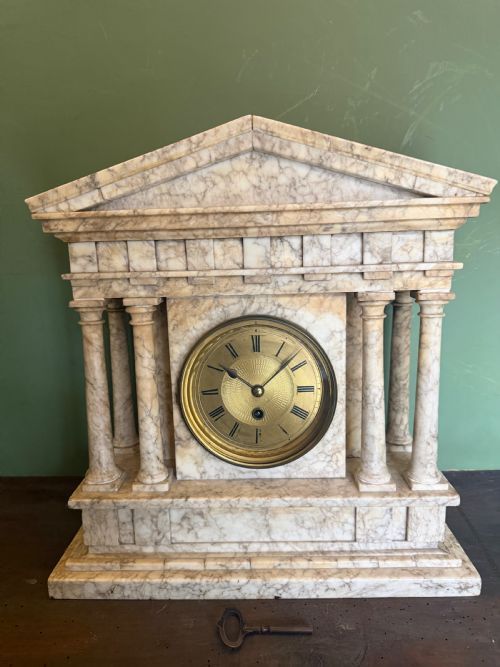


Brass and Alabaster Clock
A brass and alabaster clock brings nineteenth-century architectural elegance and pale stone to a mantelpiece.
Brass and Alabaster Clock
A brass and alabaster clock combines metallic mounts with soft white stone, often appearing as a mantel clock or part of a garniture set with candelabras. These nineteenth-century objects draw on French Louis styles, Neoclassical design, and Victorian tastes for domestic display.
Buyers encountering this selection will frequently find nineteenth-century examples produced in French workshops or decorated with gilt bronze, ormolu, and enamel dials. The forms range from compact timepieces under glass domes to large mantel clocks driven by eight-day striking movements.
How they were made
Makers shaped soft alabaster and marble into architectural cases, columns, or urns, which they then fitted with mechanical clockwork movements imported from France. Guilds and workshops cast brass, gilt bronze, and ormolu mounts to accent the pale stone.
Enamel dials with delicate numerals were set behind glass bezels, while complete garniture sets often included matching candelabras cast in the same metallic finishes.
Brass and Alabaster Clock Retail Price Guide 2026
Typical asking prices for brass and alabaster clock among the pieces listed under this phrase on Sellingantiques today, from the lower quarter to the upper quarter. They describe what is for sale here now, not the wider market.
Some delicate timepieces hide safely under their original glass domes, preserving fragile alabaster from centuries of dusting.
What varies in quality
The distinction between ordinary and exceptional pieces lies in the crispness of the cast brass and ormolu mounts, alongside the uniformity of the carved alabaster. Finer nineteenth-century examples display deeply chased gilt bronze details rather than flat, machine-stamped metal.
The integration of the movement also dictates quality, as robust eight-day striking mechanisms housed securely within substantial stone cases represent superior workshop production compared to simpler timepieces.
James Ritchie And Son
The Brass and Alabaster Clock Glossary
- Alabaster
- A fine-grained, translucent white stone used widely for Victorian and nineteenth-century clock cases. It provides a smooth, pale surface that contrasts with dark numerals and gilt metal mounts.
- Ormolu
- Finely chopped gold applied to a bronze base using a mercury amalgamation process. This technique gives the brassy mounts a rich, warm lustre.
- Garniture
- A set of matching decorative objects designed to sit together on a mantelpiece, typically consisting of a central clock flanked by a pair of candelabras.
- Striking movement
- A mechanical clockwork system that chimes on the hours and half-hours. These movements require an escapement and gear train separate from the timekeeping mechanism.
Brass and Alabaster Clock: Frequently Asked Questions
What is a brass and alabaster clock?
These nineteenth-century decorative timepieces feature cases built from pale carved alabaster paired with cast brass, gilt bronze, or ormolu mounts. They were designed to stand prominently on Victorian and continental mantelpieces.
Many examples incorporate enamel dials and mechanical eight-day striking movements, sometimes accompanied by matching garniture candelabras under glass domes.
Are these clocks French or British?
The evidence shows a strong French influence in the styling, including Louis XIV, Louis XVI, and Rococo Revival designs, alongside movements produced in France. However, individual pieces were also retailed by British makers such as James Ritchie and Son in Edinburgh.
Italian workshops also contributed carved alabaster housing fitted with French mechanisms.
What is a clock garniture?
A clock garniture is a matched set of decorative mantel ornaments featuring a central clock accompanied by matching pieces such as candelabras or urns. They were produced in the nineteenth century to create a symmetrical display.
Materials in these sets typically match the central clock, combining brass, marble, and alabaster.