




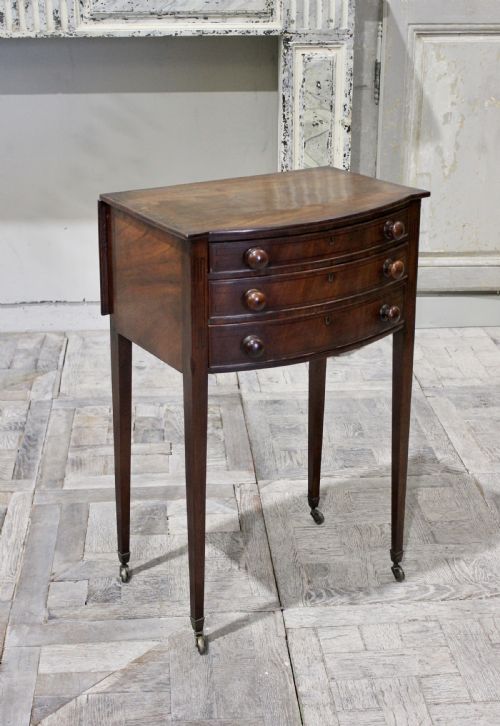


Bow Fronted Bedside Tables
Bow fronted bedside tables bring curved fronts and compact storage to the bedroom, offering period character alongside practical surface space.
Bow Fronted Bedside Tables
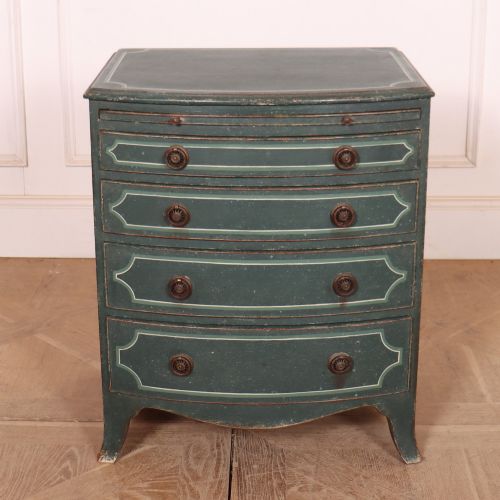
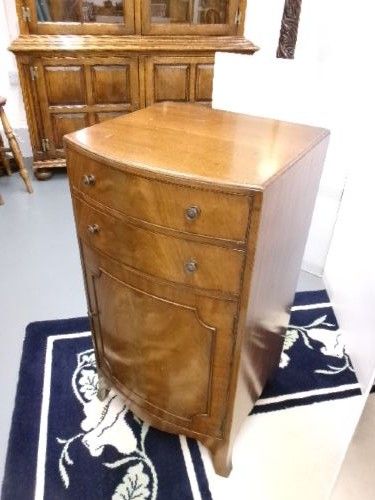
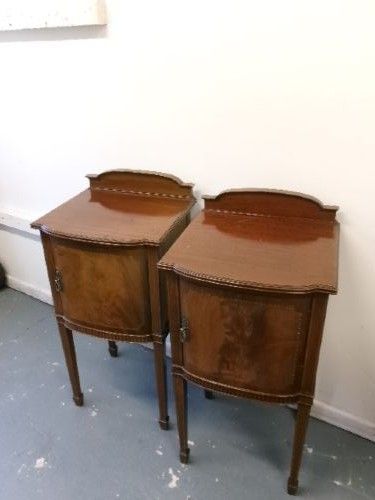
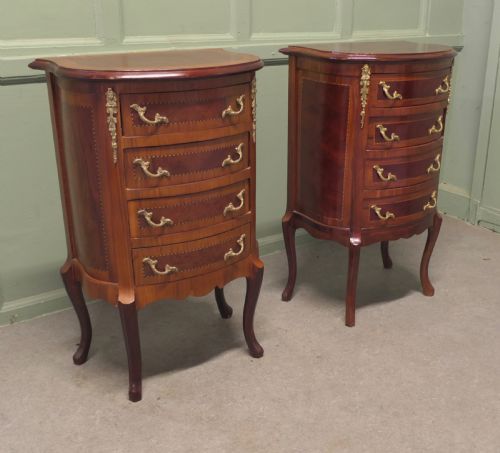
Bow fronted bedside tables are practical bedroom pieces defined by their outwardly curving fronts, appearing across Georgian, Victorian and Edwardian periods in forms ranging from pot cupboards to small chests of drawers. When searching for bow fronted bedside tables, buyers encounter pedestal cupboards, bedside cabinets and lamp tables designed to fit neatly beside a bed while concealing storage behind hinged doors or stacked drawers.
The pieces on this page span the Georgian era through to the early twentieth century, including Edwardian satinwood and mahogany interpretations as well as French Louis XV style variations. These items serve the same function as their historical predecessors, providing a surface for lamps and personal items with enclosed space underneath.
How they were made
Cabinet makers utilised solid timbers alongside wood veneers, selecting mahogany, burr walnut and satinwood to construct the curved framework of these cabinets. Carpenters shaped the distinctive bowed profile by building up timber cores or bending wood to achieve the convex sweep characteristic of the form.
Surface decoration relies on contrasting stringing, boxwood inlay, marquetry details and flame mahogany grain patterns to accentuate the curved drawer fronts and cabinet doors. Brass handles and mounts finish the pieces, while construction methods involve traditional dovetail joints for drawers and panelled carcases.
Bow Fronted Bedside Tables Retail Price Guide 2026
Typical asking prices for bow fronted bedside tables among the pieces listed under this phrase on Sellingantiques today, from the lower quarter to the upper quarter. They describe what is for sale here now, not the wider market.
Several Victorian models secretly function as nighttime commodes, hiding domestic necessity behind polite mahogany doors.
What varies in quality
Quality in these tables rests on the selection of timber veneers and the precision of the curved cabinetry, where figured mahogany or burr walnut displays rich grain movement across the bowed front. Finer examples show careful book-matching of veneers and subtle inlay work, such as boxwood stringing or marquetry, which demands high skill to execute on a curved surface.
The integrity of the construction, including smooth drawer action and original brass hardware, separates standard production from superior pieces. Proportion and balance also dictate distinction, with better workshops achieving a harmonious relationship between the curved front, the supporting legs or plinth, and the overall height of the cabinet.
The Bow Fronted Bedside Tables Glossary
- Bow front
- A convex, outwardly curving front elevation typical of case furniture from the Georgian period onwards. This shape softens the corners of the piece and adds visual depth.
- Pot cupboard
- A small bedside cabinet originally designed to house a chamber pot behind a single door. Many later function as general bedside storage or lamp tables.
- Marquetry
- Decorative patterns formed by fitting together thin slices of various wood veneers onto a structural surface. This technique creates pictorial or geometric designs.
- Stringing
- Thin lines of contrasting wood inlay used to outline drawers, tabletops or cabinet doors. It provides a crisp border that defines the edges of the piece.
- Flame mahogany
- Timber cut from the fork of the mahogany tree where the branches join, producing a distinctive flickering flame pattern. Cabinet makers reserved this veneer for prominent surfaces.
Bow Fronted Bedside Tables: Frequently Asked Questions
What is a bow fronted bedside table used for?
These tables provide a convenient surface next to a bed for lamps, books and nighttime essentials. The enclosed cupboards or drawers underneath keep personal items neatly out of sight.
Historically, many versions functioned as pot cupboards or nightstands, but today they serve purely as practical and decorative bedroom storage.
How do I identify a Georgian bow fronted table?
Georgian pieces typically feature solid mahogany or flame mahogany veneers with hand-cut dovetails and understated brass pulls. They often take the form of pot cupboards or commodes dating from the eighteenth or early nineteenth century.
Later revival pieces from the Edwardian era emulate these Georgian proportions but may incorporate lighter satinwood or marquetry inlay.
What wood types are common?
Mahogany is the predominant timber found in these pieces, particularly in Georgian and nineteenth-century examples. Burr walnut and satinwood also appear frequently, especially on Victorian and Edwardian variations.
Inlays often utilise boxwood and contrasting veneers to highlight the curved drawer fronts and cabinet doors.