

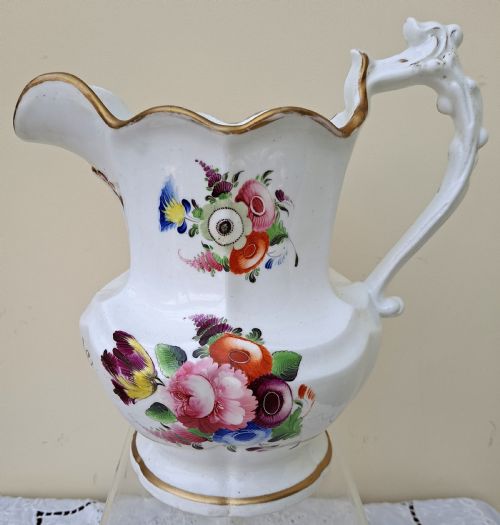


Bone China Jug
These bone china jugs and creamers combine fine nineteenth-century English craftsmanship with durable vitreous paste, offering both historic character and everyday utility.
Bone China Jug
When you search for a bone china jug, you are looking at utilitarian and decorative ceramic vessels designed for serving milk, cream, or water. The pieces found here span the nineteenth and twentieth centuries, originating from notable English potteries.
You are most likely to meet Victorian cream jugs and twentieth-century painted services on this page. Forms range from simple creamers and ewers to complete tea sets and matching sugar bowls.
The aesthetic vocabulary encompasses traditional English designs alongside revivalist movements. Pieces display heritage from the Georgian era through to mid-twentieth-century production.
Materials and manufacture
Makers utilised fine porcelain and bone china bodies, fired at high temperatures to achieve a durable and translucent finish. These ceramic bases provided a smooth canvas for subsequent painting and gilding.
Decoration relied on skilled hand-painting, enamel colours, and gold leaf applications. Artisans embellished pieces with floral panels, Kakiemon motifs, and gilt edges, often signing their work.
Bone China Jug Retail Price Guide 2026
Typical asking prices for bone china jug among the pieces listed under this phrase on Sellingantiques today, from the lower quarter to the upper quarter. They describe what is for sale here now, not the wider market.
Listings feature porcelain and bone china enhanced with gold leaf, enamel, and gilding across the nineteenth and twentieth centuries.
Assessing quality
Quality rests primarily in the execution of the painting and the precision of the gilding. Hand-painted fruit or intricate enamel patterns by named artists elevate a piece far above standard transfer-printed wares.
The refinement of the ceramic body and the crispness of the moulded form also distinguish superior examples. Potteries such as Royal Worcester demonstrate exceptional control in both porcelain casting and surface decoration.
John Baley·Royal Davenport·Royal Worcester·Minton·Rockingham Porcelain·Coalport
The Bone China Jug Glossary
- Bone china
- A type of soft-paste porcelain containing bone ash, invented in England to increase strength and translucency. It allows for thinner vessel walls while maintaining durability.
- Ewer
- A large jug with a wide spout and a curved handle, traditionally used for holding water. In decorative ceramic collections, it functions primarily as an ornamental piece.
- Gilding
- The application of gold leaf or gold gilt to ceramic surfaces. This metallic decoration highlights rims, handles, and painted panels.
- Creamer
- A small jug specifically designed for serving milk or cream with tea or coffee. It forms a standard component of larger ceramic tea services.
Bone China Jug: Frequently Asked Questions
What is a bone china jug used for?
These vessels were originally manufactured for serving milk or cream during formal tea services, as well as holding water for table use.
Today, collectors utilise them both as functional tableware for dining and as standalone decorative display items.
How do I date a ceramic jug?
Dating relies on maker's marks, registry stamps, and stylistic evidence such as Victorian revivalist motifs or twentieth-century painted signatures.
Comparing the paste thickness and gilding style against known factory production periods also helps narrow the manufacturing date.
What distinguishes bone china from porcelain?
Bone china incorporates animal bone ash into the traditional kaolin, feldspar, and quartz mixture. This specific formula creates a warmer, more translucent white body that is remarkably strong.
Standard porcelain lacks this bone ash component, though both materials share a smooth, vitreous finish.