
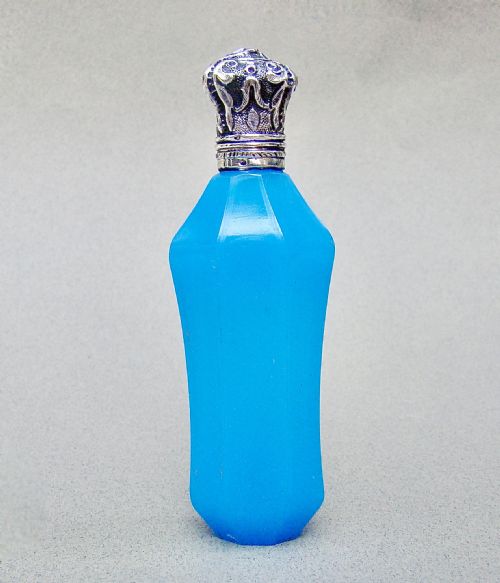


Blue Glass Scent Flask
A blue glass scent flask is a pocket vessel for perfume, prized for its colour and metal mounts.
Blue Glass Scent Flask
A blue glass scent flask is a portable container designed to hold perfume, appearing in forms such as scent bottles and perfume bottles. These vessels range from Victorian opaline glass to Art Deco opalescent pieces.
Buyers meet examples spanning the nineteenth century and the twentieth century, alongside earlier Roman glass unguentaria. French pieces with silver mounts and English Victorian designs dominate the selection.
Makers and makers' marks bring distinct character, from French glassware to Chinese inside-painted snuff bottles. Each object reflects the period aesthetics of Victorian, Art Nouveau, or Art Deco styles.
Materials and construction
Makers utilised glass, opaline glass, and opalescent glass, occasionally employing triple overlay glass and murrine techniques. These bodies provide the characteristic blue ground for each flask.
Metalwork is integral, with sterling silver, silver gilt, and enamel, including guilloche enamel, forming the mounts and caps. These components secure the contents while adding decorative contrast to the glass.
Listings include items spanning from Roman antiquity to the 1930s Art Deco period, featuring materials like sterling silver, enamel, and Murano glass.
Factors of quality
The sophistication of the glasswork distinguishes superior examples, particularly where murrine work or multi-layered glass is present. Clarity of colour and the precision of opalescent effects also separate the grades.
The quality of the metal mounts dictates value, notably when sterling silver or detailed guilloche enamel is intact. Signed pieces by established designers carry distinct manufacturing credentials compared to unmarked equivalents.
Rene Lalique·Sabino·Franchini & Bigaglia
The Blue Glass Scent Flask Glossary
- Opaline glass
- An opaque or translucent glass popular in the nineteenth century. It provides a dense pastel or vivid blue ground suited to contrasting metal mounts.
- Guilloche enamel
- A decorative technique where metal is engraved with a repetitive pattern and covered with translucent enamel. It frequently appears on twentieth-century bottle caps.
- Murrine
- Coloured patterns made by stretching glass canes and slicing them crosswise. This Italian technique creates complex mosaic designs within the body of the vessel.
- Chatelaine
- A decorative belt hook worn with a chain to suspend household items. Scent bottles made for chatelaines feature specific hanging loops on their silver mounts.
- Unguentarium
- A small ancient glass vessel used for oils or perfumes. Roman examples excavated from archaeological sites display iridescent patination from long burial.
Blue Glass Scent Flask: Frequently Asked Questions
What is a blue glass scent flask used for?
These flasks were carried in pockets or handbags to hold liquid perfume for personal freshness. They served as both functional accessories and decorative items.
Victorian and Edwardian owners used them daily, while twentieth-century examples often remained on dressing tables.
How do I date a blue glass scent flask?
Dating relies on stylistic clues, such as the shape of the silver mounts and the specific shade of blue glass. Victorian pieces often feature ornate silverwork, whereas Art Deco examples display geometric lines.
Signatures or maker stamps on the silver or glass provide more precise chronological markers.
Are all blue glass scent flasks French?
Many fine examples originate from France, particularly nineteenth-century opaline pieces and twentieth-century opalescent glass. However, English Victorian and Venetian Murano makers also produced them.
Chinese snuff bottles and Roman unguentaria represent other regional traditions found within this category.
How should I clean my scent flask?
Silver mounts require gentle polishing with a soft cloth to avoid touching the glass or enamel. The interior should remain dry to protect any residual contents or internal decoration.
Harsh chemical cleaners can damage fragile guilloche enamel and antique glass surfaces.