
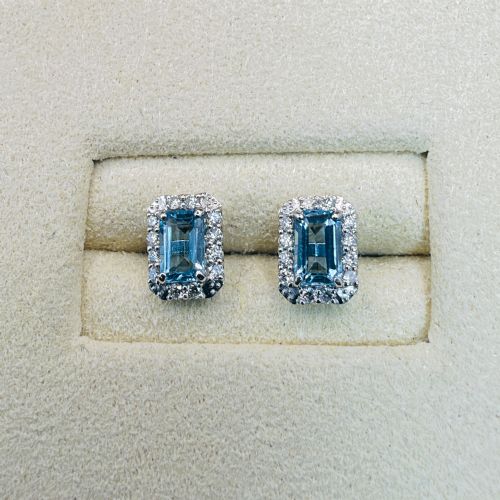


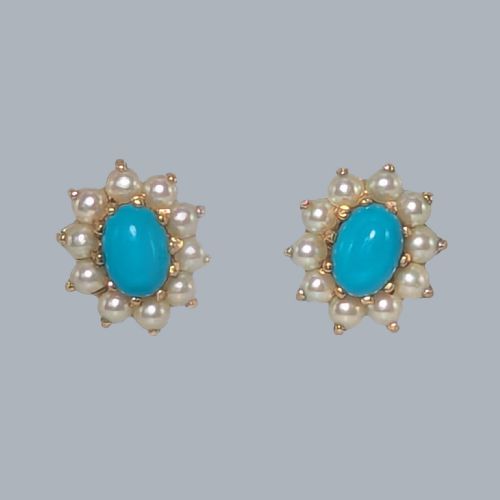


Blue Gemstone Cluster Studs
Blue gemstone cluster studs combine central sapphire, aquamarine, turquoise, or topaz with surrounding diamonds in timeless post and screw fittings.
Blue Gemstone Cluster Studs
Blue gemstone cluster studs gather a central blue stone within a border of smaller stones, typically diamonds, mounted securely on the ear. The pieces appearing here span the Edwardian period through to the late twentieth century, including Art Deco and mid-century designs.
The sapphire remains the most frequent centre stone, often paired with diamonds in eighteen-carat white gold or platinum settings. Aquamarine, turquoise, and blue topaz also feature prominently across nine-carat gold and platinum mountings.
While many examples take traditional circular or oval forms, others utilise emerald cuts or multi-stone arrangements to frame the central blue gem. These earrings span decades of changing tastes while maintaining the distinct clustered silhouette.
How they were made
Goldsmiths constructed these clusters using precious metals such as platinum, eighteen-carat yellow and white gold, and nine-carat gold. Platinum and eighteen-carat white gold provide a bright, durable framework that enhances the sparkle of accompanying diamonds.
Stones are secured using claw settings, bezel mounts, or delicate filigree work, depending on the period of manufacture. Edwardian and Art Deco examples frequently employ intricate platinum work to maximise light entry around the central sapphire or aquamarine.
One mid-century pair combines bright turquoise with split pearls, proving that sapphires do not hold a monopoly on blue cluster charm.
What varies in quality
The calibre of the central blue gemstone largely dictates the standard of the piece, particularly regarding depth of colour and stone clarity. Basaltic sapphires and large aquamarines exhibit distinct saturations that influence the visual presence of the cluster.
Precision in the arrangement and matching of the surrounding diamonds determines the refinement of the overall design. Heavier gold or platinum mountings demonstrate greater durability and substance in the finished earring.
The Blue Gemstone Cluster Studs Glossary
- Cluster
- An arrangement of smaller gemstones surrounding a larger central stone. This configuration maximises surface sparkle and visual impact.
- Basaltic sapphire
- A sapphire originating from volcanic basalt deposits, typically displaying deep, rich blue tones. These stones are frequently found in twentieth-century cluster jewellery.
- Filigree
- Delicate jewellery ornamentation created with fine threads of precious metal soldered together. This technique appears on mid-century gold backings.
- Emerald cut
- A rectangular gemstone cut with stepped facets and cropped corners. This cut highlights clarity over sheer brilliance.
- Platinum
- A dense, durable, and naturally white precious metal used for secure stone settings. It allows for finer metalwork than gold.
Blue Gemstone Cluster Studs: Frequently Asked Questions
Are all these earrings pierced?
Most items listed are stud earrings designed for pierced ears, utilising standard posts and butterfly backs.
Some titles reference drop or vintage configurations, which may incorporate different fastening mechanisms depending on the decade of origin.
How do I identify an Art Deco pair?
Art Deco pieces from the nineteen-thirties typically feature geometric symmetry, platinum settings, and precise emerald-cut stones.
White gold and platinum predominate in this era, contrasting sharply with the yellow gold favoured in earlier Edwardian designs.
What metals are used in these earrings?
Listings show a range of precious metals including platinum, eighteen-carat white gold, eighteen-carat yellow gold, and nine-carat gold.
White metals are frequently paired with diamonds and sapphires to create a bright, cohesive face.
Can I wear these every day?
Platinum and eighteen-carat gold mountings offer the durability required for regular wear when properly maintained by a jeweller.
Care should be taken with softer stones like turquoise or topaz to prevent surface scratching during daily use.