

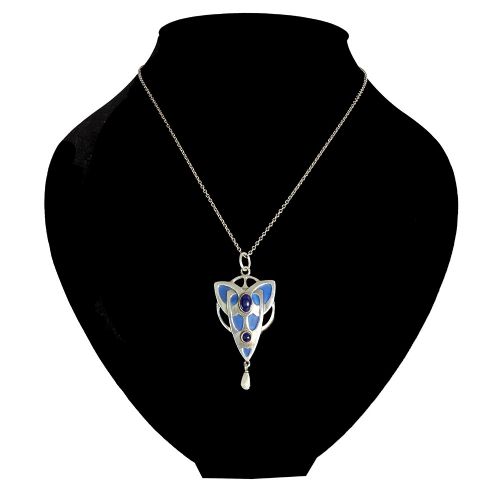
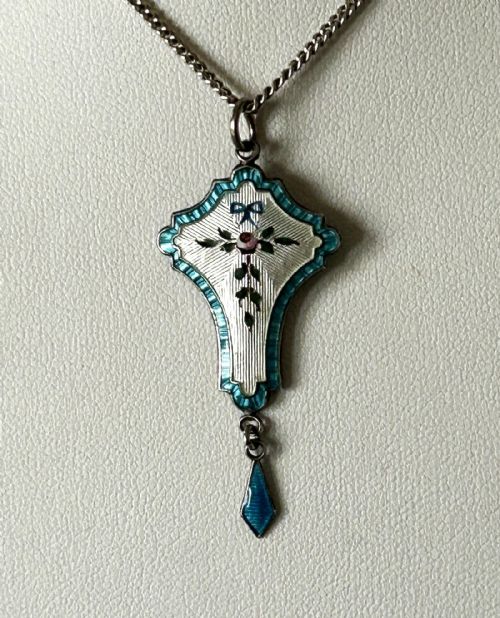
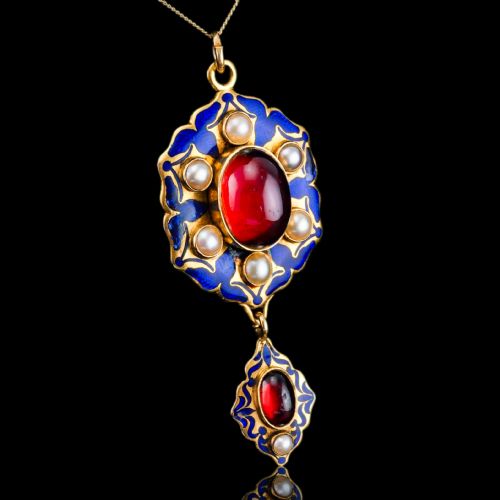


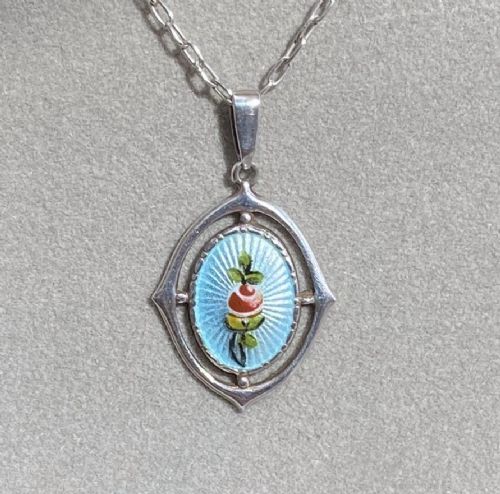
Blue Enamel Drop
These blue enamel drop pieces combine rich vitreous colour with delicate precious metals, offering collectors a striking example of period craftsmanship.
Blue Enamel Drop
A blue enamel drop represents a distinct category of antique jewellery featuring suspended pendants decorated with vitreous enamel. These pieces emerge primarily from the Victorian, Edwardian, and early twentieth century eras.
The most common examples on this page take the form of silver or gold pendant necklaces incorporating distinctive blue enamel drops. Collectors frequently encounter Art Nouveau, Arts and Crafts, and Victorian Renaissance Revival styles among these offerings.
Makers and designers utilise materials such as sterling silver, gold, pearls, chalcedony, and garnets to accent the central blue enamel components. These varied forms showcase the enduring appeal of suspended enamel work across multiple decades.
How they were made
Silversmiths and goldsmiths shaped sterling silver and high karat gold to form the structural mounts and settings for each blue enamel drop. Metalwork techniques included intricate wirework, casting, and cloisonne enamelling.
Craftspersons fused powdered glass to metal surfaces under high heat to create the durable vitreous enamel finishes seen on these pendants. Artisans then integrated suspended pearls, garnets, or chalcedony stones to complete the drops.
Listings feature silver, gold, pearls, garnets, and chalcedony across Victorian, Edwardian, and Art Nouveau periods.
What varies in quality
The refinement of the enamelwork and the precision of the precious metal setting dictate the upper tier of quality. Superior examples display flawless vitreous enamel surfaces and sophisticated integration of supporting gems like pearls and garnets.
Design attribution significantly influences distinction, with pieces bearing documented maker marks commanding greater interest from collectors. Lesser examples often feature simpler metal mounts and standard production techniques without individual artistic distinction.
Archibald Knox·Liberty and Co·Murrle Bennett·Wilhelm Fuhner·Charles Horner
The Blue Enamel Drop Glossary
- Vitreous Enamel
- Glass powder fused to a metal substrate through high temperature firing. This technique creates a glossy, durable coloured surface that resists fading.
- Cloisonne
- An enamelling method where thin metal wires are soldered to a base to form compartments that hold the coloured paste. This produces intricate linear patterns within the design.
- Chalcedony
- A cryptocrystalline variety of silica used as a decorative gemstone in period jewellery. It often appears alongside silver and enamel work to add subtle texture.
- Holbeinesque
- A Victorian revival style inspired by sixteenth century jewellery designs recorded by Hans Holbein. These pieces typically feature elaborate goldwork, enamel, and dangling gem drops.
- Renaissance Revival
- An aesthetic movement drawing inspiration from sixteenth century art and architecture. Jewellery in this style utilises rich combinations of gold, enamel, and precious stones.
Blue Enamel Drop: Frequently Asked Questions
What periods do these pieces date from?
The pieces span the Victorian, Edwardian, and early twentieth century periods, specifically encompassing items created around eighteen fifty seven through nineteen twenty.
Craftsmanship from these eras reflects distinct aesthetic movements including Art Nouveau and the Arts and Crafts philosophy.
How should I care for a blue enamel drop?
Store your pendant separately in a soft pouch to prevent scratching the delicate glass enamel and softer gemstones like pearls. Avoid exposing the piece to harsh chemicals, ultrasonic cleaners, or prolonged moisture.
Clean the metal gently with a soft polishing cloth while protecting the vitreous surfaces from abrasive contact.
What materials are typically used in these necklaces?
Makers constructed these pendants using sterling silver, fifteen karat gold, and eighteen karat gold as the primary metal foundations. Vitreous enamel provides the characteristic blue colour, while pearls, garnets, and chalcedony serve as accent stones.
Enamel variations include standard vitreous types and cloisonne applications.
How do I identify an Art Nouveau pendant?
Art Nouveau pieces display characteristic organic motifs, flowing asymmetrical lines, and stylised depictions of natural forms. These designs frequently incorporate whipped wirework alongside vibrant blue enamel and suspended pearls.
Makers working in this style often utilised silver to complement the cool tones of the enamel.