
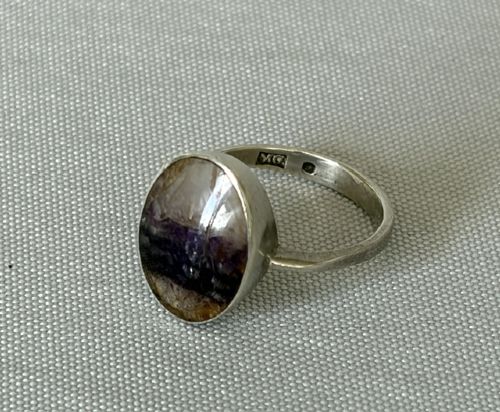
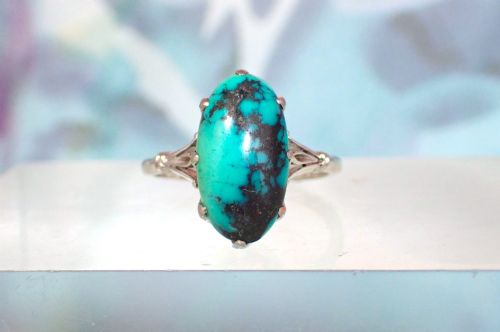

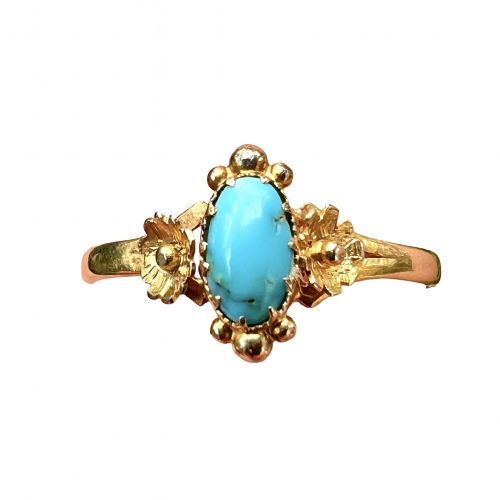
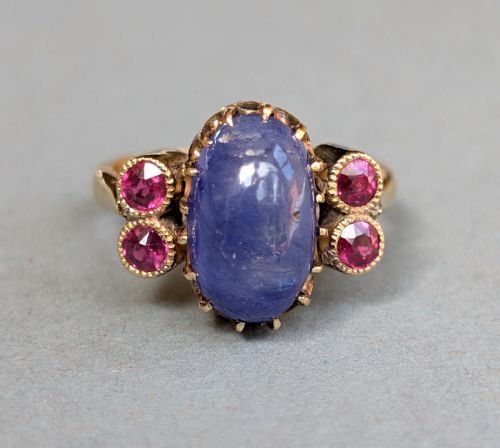


Blue Cabochon Dress Ring
A blue cabochon dress ring brings together polished, unfaceted stones and precious metals across periods from the Victorian era to the mid-century.
Blue Cabochon Dress Ring
A blue cabochon dress ring is a finger ornament centred on a smooth, rounded dome of stone rather than a faceted gem. The listings show these pieces appearing primarily in Victorian, Edwardian, Art Deco and mid-century styles, capturing shifts in design from naturalistic floral motifs to geometric lines.
The version a buyer meets most frequently on this page pairs a central blue sapphire, turquoise, moonstone or Blue John with surrounding diamonds in a cluster or flower formation. Precious metals span yellow and white gold in various carats, platinum and silver, reflecting the materials favoured by makers over the decades.
How they were made
Goldsmiths shaped high-carat yellow and white gold, platinum and silver into settings designed to hold smooth dome-cut stones securely. Stones such as star sapphires, moonstones and turquoise were shaped into cabochons to display their internal phenomenon or flat colour rather than optical brilliance through facets.
Settings often incorporated rose-cut, old-cut or brilliant-cut diamonds alongside the central blue stone, mounted in multi-stone clusters or flower shapes. Metalwork techniques combined casting and hand-working, particularly evident in platinum settings and detailed gold work from the Victorian and Art Deco periods.
Periods represented on this page range from late Victorian and Edwardian examples through the Art Deco era and into mid-century designs.
What varies in quality
Quality rests upon the natural characteristics of the central stone, such as the distinct chatoyancy of a star sapphire or the even saturation of a cabochon sapphire. Weight, clarity and the presence of unheated natural origins separate exceptional stones from standard examples.
The precision of the surrounding metalwork and the integration of supporting diamonds also define the tier of a piece. Substantial gold or platinum weights and refined cluster proportions distinguish high-end examples from simpler silver or lower-carat mounts.
The Blue Cabochon Dress Ring Glossary
- Cabochon
- A gem that has been shaped and polished rather than faceted. This style displays the smooth, rounded dome characteristic of these rings.
- Cluster ring
- A ring featuring a central stone encircled by smaller gems, often diamonds. This arrangement maximises visual impact and light reflection.
- Star sapphire
- A type of sapphire that exhibits a star-like phenomenon known as asterism when cut as a cabochon. This optical effect is caused by intersecting needle-like inclusions.
- Rose-cut
- An antique diamond cut featuring a flat base and a dome composed of triangular facets. It produces a soft, understated gleam rather than modern brilliance.
Blue Cabochon Dress Ring: Frequently Asked Questions
How do I wear a cabochon ring safely?
Smooth-domed stones sit higher on the finger and can be susceptible to surface scratches during daily tasks. Regular care helps preserve the polished finish of softer materials like turquoise and opal.
Matching the ring to appropriate occasions ensures the metal and stone endure. Removing the piece before heavy manual work protects both the setting and the smooth crown of the stone.
What is the difference between Victorian and Art Deco rings?
Victorian rings frequently utilise yellow gold and feature sentimental, floral or cluster designs incorporating turquoise and diamonds. These pieces lean toward organic shapes and symbolic motifs.
Art Deco rings embrace geometric symmetry, platinum settings and white gold. They often highlight large central cabochon sapphires framed by precise lines of small diamonds.
Are star sapphires natural?
Many star sapphires found in vintage and antique pieces are natural and unheated stones originating from regions like Ceylon or Burma. Their characteristic star effect is an entirely natural optical property.
Evaluating the clarity and the sharpness of the star helps determine the origin and character of the sapphire. Natural unheated examples are particularly sought after by collectors.
How do I identify the metal purity?
Many pieces feature hallmarks stamped into the metal band indicating the exact gold carat or the use of platinum and sterling silver. These stamps provide official confirmation of the materials used by the maker.
Unmarked pieces rely on traditional testing methods and the historical context of the period style. Platinum and higher carats like 18ct gold generally indicate finer period production.