





Blue and White Diamond Ring
When you search for a blue and white diamond ring, you enter a field of jewelled geometry spanning Edwardian refinement through to mid-century modernism.
Blue and White Diamond Ring
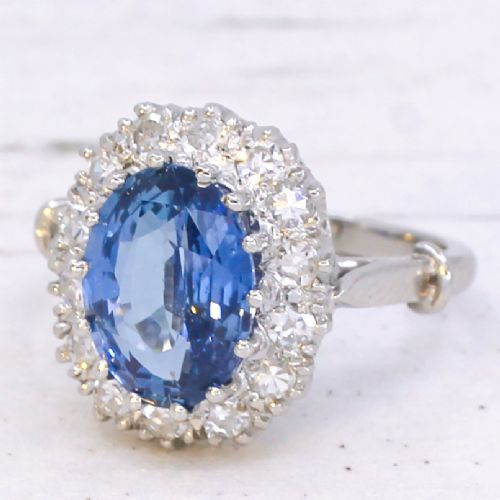
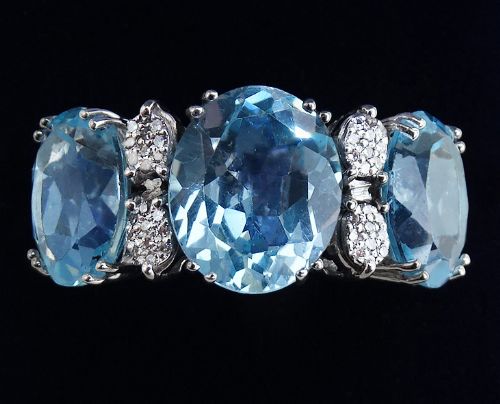
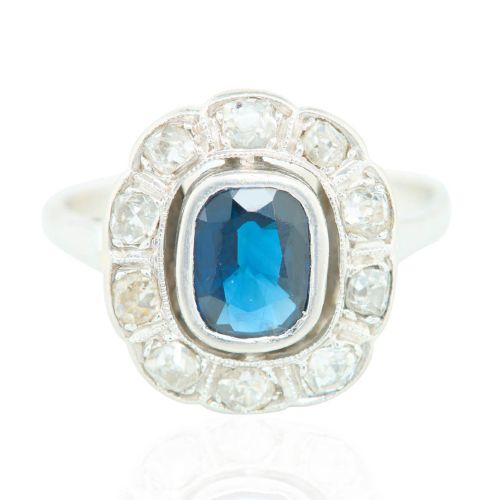
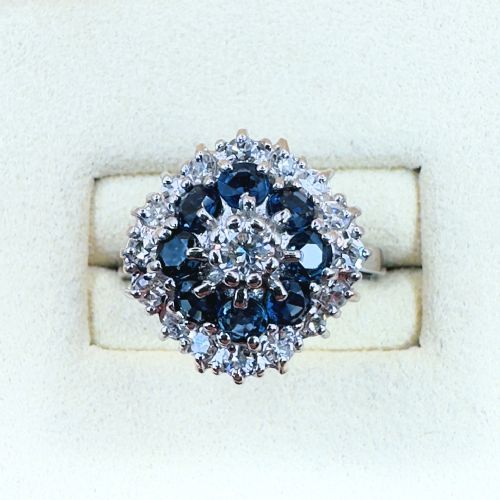
A blue and white diamond ring brings together colour and brilliance, most commonly expressed through clusters, targets, and geometric plaques set with sapphires alongside diamonds. These pieces span from Edwardian workshop creations through to Art Deco designs and mid-century cocktail rings.
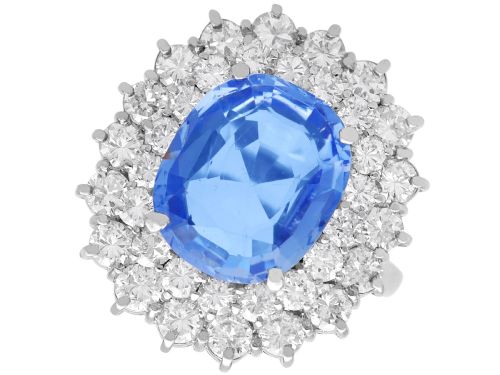
The sapphire or aquamarine takes centre stage in many examples, framed by brilliant or old-cut diamonds in arrangements that emphasise symmetry and contrast. The dominant versions met here utilise white gold or platinum as a neutral mounting ground.
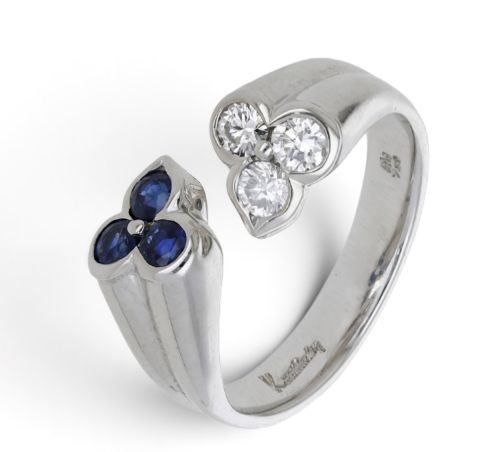
Cluster configurations prevail across the selection, though crossover, trilogy, and floral arrangements appear frequently. Each form reflects the aesthetic preoccupations of its decade, from the linear precision of the nineteen-twenties to the bolder proportions of the nineteen-fifties.
Materials and construction
Goldsmiths of the early and mid-twentieth century relied primarily upon eighteen-carat white gold and platinum to construct these mounts, often pairing platinum settings with white gold shanks. Platinum provided the structural strength required for delicate millegrain edges and secure claw or bezel settings.
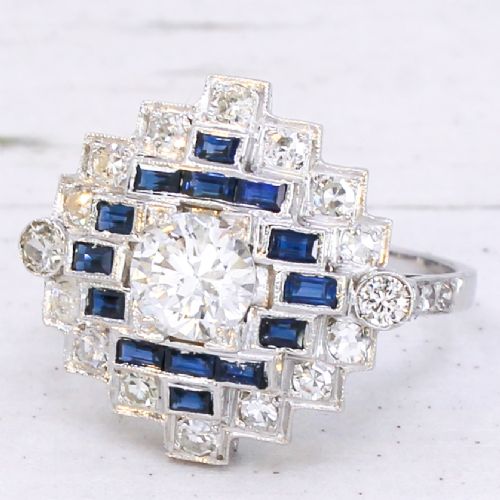
Coloured gemstones including natural sapphires, aquamarines, and tanzanites were shaped into calibre cuts, emerald cuts, cabochons, and traditional facets. These stones were then juxtaposed with old-cut, baguette, or brilliant-cut diamonds, secured meticulously within hand-finished metalwork.
Blue and White Diamond Ring Retail Price Guide 2026
Typical asking prices for blue and white diamond ring among the pieces listed under this phrase on Sellingantiques today, from the lower quarter to the upper quarter. They describe what is for sale here now, not the wider market.
Some Edwardian fingers apparently possessed a distinct fondness for architectural geometry, packing entire optical illusions into a single square millimetre.
Distinctions in quality
The caliber of a piece rests heavily upon the precision of stone cutting and the integrity of the setting work. Master jewellers matched the curvature of calibre-cut sapphires precisely to the geometry of the mount, ensuring unbroken lines without excessive gaps in the metal.
Subtlety in hand-worked details, such as crisp millegrain beading and integrated gallery wirework, separates standard commercial production from finer atelier pieces. The provenance of origin-certified gems, particularly Ceylon sapphires, further distinguishes the upper tier of the range.
Kutchinsky
The Blue and White Diamond Ring Glossary
- Millegrain
- A decorative technique featuring a raised line of tiny rounded metal beads along the edge of a setting. This adds a soft texture that frames the gemstones.
- Calibre cut
- Gemstones specifically shaped and faceted to fit tightly together in a geometric pattern without metal partitions between them. It requires exceptional skill from the lapidary.
- Target ring
- A circular cluster design featuring a central gemstone enclosed by one or more concentric rings of contrasting stones. The arrangement mimics the appearance of a shooting target.
- Old-cut diamond
- A hand-cut diamond shape typical of antique jewellery, characterised by a smaller table, higher crown, and open culet. These stones catch candlelight and lower lighting with a distinctive chunky sparkle.
Blue and White Diamond Ring: Frequently Asked Questions
How do I care for my ring?
Clean your piece gently using warm soapy water and a soft brush to remove everyday oils from beneath the stones. Avoid harsh chemical dips, particularly if the mounting contains softer gems or pearls.
Store each piece individually in a lined box to prevent metal friction and stone scratching. Regular checks by a professional jeweller ensure settings remain secure over decades of wear.
How can I tell Art Deco from mid-century?
Art Deco rings from the twenties and thirties favour rigid symmetry, linear motifs, and flat plaque settings. White gold and platinum dominate, often accented with calibre-cut stones.
Mid-century pieces from the fifties and sixties introduce softer curves, organic floral groupings, and bolder cocktail proportions. Mounts often showcase heavier gold weights and mixed stone cuts.
What is a cluster ring?
A cluster ring arranges several smaller gemstones around a prominent central stone to create a unified visual impact. This layout maximises surface sparkle and colour contrast without requiring a single massive gem.
Historically favoured for engagement and dress wear, this style allowed makers to showcase varied cuts and contrasting hues within a compact footprint.
Are these rings suitable for daily wear?
Diamonds and sapphires possess high durability, making them well-suited for everyday enjoyment when set securely. However, antique and vintage pieces require mindful handling during strenuous manual tasks.
Consider having a professional inspect the claws and gallery work periodically to maintain structural integrity. Preserving these historic mountings ensures they endure for future generations.