
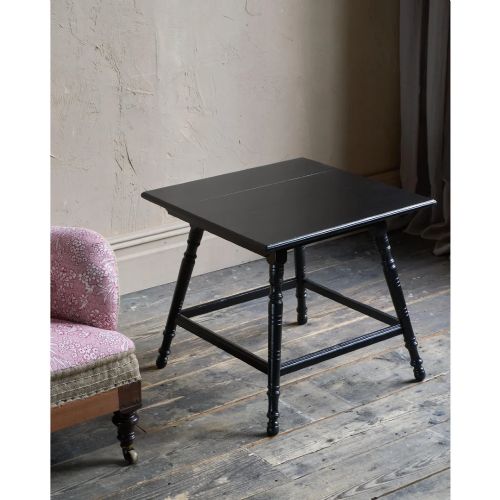


Black Wooden Hall Table
A black wooden hall table anchors an entryway with deep ebonised finishes, hand-painted details and practical proportions.
Black Wooden Hall Table
A black wooden hall table offers a striking arrival point in a hallway, combining practical surface space with dark, dramatic timber. When you search for a black wooden hall table, you encounter console tables, side tables and compact dressers designed to stand against narrow walls.
The pieces on this page span the eighteenth and nineteenth centuries, taking in Georgian, Victorian and Aesthetic Movement designs. You meet both ebonised finishes that mimic expensive exotic hardwoods and painted surfaces featuring geometric motifs.
Makers utilised oak, hardwood and secondary timbers treated with dark paint or polish to achieve the characteristic sombre tone. These forms serve as functional furniture while establishing a distinct period atmosphere near the front door.
Materials and construction methods
Craftsmen built these tables using solid oak and various dense hardwoods to ensure stability in busy entranceways. Surfaces received applications of dark paint or specialised ebonising agents to darken cheaper woods.
Decorative touches often included hand-painted geometric patterns on the top boards and gilt highlights to accentuate carved details. Brass fittings frequently appeared on drawer fronts, contrasting sharply against the dark wooden backgrounds.
Hindley and Sons once supplied furnishing goods to discerning Victorians who liked their furniture decidedly black.
Distinguishing quality across examples
Quality rests upon the depth of the ebonising or the skill behind the hand-painted decoration on the top surface. Tables finished with meticulous brushwork or genuine gilt detailing stand apart from simpler, utilitarian pieces.
Structural integrity also separates the range, with well-joined drawers and solid timber frames commanding greater appreciation. The sophistication of the period style, whether Dutch Baroque or English Country, dictates the refinement of the finished form.
Hindley and Sons
The Black Wooden Hall Table Glossary
- Ebonised wood
- Timber treated with stain, dye or paint to imitate the dark, dense appearance of ebony. This finish gained immense popularity during the Victorian and Aesthetic Movement eras.
- Console table
- A table designed to fix against a wall, often supported by brackets or legs at the front only. These pieces suit narrow hallways where floor space remains at a premium.
- Aesthetic Movement
- A late nineteenth-century design current that prioritised visual beauty over narrative content. Pieces from this style often feature clean ebonised surfaces.
- Bowfront
- A curved furniture front that swells outward in the centre. This shape softens the profile of a hall table in a confined space.
- Dresser base
- The lower section of a traditional dresser, featuring cupboards and drawers without the upper plate racks. These low boards frequently function as substantial hall tables.
Black Wooden Hall Table: Frequently Asked Questions
What is a black wooden hall table?
A black wooden hall table is a narrow piece of furniture finished in dark paint or ebonised wood, designed for placement in an entryway.
These tables provide a surface for keys and decorative items while setting a formal tone immediately inside the front door.
How do I date a black wooden hall table?
Dating relies on identifying construction traits, materials and stylistic clues such as Georgian proportions or Victorian ebonising techniques.
Examining drawer joints and secondary timbers also helps narrow down the period of manufacture.
Where should I place a hall table?
A hall table belongs in an entrance hall, corridor or landing where its narrow profile prevents obstruction of passageways.
Pairing the table with a mirror or lamp enhances both its utility and appearance in the space.
Are painted and ebonised tables durable?
These tables utilise solid hardwoods and durable surface treatments designed to withstand daily use in high-traffic areas.
Regular dusting and careful placement away from direct heat sources preserve the painted and ebonised finishes.