


Birch Tripod Table
A birch tripod table brings figured timber and slender three-legged support to a room, offering both balance and utility.
Birch Tripod Table
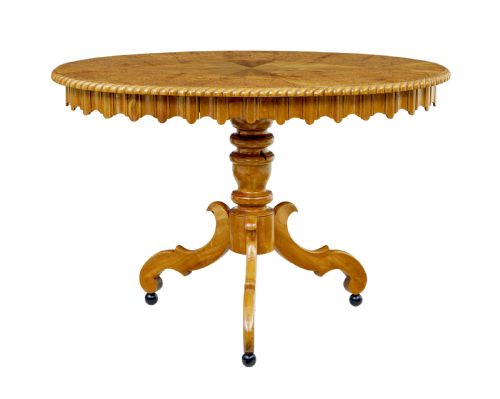
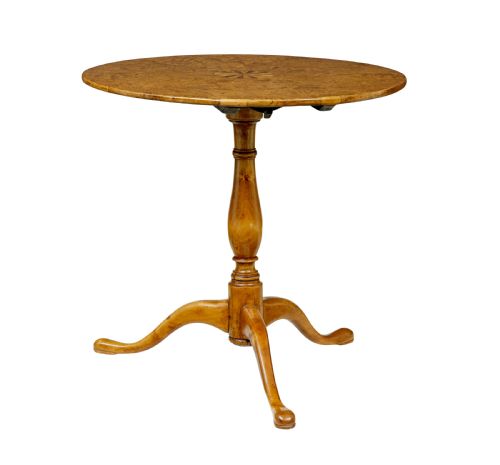
A birch tripod table stands on three legs beneath a central pillar supporting a circular, oval, or occasionally octagonal top. These pieces serve as occasional, side, games, or centre tables across the nineteenth century and into the early twentieth century.
The version most commonly met on this page is the Swedish Biedermeier or nineteenth-century burr birch occasional table, often featuring figured grain patterns. Makers across this period also utilised satin birch, birch root, and ebonised wood to build these tripod forms.
Examples range from plain country-made tripod tables to sophisticated Regency, Empire Revival, and Adam-style designs. The top might tilt for storage or remain fixed upon the pedestal base.
How they were made
Joiners constructed these tables using solid birch and applied veneers of burr birch, satin birch, or Karelian birch over secondary timbers. Selected sections of timber display rich figuring, while inlay work frequently incorporates contrasting woods.
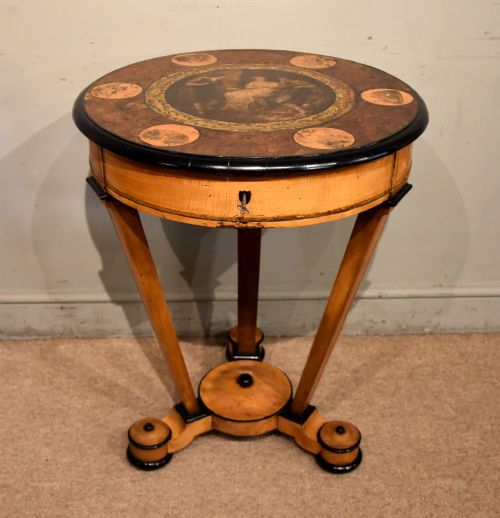
Turning and carving shaped the central pillars and the three legs of the tripod base, sometimes finished with brass details or ebonised wood highlights. Specimen marble tops also appear inset into satin birch frames.
The selection spans Swedish Biedermeier, Regency, Victorian, and Edwardian periods, alongside Adam-style and Empire Revival designs.
What varies in quality
The choice and cut of the birch veneer dictate much of the visual impact, with lively burr and satin grains marking out superior examples. Plain timber surfaces rely entirely on proportion and the crispness of the turned pillar.
Construction methods also separate standard production from finer work, visible in the stability of the tripod joint and the precision of any inlay. Tables retaining their original tilting mechanism and surface finish demonstrate better preservation.
Holland & Sons·Hindley & Sons
The Birch Tripod Table Glossary
- Birch
- A pale, close-grained hardwood native to northern Europe and Britain, frequently chosen for its smooth finish. In figured forms like burr or satin birch, it yields striking decorative patterns.
- Tripod base
- A support structure comprising three legs radiating from a central vertical pillar. This design provides steady placement on uneven floors.
- Biedermeier
- A Central European style dominant during the first half of the nineteenth century, prioritising clean lines and figured veneers over heavy ornamentation. Swedish interpretations make extensive use of birch.
- Tilt-top
- A table mechanism allowing the top to pivot upright when not in use. This clever engineering saved floor space in period interiors.
Birch Tripod Table: Frequently Asked Questions
How do I date a birch tripod table?
Dating relies on observing the style, construction methods, and timber choice used in the piece. Nineteenth-century examples often display Biedermeier, Regency, or Victorian design characteristics.
Earlier tables typically show hand-turned pillars and specific veneer cuts like burr or satin birch, while later pieces adopt revival styles.
Were these tables used for games?
Certain tripod and occasional tables incorporate specific tops designed for board games or card playing. These versions often feature inlaid details on the surface to mark out playing areas.
Most tripod tables, however, served general occasional use as side or centre tables in nineteenth-century reception rooms.
How do I care for a birch surface?
Polished birch surfaces require gentle dusting with a soft, dry cloth to protect the timber and veneer. Avoiding direct sunlight and excessive moisture prevents the wood from fading or warping over time.
Occasional application of appropriate wax maintains the lustre of the polished finish without building up heavy residue.