



Beech Office Chair
A beech office chair brings durable timber construction and supportive seating to a workspace, offering a practical antique choice for daily use.
Beech Office Chair
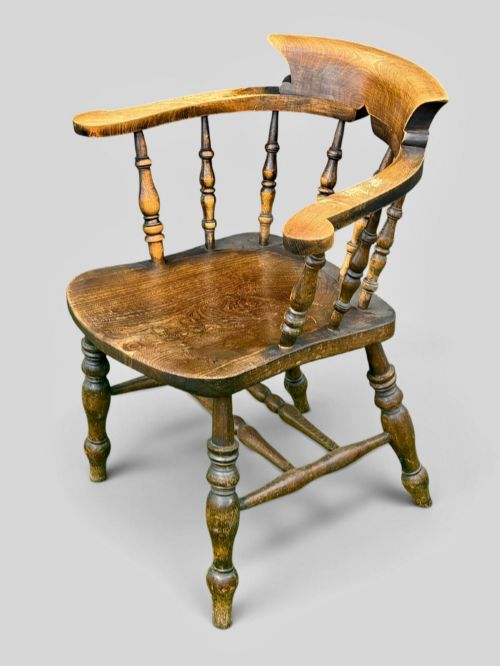
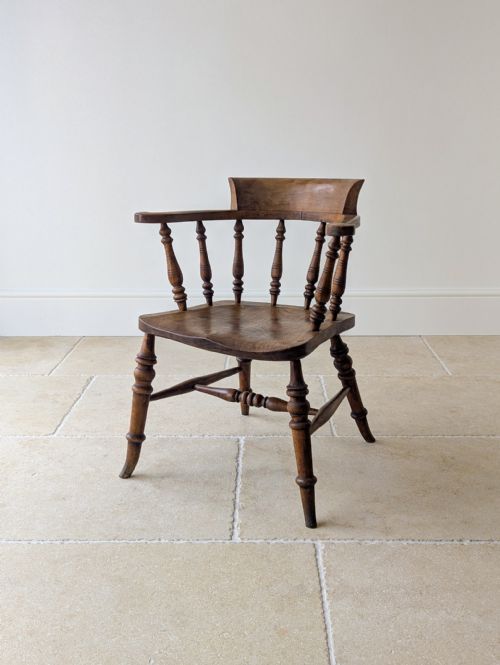
A beech office chair encompasses functional seating designed for desks and workspaces, drawing on forms produced across the Victorian, Edwardian, and George V periods. Buyers encountering this search phrase find two distinct typologies sharing a timber framework: fixed-base captain or smoker's bow chairs built with solid wood saddles, and swivel desk chairs featuring upholstered leather pads.
The material profile relies heavily on beech combined with elm seats or leather inserts, reflecting utilitarian workshop production from the nineteenth and early twentieth centuries. Surviving examples demonstrate how robust hardwoods served professional offices, libraries, and domestic writing rooms across various historical eras.
How they were made
Cabinet makers utilised dense timbers like beech for turned spindles, steam-bent rails, and structural frames, frequently pairing them with contrasting elm or oak components for added strength. Seats were often deeply saddled from solid blocks of wood to provide ergonomic comfort during long hours at a desk.
Revolving mechanisms introduced in later periods incorporated iron and brass swivel assemblies, allowing height adjustment and rotation. Upholstered variants integrated green, red, or burgundy leather fastened with brass studs over padded seats and tub armrests.
Countless clerks spun in circles on these very pivots, perhaps inventing the modern office chair race a century early.
What varies in quality
The distinction between standard utility seating and finer workshop production lies in the execution of turned components, the depth of the seat carving, and the integrity of the timber framing. Superior examples maintain tight joinery without excessive movement in the spindle joints or arm connections.
Hardware preservation dictates the operational value of swivel variants, where original iron and brass rotating mechanisms must function smoothly. The quality of secondary woods, such as the grain pattern selected for elm seats or the thickness of the applied leather upholstery, further differentiates individual pieces.
Thonet·Watkins & Doncaster·A. H. Parker Ltd.·Simpoles of Manchester
The Beech Office Chair Glossary
- Smoker's bow
- A low-backed Windsor-style armchair featuring a continuous bentwood rail and a solid saddled wooden seat, frequently utilised as an early office desk chair.
- Captain's chair
- An armchair design with a rounded upper backrest supported by numerous turned spindles, originally intended for shipboard or office use.
- Swivel chair
- A seating form mounted on a central pivoting base with a revolving mechanism, often incorporating iron and brass components.
- Tub armchair
- A chair featuring a continuous curved back and armrest assembly that wraps around the sitter in a semicircular enclosure.
- Saddled seat
- A wooden seat base carved into a contoured, concave shape to improve ergonomic comfort during prolonged sitting.
Beech Office Chair: Frequently Asked Questions
How do I identify a Victorian beech office chair?
Victorian examples typically feature solid turned wooden frames combined with elm saddle seats, often following traditional smoker's bow or captain's chair configurations. They rely on fixed wooden bases rather than swivel mechanisms.
Construction from this era prioritises heavy turned spindles and deep wood patination acquired through decades of functional service in offices and libraries.
When did revolving office chairs become common?
Revolving office chairs gained widespread popularity during the Edwardian period and the George V era, driven by the expansion of administrative workplaces.
These later iterations combined beech frames with adjustable iron and brass swivel hardware and upholstered leather desk pads.
Are these chairs suitable for daily computer desk use?
Antique beech desk chairs provide sturdy structural support and ergonomic wooden seats designed for long hours of administrative work. Many Edwardian swivel variants also offer adjustable height functionality.
Placing them in a modern workspace requires verifying that the seat height aligns correctly with contemporary desk dimensions.
What woods are typically found alongside beech?
Elm is frequently paired with beech to form the contoured saddle seats of captain's chairs and smoker's bows due to its resistance to splitting. Other associated timbers include oak, ash, alder, and birch used in structural framing and spindles.