




Barley Twist Brass Lamps
These barley twist brass lamps bring together the distinctive helical stem and sturdy metal work that collectors prize.
Barley Twist Brass Lamps
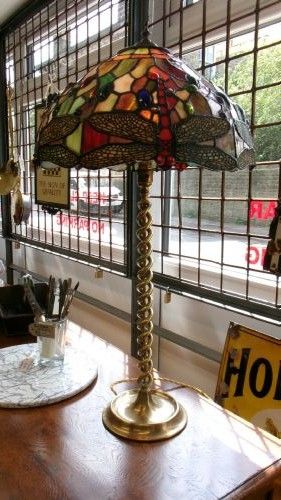
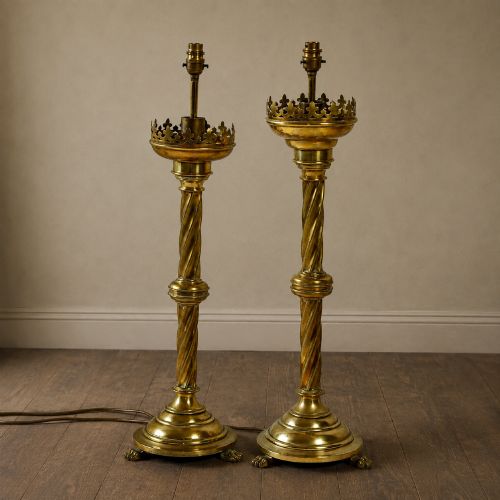
When you search for barley twist brass lamps, you encounter lighting fixtures defined by their spiral stems fashioned in metal. The selection on this page spans table lamps, floor lamps, and converted oil lamps, alongside related altar candlestick table lamps and desk lamps. These pieces originate from the Victorian and Edwardian eras, through to the 1920s.
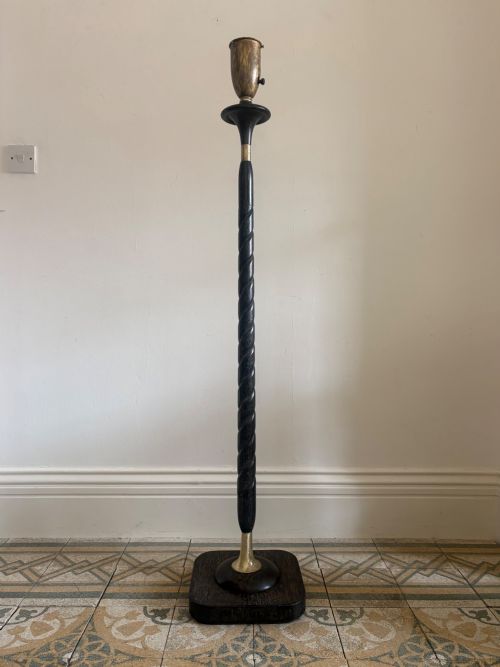
The forms range from compact table models to tall floor stands, including telescopic designs and double helix formations. You will find examples paired with fabric shades and Tiffany style shades, as well as bases incorporating ebonised wood. Their aesthetic draws upon traditional English, Gothic Revival, Arts and Crafts, and French design movements of the nineteenth and early twentieth centuries.
How they were made
The construction of these lamps relies heavily on brass, shaped into open twists and double helix columns to create the characteristic spiral silhouette. Some examples integrate ebonised wood alongside the metal to build the stands, whilst others utilise telescopic mechanisms for adjustable height.
Lighting components incorporate glass, moulded glass, clear glass, and lead, frequently complementing fabric or stained glass shades. Altar candlestick adaptations and oil lamp conversions demonstrate the repurposing of ecclesiastical and domestic metalwork into functional lighting.
Even the humble altar candlestick found a second life illuminating a Victorian parlour.
What varies in quality
Quality in these lamps rests upon the definition and execution of the brass twist itself, distinguishing between a fluid, well-formed spiral and a rigid or plain shaft. The choice of materials also dictates standard, where combinations involving ebonised wood or detailed metalwork elevate the piece.
The distinction between standard domestic lighting and specialist forms, such as Gothic Revival altar candlesticks or telescopic floor stands, influences the desirability of the construction. Furthermore, the inclusion of period-appropriate elements like stained glass or Tiffany style shades contributes to the overall character of the fixture.
The Barley Twist Brass Lamps Glossary
- Barley twist
- A spiral column resembling a twisted stalk of barley, forming the central shaft of the lamp. This classical turning style adds visual texture and movement to the metal or wood structure.
- Telescopic
- Describing a floor lamp stand designed with adjustable sections to alter the height. This mechanism allowed users to position the light source according to their needs.
- Double helix
- A twisted column formation featuring two parallel spiral strands winding around a central axis. This variation creates a more intricate visual rhythm than a single twist.
- Ebonised wood
- Timber treated with a finish to imitate ebony, providing a dark, contrasting element paired with the bright brass components of the lamp base.
Barley Twist Brass Lamps: Frequently Asked Questions
What periods do these lamps come from?
The pieces span the Victorian and Edwardian eras, extending into the 1920s.
You will also encounter items dated generally to the nineteenth century, reflecting traditional English and continental manufacturing styles.
How are floor lamps and table lamps different?
Floor lamps are tall, freestanding stands designed to rest directly on the floor, occasionally featuring telescopic adjustments for height.
Table lamps are smaller iterations intended for placement on desks, tables, or sideboards, and frequently originate from converted oil lamps or altar candlesticks.
What styles influence the design?
Makers drew upon traditional English domestic design alongside Gothic Revival, Arts and Crafts, and 1920s French aesthetics.
These movements determined the ornamentation of the brass bases and the choice of accompanying shades.
What materials are used alongside brass?
Construction frequently incorporates ebonised wood for contrast within the stems and bases.
Shades and upper components utilise glass, moulded glass, clear glass, lead, fabric, and stained glass, including Tiffany style designs.