

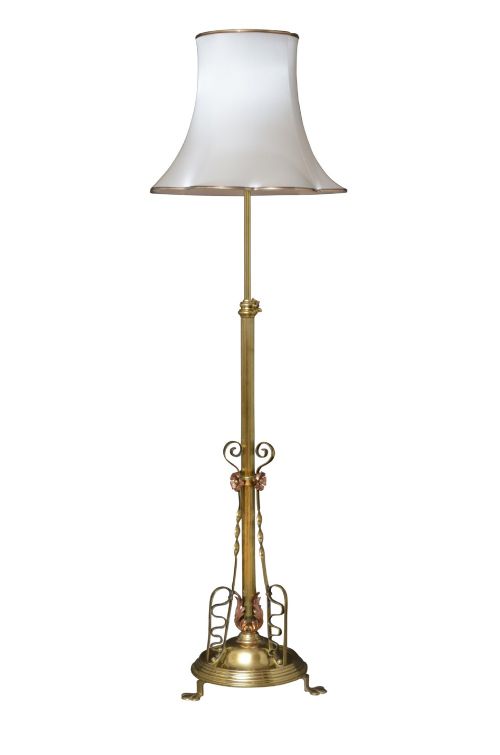
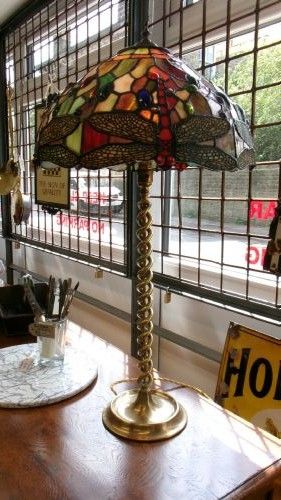


Art Nouveau Reading Light
An art nouveau reading light brings organic line and warm illumination to a desk or corner, crafted from brass, bronze, and glass.
Art Nouveau Reading Light
An art nouveau reading light encompasses table lamps, floor lamps, desk lamps, and standard lamps dating from the late nineteenth century into the early twentieth century. You will encounter standard lamps most frequently on this page, often standing tall in brass or copper with adjustable heights for direct task lighting.
The aesthetic draws heavily on natural forms, merging Edwardian, Arts and Crafts, and Belle Epoque influences into fluid metalwork. Pieces range from French bronze desk lamps set with glass cabochons to heavy iron floor lamps and open twist tall lamps.
Makers such as WAS Benson, The Charles Parker Company, and Tiffany Studios appear amongst the listings, alongside unmarked pieces in gilt bronze, ormolu, and spelter. These lamps served as functional reading implements in studies and libraries, now repurposed for ambient domestic lighting.
How they were made
Metal forms were cast, forged, or spun primarily in brass, bronze, copper, and iron, utilising the ductile properties of these metals to create whiplash curves and floral motifs. Surfaces were occasionally silver plated or finished with gilt, while others relied on the natural warmth of unpolished copper and brass.
The selection covers table lamps, floor lamps, desk lamps, and standard lamps spanning the late nineteenth and early twentieth centuries.
What varies in quality
The refinement of the casting and the expressiveness of the organic modelling dictate the upper tier of these lamps, where hand-finishing is evident in every petal and stem. Lesser examples rely on repetitive factory stamping and simpler, rigid junctions that lack the fluid grace associated with the style.
Materials also divide the range, with substantial bronze, heavy copper, and genuine Tiffany style or stained glass shades commanding greater appreciation than lighter spelter or plain metal alternatives. The presence of documented workshop attribution further distinguishes an exceptional standard lamp from standard commercial production.
WAS Benson·The Charles Parker Company·Tiffany Studios NYC
The Art Nouveau Reading Light Glossary
- Spelter
- An alloy of zinc and lead, often cast to imitate bronze in commercial lighting of the period. It has a lighter weight and a softer surface texture.
- Ormolu
- A technique of applying finely ground high-carat gold to a bronze object using a mercury amalgam. This imparts a rich, enduring golden lustre to the metal surface.
- Cabochon
- A polished, convex gem or piece of coloured glass without facets. These are frequently set into bronze frames to catch and refract the light.
- Standard lamp
- A tall floor lamp designed to stand independently in a room. They often feature adjustable height mechanisms or swan neck arms for reading.
- Arts and Crafts
- A design movement valuing traditional craftsmanship and simple, honest construction. It heavily influenced the structural honesty seen in many reading lamps of this era.
Art Nouveau Reading Light: Frequently Asked Questions
How do I distinguish Art Nouveau from Edwardian lighting?
Art Nouveau pieces prioritise asymmetrical, flowing organic lines inspired by stems and flowers. Edwardian designs often lean towards more restrained, classical symmetry while sharing the same period materials.
Many listings bridge both eras, reflecting the crossover in production styles around nineteen hundred.
Where should I place a standard lamp?
Standard lamps work best beside armchairs or in dark corners where height adjustable stems can direct light downward for reading. Their sculptural metal frames also make them effective focal points in a traditional interior.
Ensure the heavy base rests firmly on level flooring to support the extended height safely.
What maintenance do bronze and brass lamps need?
Regular dusting with a dry microfibre cloth keeps metal surfaces free from grime without disturbing the accumulated patina. Avoid harsh chemical polishes that strip away age and character from copper, bronze, and brass.
Glass shades and cabochons can be gently cleaned with mild soapy water when removed from the fitting.