
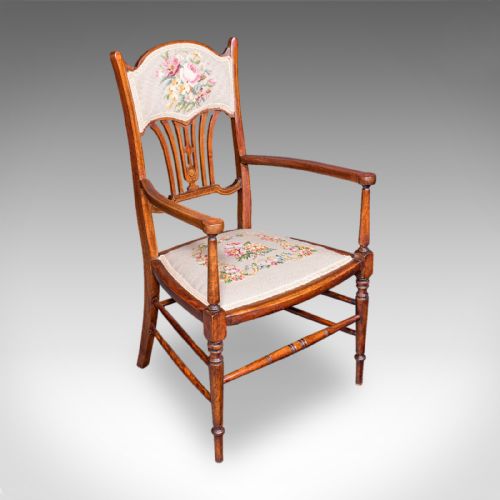


Art Nouveau Carver Armchairs
These art nouveau carver armchairs combine organic floral lines with robust period timber to anchor a seating layout.
Art Nouveau Carver Armchairs
When you search for art nouveau carver armchairs, you encounter seating featuring fluid, plant-inspired motifs alongside more geometric Arts & Crafts influences.
The pieces listed on this page span several decades from the Victorian and Edwardian eras up to the 1930s, encompassing both salon carvers and occasional armchairs.
Mahogany and beech form the structural backbone of these designs, often accented by delicate wood inlay or marquetry.
You will also find related dining chairs and side chairs sharing the same stylistic vocabulary.
How they were made
Carpenters constructed these frames primarily from solid mahogany, beech, and various hard woods, occasionally employing bentwood techniques for curved components.
Decoration relied heavily on wood inlay and marquetry to depict characteristic floral and botanical motifs directly into the timber surfaces.
Upholstery completed the seating, utilising traditional textiles including fabric, tapestry, and velvet across the seat pads and high backs.
Some chairs arrive with unexpectedly petite proportions built specifically for children.
What varies in quality
Quality depends upon the crispness of the inlaid details and the precision with which the organic wood curves are joined to the main frame.
Subtlety of proportion separates standard production seating from pieces featuring unusual silhouettes and refined high-backed structures.
The integrity of the original wood grain and the harmony between the textile upholstery and the timber define the upper tier of these examples.
Thonet·Louis Majorelle
The Art Nouveau Carver Armchairs Glossary
- Carver armchair
- An armchair, traditionally placed at the head of a dining table, featuring supportive armrests integrated into the frame. These pieces offer a wider seat than standard side chairs.
- Marquetry inlay
- Pieces of contrasting wood veneer assembled into pictorial or decorative patterns and fitted flush into a solid timber surface. This technique creates detailed surface decoration without adding bulky ornamentation.
- Bentwood
- Wood softened by steam and bent under pressure into curved structural components. This process allows for continuous, flowing frames without traditional joints.
- Arts and Crafts
- A design movement prioritising handcraftsmanship and simple vernacular forms over mass production. It heavily influenced the development of early twentieth-century seating.
Art Nouveau Carver Armchairs: Frequently Asked Questions
What defines an art nouveau carver armchair?
These seats feature characteristic organic lines, plant-inspired motifs, and integrated armrests executed in period timbers such as mahogany and beech. They bridge the decorative transition from the late Victorian era into the twentieth century.
Craftsmen often enhanced the frames with subtle wood inlay, marquetry, or high-backed profiles to create functional seating with strong aesthetic presence.
How do I distinguish these from Victorian chairs?
While many examples date from the Victorian and Edwardian periods, the defining stylistic element is the linear fluidity typical of the movement rather than heavy historic revival ornament. Look for whiplash curves and stylised floral marquetry.
Construction methods remain traditional, but the decorative vocabulary shifts away from rigid symmetry toward organic asymmetry.
Where should I place a carver armchair?
These armchairs suit reception rooms, studies, and bedrooms as occasional seats, or positioned alongside complementary dining chairs. Their supportive armrests make them practical for everyday use.
Ensure the scale of the timber frame matches your existing room layout and allows adequate clearance for the arms.
What upholstery materials are typical?
Original and period-appropriate upholstery includes woven tapestry, velvet, and various patterned textiles designed to complement the wooden frames. These materials soften the overall appearance of the hardwood structure.
Textiles often reflect the organic colour palettes favoured during the early twentieth century.