
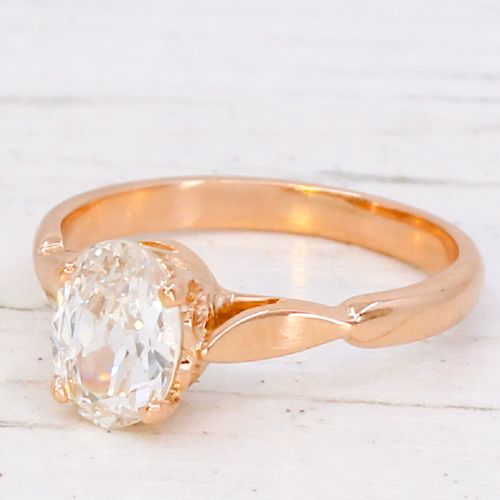
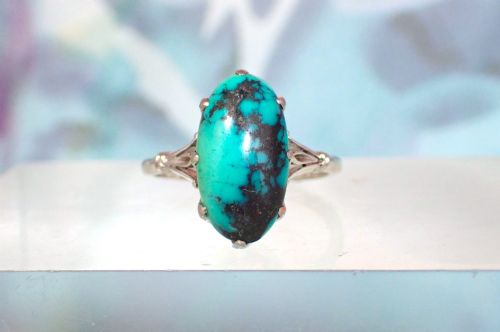


Art Deco Oval Solitaire
Art deco oval solitaire pieces combine geometric lines with central stones, offering striking period design for daily wear.
Art Deco Oval Solitaire
Art deco oval solitaire pieces comprise rings, necklaces, and pendants centred on a single prominent stone. The form showcases an oval cut gemstone held within geometric mountings typical of the period.
Most items you encounter belong to the 1920 and 1930 periods, with occasional pieces spanning into later than 1960. Rings dominate the selection, alongside pendants featuring turquoise, sapphire, opal, aquamarine, emerald, amethyst, citrine, and diamond.
Originating from the height of the art deco style, these designs balance bold symmetry with the softer curves of oval stones. Edwardian examples and French tank variations also appear among the offerings.
How they were made
Makers utilised platinum and 18ct white gold to form crisp, durable settings that complement the central gem. Yellow gold and rose gold also provide contrasting warmth in specific mountings.
Stones receive old oval cuts and standard facet arrangements designed to maximise light return within geometric bezels and prong settings. Jewelers integrated smaller accent diamonds around central sapphires, opals, and aquamarines.
Materials seen across listings include diamond, platinum, sapphire, 18ct white gold, opal, 18ct gold, rose gold, and turquoise.
What varies in quality
The choice of central material creates the primary distinction across the range, moving from citrine and amethyst to significant unheated Ceylon sapphires and large old cut diamonds. Metal purity shifts between 9ct gold, 18ct gold, white gold, and platinum.
Execution of the metalwork defines the structural integrity, separating standard commercial production from finer jeweller output. The precision of the geometric layout and the secure retention of the central stone dictate overall merit.
The Art Deco Oval Solitaire Glossary
- Solitaire
- A jewellery design featuring a single central gemstone mounted on its own. This setting draws complete focus to the primary stone.
- Oval cut
- A symmetrical curved gemstone shape combining round brilliance with elongated proportions. It creates a larger perceived surface area than a round cut of identical weight.
- Platinum
- A dense, durable white precious metal favoured in early twentieth century settings for its strength. It allows delicate prongs to hold heavy stones securely.
- Ceylon sapphire
- A corundum gemstone originating from Sri Lanka, noted for vivid blue coloration. Examples often command attention for their natural saturation.
- Old cut
- A vintage diamond faceting style characterised by a smaller table and higher crown. These stones produce a softer candlelight sparkle compared to modern brilliant cuts.
Art Deco Oval Solitaire: Frequently Asked Questions
How do I care for an antique gemstone ring?
Antique gemstone rings require gentle cleaning with soft cloths and mild soapy water, avoiding harsh ultrasonic machines that can damage softer stones like opal or turquoise.
Regular checks on the prongs ensure the central oval stone remains secure in its historical setting.
Are these pieces from the 1920s?
Many listings date from the 1920 and 1930 periods, reflecting authentic art deco and Edwardian design movements.
Some variations extend into later than 1960 while maintaining historical style characteristics.
What metals are used in these mountings?
Mountings utilise platinum, 18ct white gold, 18ct gold, rose gold, and 9ct gold depending on the specific period and maker.
White metals dominate art deco designs to contrast sharply with coloured gemstones and diamonds.