

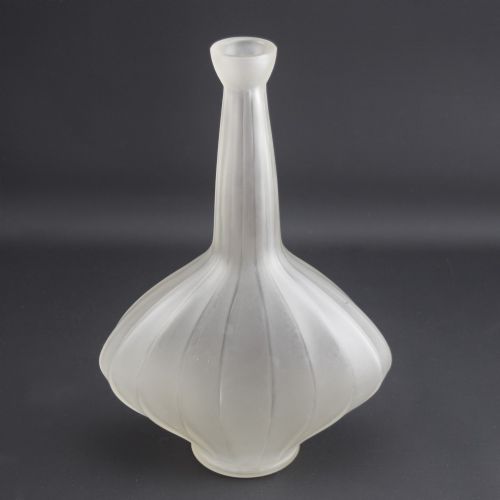


Art Deco Liquor Decanters
Art deco liquor decanters bring sharp geometric lines and vibrant colour to the home bar, making them essential centrepieces for period entertaining.
Art Deco Liquor Decanters
Art deco liquor decanters span the period from the 1920s to the 1940s, capturing the distinct architectural and geometric spirit of the era. Buyers seeking these pieces will mostly encounter comprehensive sets complete with matching glasses, trays, and original stoppers.
Originating predominantly from Czech workshops alongside English and French makers, these vessels range from minimalist black glass to elaborate hand-enamelled lead crystal. The typical form relies on sharp angles, contrasting bands of colour, and stylized motifs that break entirely from traditional floral designs.
The material execution reflects the height of interwar design, utilising industrial metals alongside traditional glassmaking. Many examples incorporate matching trays to anchor the set, turning a simple drinks service into a unified sculptural display.
How they were made
Makers shaped these vessels using heavy lead crystal or standard glass, often employing geometric cutting techniques to catch the light from multiple angles. Frosted glass and black glass variants provided a stark, matte contrast to polished crystal surfaces.
Enamelling and applied metalwork defined the surface decoration of many pieces, particularly those from Bohemian workshops. Artisans used hand-applied enamels in bold colour palettes, while English producers frequently mounted their crystal in sterling silver or chrome frames.
Art Deco Liquor Decanters Retail Price Guide 2026
Typical asking prices for art deco liquor decanters among the pieces listed under this phrase on Sellingantiques today, from the lower quarter to the upper quarter. They describe what is for sale here now, not the wider market.
Listings feature pieces spanning the 1920s to the 1940s, utilising materials from frosted glass and sterling silver to black glass and chrome.
What varies in quality
The calibre of an art deco liquor decanter rests upon the crispness of its facets and the precision of its enamel work. Superior examples exhibit clean, sharp geometric cuts and evenly saturated colours that do not fade or blur at the edges.
Completeness dictates much of the standing for these items, particularly when the original matching glasses and trays survive intact alongside the main vessel. The weight of the glass and the snugness of the stopper fit also separate standard production wares from the finest atelier output.
Rene Lalique·Karl Palda·Val Saint Lambert·Hukin and Heath·Mosey
The Art Deco Liquor Decanters Glossary
- Lead crystal
- Glass containing metal oxide that increases weight, brilliance, and refractive index. This material allowed makers to achieve deep, sharp cuts that scatter light effectively.
- Enamel
- Opaque vitreous composition fused to the glass surface through firing. It provided the vibrant, contrasting geometric patterns characteristic of Bohemian production.
- Sterling silver
- Silver alloy of high purity used for mounts, collars, and locking mechanisms. English makers frequently employed this metal to frame and reinforce crystal decanters.
- Frosted glass
- Glass treated to create a textured, matte surface finish. This technique created subtle tonal contrasts against polished clear sections.
- Decanter set
- A coordinated grouping comprising a serving vessel, matching glasses, and occasionally a tray. These ensembles formed the standard barware service of the period.
Art Deco Liquor Decanters: Frequently Asked Questions
What defines art deco liquor decanters?
These vessels are characterised by strong geometric forms, angular silhouettes, and bold ornamentation typical of the interwar period. They frequently incorporate contrasting materials like chrome, sterling silver, or hand-applied enamel upon clear or black glass.
Most surviving examples originate from the 1930s, reflecting the widespread modernist shift away from ornate Victorian and Edwardian aesthetics towards streamlined industrial design.
How were decanter sets used?
Decanter sets served as the primary method for dispensing spirits during cocktail hour and formal home entertaining in the interwar years. The inclusion of matching glasses and trays allowed hosts to present liquor in a cohesive, stylish manner.
They were kept on sideboards, drinks trolleys, or dedicated bar cabinets, combining practical storage for spirits with a striking decorative display.
How do I care for my decanter?
Wash these pieces strictly by hand using warm water and mild detergent to protect delicate enamel work and metallic mounts. Avoid sudden temperature changes to prevent thermal shock in heavy crystal.
Remove stoppers during long periods of storage to prevent them from sticking, and use soft cloths to polish silver and chrome components without abrasive cleaners.
Are original stoppers important?
Original stoppers are vital because they were individually ground to fit the neck of each specific decanter during manufacture. Finding a correct replacement matching the exact period cut and tint remains exceptionally difficult.
A matched original stopper preserves the stylistic integrity and visual balance of the piece, whereas a mismatched replacement alters the silhouette.