


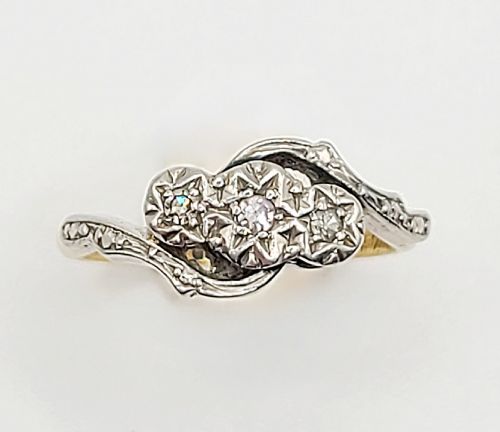


Art Deco Illusion Setting
An art deco illusion setting makes a single diamond look larger by framing it with a brilliant platinum plate.
Art Deco Illusion Setting
When you search for art deco illusion setting, you find rings that use clever metalwork to magnify the stone at the centre. These pieces are predominantly rings originating from the 1920s, 1930s and 1940s, capturing the geometric elegance of the period.
The version you meet most often on this page pairs a diamond with platinum and gold. Solitaire and trilogy designs dominate the selection, showing how makers arranged the metal to catch the light around the gem.
Materials and construction
Goldsmiths combined durable platinum with 18ct gold, 18ct yellow gold, 9ct gold or palladium to build these structured mounts. Platinum was favoured for the illusion plates because its white lustre enhanced the perceived size of the diamond.
Diamonds are secured within faceted or star-cut platinum settings that mimic the appearance of a much larger stone. The shank is typically formed from gold, creating a strong two-tone contrast characteristic of the era.
Star motifs cut into the platinum trick the eye so successfully that you almost need a loupe to find the actual edges of the stone.
What separates the best from the rest
Quality rests in the precision of the metal faceting and the crispness of the illusion plate. Finer examples feature sharp geometric engraving that holds its edge, whereas simpler mounts show softer contours.
The integration of the platinum top onto the gold shank dictates the refinement of the piece. Superior work conceals the join entirely, presenting a seamless face to the viewer.
The Art Deco Illusion Setting Glossary
- Illusion setting
- A metal mounting technique designed to make a diamond appear larger by surrounding it with a reflective plate. This method was widely used in the early twentieth century to maximise visual impact.
- Solitaire
- A ring set with a single diamond. It is the most common form found in this selection.
- Trilogy
- A ring featuring three diamonds arranged in a row. These pieces often incorporate platinum settings on gold bands.
Art Deco Illusion Setting: Frequently Asked Questions
What is an illusion setting?
An illusion setting uses a specially faceted metal plate around a diamond to trick the eye into seeing a larger stone.
This technique became popular during the early twentieth century as a way to create bold designs without requiring massive gems.
How do I date these rings?
Dating relies on stylistic clues like geometric lines, metal combinations, and the specific proportions typical of the 1920s through to the 1940s.
Most examples seen here sit firmly in the interwar period when platinum-topped gold was standard practice.
Are these rings suitable for daily wear?
These pieces were built for everyday use, combining durable platinum heads with sturdy gold or palladium bands.
Normal care keeps the intricate metalwork bright and secure for modern wear.