


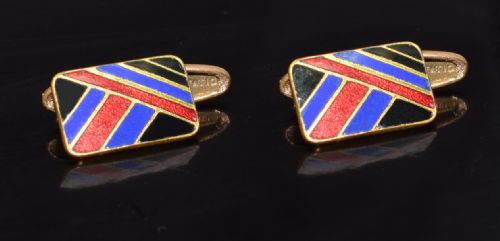


Art Deco Enamel Cufflinks
Art deco enamel cufflinks are sharp geometric gentlemen's accessories that bring vibrant colour to a cuff.
Art Deco Enamel Cufflinks
Art deco enamel cufflinks are gentlemen's shirt fastenings produced predominantly during the 1930s, featuring striking geometric designs and vibrant coloured glass pastes fused to metal bases. These pieces showcase the modernist aesthetic popular during the period, often built as matching pairs for formal attire.
The version most commonly encountered in these selections is the modernist gents cufflink originating from English makers around 1930. These frequently display blocky patterns, green and black combinations, or blue and white motifs designed to catch the eye against traditional shirt cuffs.
Materials and construction methods
Manufacturers utilised vitreous enamel fused onto silver, silver plate, or brass, alongside alternative bases such as chrome, gilt metal, rolled gold, and proprietary alloys like platinon. Higher-end versions incorporated 18ct yellow gold, providing a heavier and more substantial foundation for the colourful glass work.
The decorative surfaces rely on precise geometric layouts, sometimes incorporating engine-turned guilloche patterns beneath translucent enamel layers. Artisans secured these components with traditional chain links or rigid pivoting backs suited for gentlemanly double cuffs.
Art Deco Enamel Cufflinks Retail Price Guide 2026
Typical asking prices for art deco enamel cufflinks among the pieces listed under this phrase on Sellingantiques today, from the lower quarter to the upper quarter. They describe what is for sale here now, not the wider market.
Listings feature items primarily from the 1920s to the 1940s, with a strong concentration originating around 1930.
Distinguishing quality factors
Quality rests significantly on the choice of base metal, moving from base brass and chrome up to sterling silver and solid 18ct yellow gold. Pieces formed in precious metal typically exhibit finer detailing and more resilient construction that endures decades of handling.
The preservation and execution of the enamel itself define the upper tier of pieces, where smooth, flush surfaces and crisp geometric lines demonstrate superior craftsmanship. Intricate combinations of contrasting colours, such as green and black or blue and white, demand exact kiln control to avoid muddoning the distinct shapes.
The Art Deco Enamel Cufflinks Glossary
- Vitreous enamel
- A material made by fusing powdered glass to a metallic substrate at high temperatures. This technique produces a hard, glossy surface resistant to fading and daily wear.
- Guilloche
- An ornamental engraving technique where a precise geometric pattern is mechanically etched into the metal base before applying translucent enamel. The underlying design shows through the coloured glass with distinctive optical depth.
- Modernist
- A design style emerging in the early twentieth century prioritising clean lines, abstraction, and geometric form over ornate historical revivalism. It heavily influenced the architecture of the era.
- Chain link
- A flexible connector joining the two faces of a cufflink using small metal rings. This traditional configuration allows the fastening to drape naturally through shirt buttonholes.
- Platinon
- A proprietary white metal alloy utilised by period manufacturers to imitate platinum without the associated cost. It provided a bright, non-tarnishing surface for geometric decorative work.
Art Deco Enamel Cufflinks: Frequently Asked Questions
How do I fasten chain link cufflinks?
Chain link fasteners require threading one face through the double cuff holes manually, allowing the connecting rings to rest across the fabric. They offer a looser, more traditional drape than modern hinged mechanisms.
Practising with the links ensures you can secure them smoothly without stretching your shirt cuffs. The flexible connection rewards patience with an authentic period look.
Are these cufflinks suitable for daily wear?
These accessories were built for gentlemen's formal attire and handle regular modern use well when treated with basic care. Avoiding impacts against hard surfaces protects the glass enamel from chipping.
Storing them in a lined box prevents the metal faces from scratching each other between outings. Gentle cleaning with a soft cloth maintains the lustre of both the metal and the enamel.
How can I tell a 1930s pair from later reproductions?
Period pieces from the 1930s exhibit specific construction traits, such as traditional chain connectors and distinct material weights associated with base metals and early alloys. Examining the reverse side often reveals authentic patination and maker conventions typical of the era.
Modern reproductions frequently use contemporary findings or synthetic resins rather than true vitreous enamel. Familiarising yourself with genuine period weights and geometric motifs helps clarify the timeline.
What shirt cuffs work best with geometric designs?
Crisp double cuffs, often called French cuffs, provide the ideal canvas for showcasing bold geometric patterns and vibrant enamel colours. Stiff white or pastel cotton fabrics allow the sharp lines of the design to stand out clearly.
Matching the metal tone of the cufflinks to other accessories like tie slides or watch chains creates a cohesive appearance. The contrasting colour blocks perform particularly well against understated shirting.