

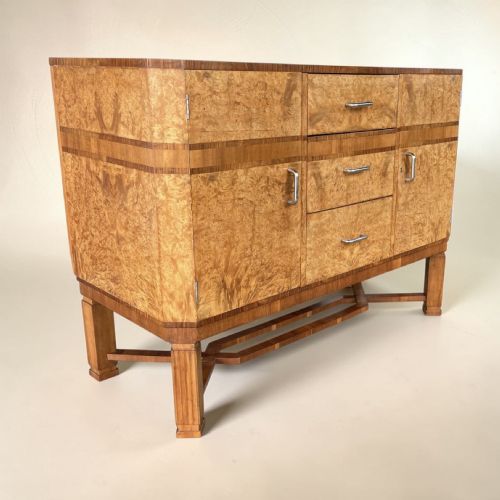
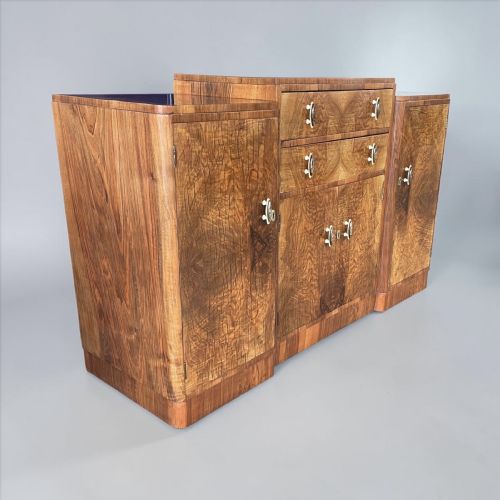


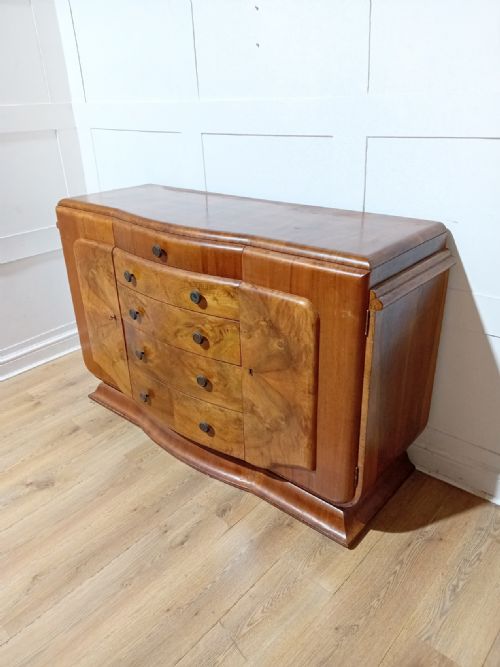

Art Deco Dining Storage
Art deco dining storage brings geometric form and rich timber to the room, offering practical service and bold twenties presence.
Art Deco Dining Storage
Art deco dining storage comprises sideboards, credenzas, buffets and cutlery canteens built to serve the dining room with functional capacity. These pieces provide deep cupboards, drawers and fitted interior trays for tableware and silver.
The versions most commonly met on this page date from the nineteen twenties and nineteen thirties, capturing the height of the style. Makers ranged from prominent London houses to continental cabinet makers.
Forms span from compact limed oak cabinets to grand serpentine sideboards finished in figured veneers. Each piece uses geometry and clean lines to organise dining spaces effectively.
How art deco dining storage was made
Cabinet makers constructed these pieces using solid hardwoods like oak, mahogany and maple as sturdy carcases. They applied decorative veneers of walnut, burr walnut and other timbers across the exterior surfaces to create striking grain patterns.
Metal components in chrome and bakelite appear frequently on handles, hinges and decorative mounts. These materials provided the sleek, modern contrast characteristic of the period.
Art Deco Dining Storage Retail Price Guide 2026
Typical asking prices for art deco dining storage among the pieces listed under this phrase on Sellingantiques today, from the lower quarter to the upper quarter. They describe what is for sale here now, not the wider market.
Materials recorded across the inventory include walnut, burr walnut, oak, mahogany, maple, metal, chrome and bakelite.
What varies in quality
The choice of veneer defines the visual standard of the piece, with matched burr walnut standing above plain timber surfaces. Expert book-matching creates symmetrical patterns across cupboard doors and drawer fronts.
Hardware execution and interior fitting distinguish finer pieces from standard production. Original chrome mounts, bakelite details and well-organised cutlery drawers indicate superior maker attention.
Harry and Lou Epstein·Heals of London·Hamptons of Pall Mall London·Gomme
The Art Deco Dining Storage Glossary
- Serpentine
- A curved line that sweeps outward at the ends and inward at the centre. This shape adds movement and complexity to sideboard fronts.
- Limed oak
- Timber treated with a white pigment to highlight the grain and lighten the overall colour. It creates a pale, matte finish popular in nineteen twenties design.
- Canteen
- A fitted box or cabinet designed to hold a complete set of cutlery securely. These interiors often feature slotted trays and velvet linings.
Art Deco Dining Storage: Frequently Asked Questions
What is art deco dining storage?
Art deco dining storage consists of sideboards, buffets and cutlery canteens produced during the nineteen twenties and nineteen thirties. These items combine practical storage compartments with the characteristic geometric lines of the period.
They serve as the main storage furniture in a dining room, designed to hold tableware, linen and cutlery. Their surfaces also provide space for serving food or displaying decorative objects.
How do I identify a nineteen thirties sideboard?
Nineteen thirties sideboards typically feature bold geometric forms, symmetrical veneer patterns and streamlined silhouettes. Materials like walnut veneer and chrome hardware point directly to this era.
Check for maker marks or stamps inside the drawers or on the back panels. The absence of heavy Victorian carving and the presence of clean architectural lines help confirm the period.
What woods were used in these pieces?
Cabinet makers utilised a range of timbers including walnut, burr walnut, oak, mahogany and maple. They often combined solid structural frames with decorative veneers on the visible exterior surfaces.
Contrasting wood tones enhanced the geometric patterns popular in the style. Limed oak finishes also appear on earlier pieces from the nineteen twenties.
How do I care for walnut veneer?
Walnut veneer requires protection from direct sunlight and excessive moisture to prevent fading and lifting. Dust the surface regularly with a soft, dry cloth and avoid harsh chemical cleaners.
Apply a quality beeswax occasionally to nourish the timber and maintain the lustre of the finish. Keep the piece away from direct heat sources such as radiators.