
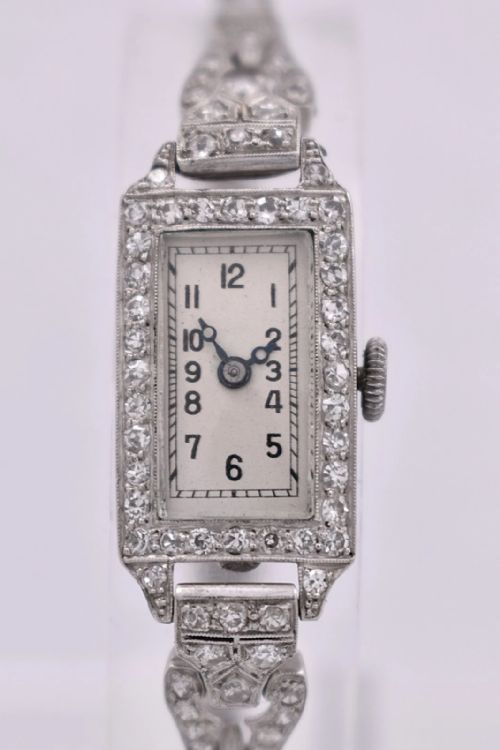


Art Deco Diamond Watch
An art deco diamond watch combines precise timekeeping with geometric elegance, offering a wearable sculpture of platinum and gemstones.
Art Deco Diamond Watch
The cocktail watch variation dominates current selections, showcasing rectangular or symmetrical cases set densely with small diamonds. Alongside these, you find pieces integrated into flexible mesh bracelets or heavy platinum mountings that sit flat against the wrist.
Materials and construction
Platinum serves as the primary metal for the finest examples, chosen for its strength in holding tiny stones securely in narrow claw or channel settings. White gold, including 14ct and 18ct variants, appears frequently as a durable alternative for housing the internal manual wind movements.
Diamonds are cut predominantly in old European, rose, or single cuts to catch candle and gas light, complemented by glass crystals protecting the dials. Leather and fabric straps occasionally replace metal mesh bracelets, though precious metal dominates the surviving inventory.
Listings feature platinum and white gold housings set with diamonds, originating across the 1920s, 1930s, 1940s, 1950s, and 1960s.
Judging the standard
Quality rests heavily on the integrity of the platinum case work and the uniformity of the diamond pavé setting. Pieces displaying hand-engraved geometric details along the sides show superior craftsmanship compared to mass-produced stamped housings.
The reputation of the internal Swiss movement manufacturer, such as Longines, Movado, or Tissot, dictates the mechanical reliability and pedigree of the watch. Original signed dials and matching bracelet clasps elevate the overall standard of any given piece.
Bucherer·Asprey·Vertex·Movado·Tissot·Longines·Arsa·Rolex·Bar·Benson·Tudor Royal·Omega
The Art Deco Diamond Watch Glossary
- Cocktail watch
- A small women's dress watch designed specifically for evening social events. These timepieces prioritise decorative gemstone settings over legibility.
- Platinum
- A dense, white precious metal offering high tensile strength. It allows jewellers to create ultra-thin bezels and intricate filigree without risking stone loss.
- Manual wind
- A mechanical movement requiring daily hand rotation of the crown to tension the mainspring. Most period examples rely entirely on this manual mechanism rather than automatic self-winding rotors.
- Swiss jewelled lever
- An escapement mechanism utilising synthetic rubies to reduce friction within the gear train. This addition ensures greater chronological accuracy in miniature watch casings.
Art Deco Diamond Watch: Frequently Asked Questions
Can I wear an art deco diamond watch daily?
These delicate historical items suit special occasions rather than rigorous daily wear. The tiny gears and intricate stone settings require careful handling to prevent damage.
Storing the watch in a secure box when not in use protects the fragile glass crystals and platinum links from unnecessary friction and potential impacts.
How do I wind a vintage watch?
Hold the crown firmly between your thumb and forefinger, turning it gently clockwise until you feel light resistance. Stop immediately to avoid over-winding and snapping the internal mainspring.
Routine maintenance by a professional watchmaker ensures the mechanical movement continues to function smoothly without placing undue stress on vintage components.
What is a fob watch?
A fob watch is a portable timepiece designed to be pinned to clothing or worn suspended from a ribbon rather than strapped directly to the wrist. These pieces share the same geometric diamond settings and platinum cases found on standard cocktail variations.
During the early decades of the twentieth century, women frequently wore these pinned near the lapel as functional ornaments before wristwatches gained widespread popularity.