
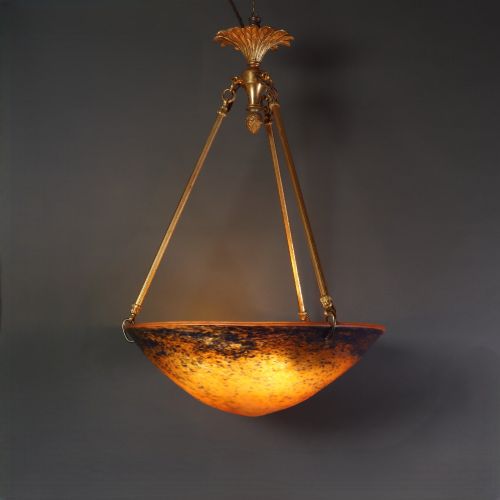


Art Deco Bowl Light Shade
These art deco bowl light shades bring geometric symmetry and warm overhead illumination to any room, exactly as they did in the interwar years.
Art Deco Bowl Light Shade
When you search for an art deco bowl light shade, you are looking at ceiling fixtures and suspended pendant lamps designed to diffuse light evenly across a space. The examples on this page span the 1920s and 1930s, featuring shallow dishes, plafonniers, and hanging bowls that hug or suspend closely from the ceiling.
You will most frequently meet pressed glass, satin glass, and carved alabaster bowls held by brass, patinated brass, or copper hardware. These pieces served as the central illumination for interwar interiors, offering a streamlined aesthetic that moved away from fussy Victorian fixtures.
The selection ranges from pink glass clam shell chandeliers to opalescent uplight lampshades and white alabaster dish lights. Swedish and English workshops both contributed distinct regional interpretations to this enduring decorative style.
How they were made
Glass bowls were produced using pressing and moulding techniques to achieve thick, tactile surfaces that could be frosted, opalescent, or satin-finished. These methods allowed makers to incorporate stylised floral motifs, geometric ridges, and clamshell contours directly into the molten material.
Stone variants relied on the careful turning and carving of natural alabaster to exploit its translucent qualities, letting the natural veining diffuse the bulb's glare. Metal components in brass, copper, and patinated bronze were cast or spun to create the suspension rings, chains, and galleries supporting the heavy glass or stone bowls.
Some pink glass shades resemble giant marine clam shells, proving that interwar designers happily took lighting cues from the beach.
What varies in quality
The distinction between standard commercial production and exceptional work lies in the depth of the glass moulding and the purity of the material. Superior pieces exhibit crisp relief work and deliberate optical effects, such as opalescence that shifts in tone under different lighting conditions.
Hardware weight and metal finishing also separate the grades, with top-tier fixtures utilising heavy cast brass or copper rather than thin stamped sheet metal. The quality of the suspension mechanism and the harmonious proportion between the bowl and its metal mount define the overall success of the design.
René Lalique
The Art Deco Bowl Light Shade Glossary
- Plafonnier
- A ceiling light fixture with a bowl or dish that mounts directly or very closely to the ceiling without a long suspension drop. This form became popular during the interwar period for rooms with standard ceiling heights.
- Opalescent glass
- Glass containing ingredients that cause it to display a milky blue or fire-like orange appearance when lit from behind or viewed from certain angles. It adds a subtle chromatic shift to simple white or clear shades.
- Satin glass
- Glass treated with an acid dip or sandblasting to create a velvety, non-reflective surface finish that softens bulb glare. It is characteristic of decorative lighting from the 1920s and 1930s.
- Alabaster
- A fine-grained, translucent form of gypsum or calcite carved into solid lighting bowls. Its natural stone veining ensures that no two shades diffuse light in the exact same pattern.
- Uplight
- A lighting configuration where the bowl directs the primary beam toward the ceiling to bounce ambient light back down into the room. This arrangement reduces harsh shadows and glare.
Art Deco Bowl Light Shade: Frequently Asked Questions
How do these bowl lights mount to the ceiling?
Most bowl lights hang from metal rods, chains, or fabric cords attached to a central ceiling canopy, while flush variants mount directly against the plaster. The bowl itself typically rests within a metal ring or is secured by three or four decorative clips.
Ensuring the ceiling junction box can support the combined weight of the glass or stone bowl and its metal hardware is essential during installation.
What rooms suit an art deco bowl light?
These fixtures work well in hallways, dining rooms, and bedrooms where ambient, diffused overhead lighting is preferred over harsh directional beams. Their shallow profile makes them practical for spaces with moderate ceiling heights.
Matching the metal finish of the shade's hardware to existing door furniture or fittings helps tie the room together.
How do I distinguish 1920s pieces from 1930s ones?
Pieces from the 1920s often feature more flamboyant ornamentation, such as coloured glass, clam shell forms, and organic motifs influenced by early modern luxury. The 1930s tended toward streamlined, functional designs with frosted white glass and minimalist metalwork.
Overlaps in production styles remain common, as factories continued manufacturing popular moulds across both decades.
Are alabaster and glass shades cleaned differently?
Glass bowls can be removed and washed in warm soapy water to clear away dust and grease without harming the surface. Alabaster requires dry dusting or a barely damp cloth, as porous stone absorbs moisture easily.
Avoiding harsh chemical cleaners protects both the vintage metal patination and the delicate surface finishes of the shades.