




Architectural Door Handles
Architectural door handles are practical fittings in brass, bronze and iron that shape the character of a room the moment you touch them.
Architectural Door Handles
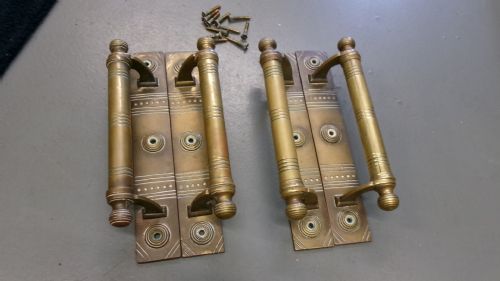
Architectural door handles encompass functional hardware pieces designed for domestic and commercial entrances, spanning periods from the seventeenth century through the Victorian era and into the Art Deco twentieth century. Buyers seeking architectural door handles encounter various forms including pairs of lever handles, heavy finger plates, matching push plates, and centre door knobs.
The selections on this page lean heavily towards nineteenth-century production, particularly Victorian brass beehive designs and Regency oval knobs, alongside earlier heavy metalwork and twentieth-century French ballroom pulls. These items cross multiple stylistic categories, from Arts and Crafts brass sets to ornate ebony wood and horn fittings.
How they were made
The pieces rely primarily on durable metalcasting techniques using brass, bronze, cast iron, and wrought iron to achieve robust handles and backplates. Manufacturers also incorporated contrasting elements such as lead crystal inserts, ebony wood, and horn.
Makers utilised casting and forging methods suited to each period, producing intricate ornamentation on Victorian centre knobs and streamlined geometric profiles for Art Deco pulls. Surface finishes range from polished brass to patinated bronze developed through age and handling.
What varies in quality
Quality rests in the weight of the metal and the crispness of the cast ornamentation, distinguishing mass-produced utilitarian hardware from heavier, bespoke architectural fittings. Superior examples display substantial cast bronze or brass construction with integrated matching push plates or lock mechanisms.
The grade of secondary materials also dictates the tier of the piece, where lead crystal inserts, turned ebony wood, or genuine horn retain finer detailing and secure mounts compared to simpler utilitarian alternatives.
Gerwin & Co Birmingham
The Architectural Door Handles Glossary
- Door furniture
- The collective term for functional metal fittings attached to a door, including handles, knobs, knockers and finger plates. These items combine mechanical utility with decorative style.
- Finger plate
- A flat protective plate mounted behind a door handle or latch to prevent fingerprints and wear on the door surface. They often match the material and decorative style of the accompanying handle.
- Centre door knob
- A stationary handle placed in the middle of a heavy main door rather than the edge. These serve as a pull or a mount for a door knocker.
- Bell pull
- A mechanical lever or handle wired to ring a household bell in another part of the building. Victorian and Georgian examples often feature ornate brass mountings.
- Push plate
- A metal plate fixed to the swinging side of a door to push it open without turning a latch. They appear frequently in pairs alongside matching pull handles.
Architectural Door Handles: Frequently Asked Questions
How do I date antique door handles?
Dating relies on matching the metal composition, fastening methods, and stylistic motifs such as Regency oval shapes or Victorian beehive turnings to known manufacturing periods.
Changes in production technology from hand-forged iron to nineteenth-century brass casting provide clear chronological markers for individual pieces.
Are old door handles easy to install?
Most antique handles fit standard nineteenth-century spindle sizes, though older seventeenth-century or bespoke French pieces may require custom spindle adjustments.
Careful measurement of existing backplate fixings ensures historical hardware aligns correctly with modern door preparations.
Can I use antique handles on exterior doors?
Sturdier brass, bronze, and cast iron variants withstand exterior exposure well, provided the underlying metal remains free from deep structural corrosion.
Heavier bronze and brass architectural pulls from the Victorian and Edwardian periods offer sufficient durability for front entrance use.
What is the difference between a knob and a pull?
A door knob rotates to operate a latch mechanism inside the door mortise, whereas a pull remains stationary to physically drag the door open.
Stationary pulls often accompany push plates on heavy double doors or commercial shop entrances.