

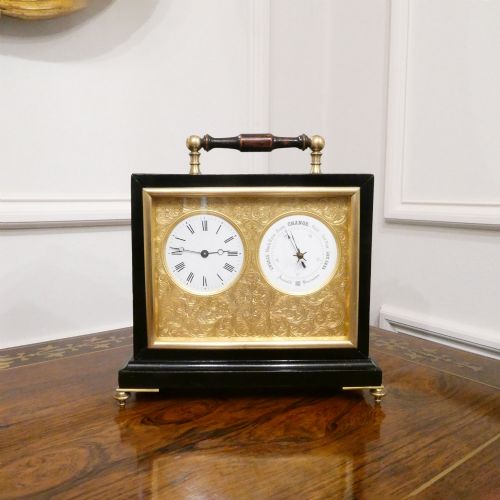
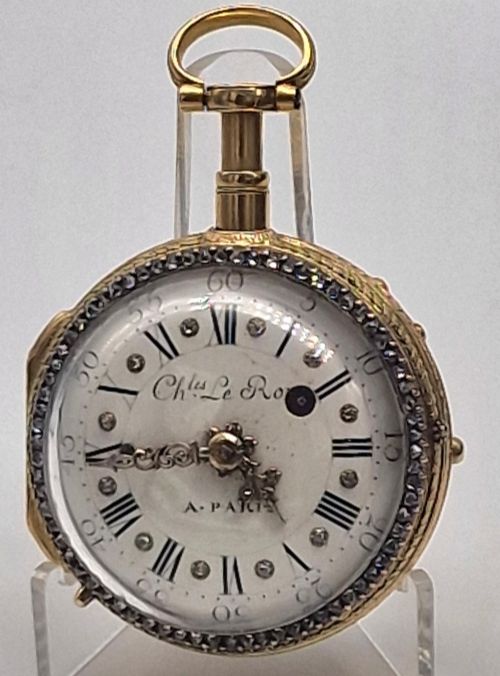


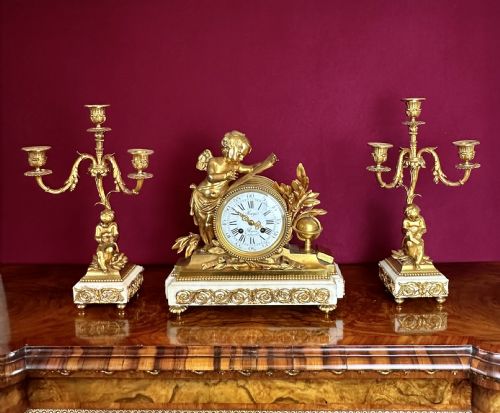


Antique Timepiece Set
An antique timepiece set brings together matching horological and decorative objects, offering a complete mantel or desk arrangement.
Antique Timepiece Set
When you search for an antique timepiece set, you are looking at matched groupings centred around a main clock, often accompanied by side pieces such as garnitures, barometers, or matching vases. These ensembles most frequently appear from the Victorian period, alongside examples spanning the eighteenth century to the mid-twentieth century.
The objects take several formal shapes in the listings, including French clock garnitures, mantel clocks paired with side ornaments, and combined clock and barometer instruments. Origins lean towards French workshops and English makers, reflecting formal drawing room and parlour displays of past centuries.
Materials and styles vary widely across the selection, ranging from ornate Victorian ormolu and marble pieces to sleek Art Deco designs. Buyers frequently encounter complete clock garniture sets that retain their original flanking ornaments, maintaining the intended symmetry of the period.
Materials and construction methods
Decorative elements incorporate precious gemstones and luxury metals in smaller personal items, seen in platinum and diamond cocktail watches. Workshops employed casting, gilding, and stone-cutting techniques to produce matching garniture sets and precise repeaters.
Antique Timepiece Set Retail Price Guide 2026
Typical asking prices for timepiece set among the pieces listed under this phrase on Sellingantiques today, from the lower quarter to the upper quarter. They describe what is for sale here now, not the wider market.
Listings span from the 18th century to the 1960s, incorporating Victorian, Edwardian, and Art Deco styles alongside materials like platinum, marble, and gilt bronze.
Assessing quality in matching sets
Quality rests upon the uniformity of the matched pieces and the crispness of the cast metal ornamentation, such as ormolu and gilt bronze mounts. Superior examples demonstrate harmonious integration between the central clock and its flanking garnitures, using matching materials like high-grade marble.
The refinement of the dial work, the presence of signed movements by established makers like AD Mougin or Charles Le Roy, and the preservation of delicate enamel dials elevate certain pieces above standard production.
Charles Le Roy·Asprey·Vertex·Invicta·AD Mougin
The Antique Timepiece Set Glossary
- Garniture
- A set of decorative matching objects designed to be displayed together on a mantelpiece or sideboard, typically comprising a central clock flanked by two urns, vases, or candelabra.
- Ormolu
- Gilt bronze, where a finely ground high-carat gold-mercury amalgam is applied to a bronze base, creating a rich golden surface finish common in French decorative arts.
- Spelter
- A zinc alloy frequently used as a cost-effective alternative to bronze in the manufacture of figurative clock cases and garniture ornaments.
- Repeater
- A mechanical watch or clock mechanism that chimes the hours and quarters upon demand when a small slide or pendant is activated.
- Chapter ring
- The circular band on a clock face that bears the numerals indicating the hours.
Antique Timepiece Set: Frequently Asked Questions
What is included in a clock garniture?
A clock garniture consists of a central mantel clock accompanied by two matching side pieces, such as urns, vases, or candelabra. These matching objects create a balanced decorative arrangement for a mantelpiece.
Historically, makers designed these sets to be displayed together as a unified ensemble, utilising identical materials and decorative motifs across every component.
How do I care for marble clock cases?
Marble clock cases require gentle dusting with a soft, dry cloth to prevent the accumulation of dirt within carved crevices. Avoid using household chemical cleaners, which can damage the polished stone surface.
Keep the set away from direct sunlight and heat sources to protect any applied gilding, bronze mounts, and internal mechanical components.
Are French clock sets different from English ones?
French clock sets often feature ornate ormolu mounts, classical Neoclassical or Louis XVI styling, and striking movements housed in marble or gilt bronze cases. They frequently include elaborate matching garniture ornaments.
English equivalents from periods like the Edwardian era tend to pair practical instruments, such as combining a mantel clock with a matching barometer.
What does an eight day movement mean?
An eight day movement indicates that the clock requires winding approximately once a week to maintain continuous operation. This mechanism uses mainsprings that store sufficient power to drive the gear train for slightly over a week.
Such movements appear frequently in Victorian and later mantel clocks, offering greater convenience than daily-wound timepieces.