



Antique Slate Mantelpiece
An antique slate mantelpiece anchors a room with heavy Victorian presence, offering a sturdy architectural focal point that collectors value for its solid weight and carved form.
Antique Slate Mantelpiece
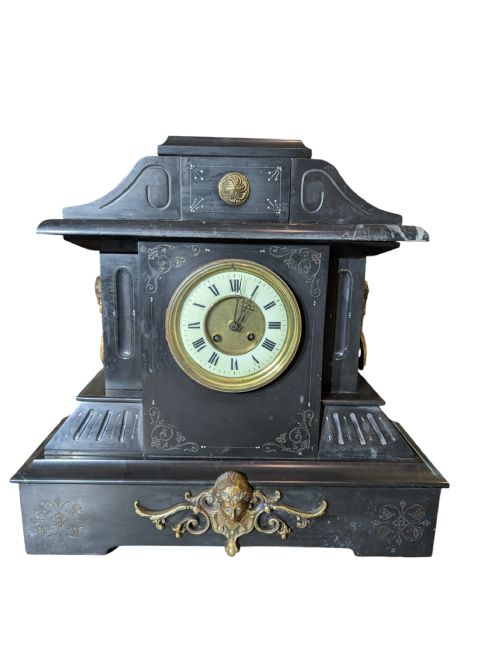
When you search for an antique slate mantelpiece, you encounter heavy architectural items and dense stone clock cases dating from the nineteenth century. These objects include functional fireplace surrounds and striking mantel clocks formed from solid black slate and Welsh slate, often enhanced with marble inlay.
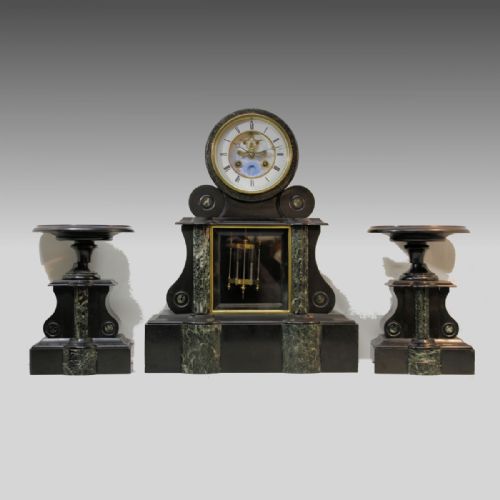
The versions most commonly met on this page combine Victorian styles with French Empire influences, spanning decades from eighteen-fifty to eighteen-ninety. They range from architectural models of fire surrounds originating in Caernarfonshire to large clock garnitures housing eight-day movements.
Makers such as Baby and Jannings appear in the records alongside French workshops, showing that these heavy stone pieces served both domestic heating and precision timekeeping roles. The selection leans heavily toward Victorian Classical and Neoclassical designs executed in dark stone.
Materials and construction methods
Craftsmen utilised dense black slate and quarried Welsh slate, often cutting the heavy stone into classical architectural proportions for fireplace surrounds and clock housings. These dark stone surfaces frequently incorporated contrasting marble inlay, brass mounts, and enamel details to break the monotony of the dark ground.
Makers integrated mechanical movements into stone housings, combining heavy masonry with glass dials and brass bezels. Ebonised wood and painted finishes also appeared alongside the raw stone, reflecting the Victorian taste for mixed media within a single decorative object.
Listings feature Victorian pieces from eighteen-fifty to eighteen-ninety, combining Welsh slate, black slate, marble, and brass.
Assessing quality in stone pieces
The division between standard and superior pieces rests on the precision of the stonecutting and the complexity of the marble inlay. Finer examples display crisp architectural mouldings, well-executed classical revival motifs, and integrated ornamental garnitures rather than plain block construction.
Movement quality separates basic timepieces from superior examples, with eight-day movements and specialist complications like penny moon dials indicating higher workshop standards. The depth of the engraving and the integration of brass and enamel elements further distinguish better examples.
Baby and Jannings
The Antique Slate Mantelpiece Glossary
- Welsh Slate
- A fine-grained metamorphic rock quarried in Wales, prized for its durability and uniform dark appearance in Victorian architectural pieces.
- Garniture
- A set of decorative matching ornaments, typically comprising a central clock and flanking side vases or urns designed for a mantelpiece.
- Marble Inlay
- Pieces of contrasting coloured marble fitted flush into a slate or stone ground to create geometric or classical patterns.
- Eight-Day Movement
- A clock mechanism that requires winding only once every eight days, standard in better quality nineteenth-century timepieces.
- Neoclassical
- A revival style drawing on classical Greek and Roman architecture, marked by symmetry, columns, and restrained geometric ornament.
Antique Slate Mantelpiece: Frequently Asked Questions
How heavy is a slate mantelpiece?
These pieces are made from dense stone and heavy slate, making them remarkably solid and weighty objects. They require secure placement on sturdy structural surfaces.
Because of their substantial mass, installation demands careful handling and adequate support beneath the mantel shelf or clock base.
How do I clean slate and marble?
Maintenance requires only a soft, dry cloth to remove dust from the carved surfaces and intricate mouldings. Avoid harsh chemical cleaners that can damage the polish of the stone.
Water should be used sparingly, and abrasive pads must be kept away from inlaid marble and enamel dial surrounds to preserve the original finish.
Are these clocks difficult to maintain?
Victorian movements generally require professional servicing to ensure the eight-day mechanism keeps accurate time. Regular oiling and adjustment keep the internal gears functioning smoothly.
When placed on a stable slate base, the movement remains secure, though professional setup helps prevent wear on the escapement.
What period do these items date from?
The available pieces originate primarily in the nineteenth century, spanning from eighteen-fifty through to eighteen-ninety. Victorian design dominates the selection, encompassing both British stone masonry and French import styles.
Stylistic shifts reflect changing tastes from strict classical revival forms towards more ornate garniture sets by the end of the century.