

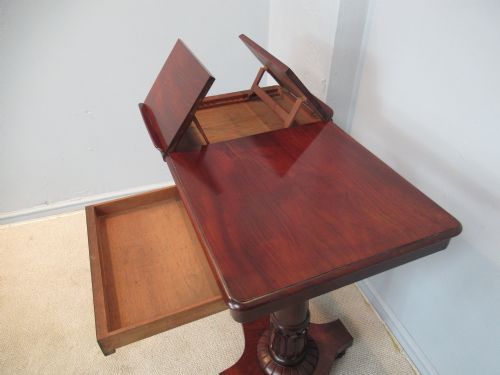


Antique Ratcheted Desk
These antique ratcheted desk pieces offer adjustable reading surfaces and surfaces for drafting, pairing mechanical movement with period timbers.
Antique Ratcheted Desk
An antique ratcheted desk provides an adjustable slope for reading, writing, and drafting through a mechanical ratcheting support underneath the surface. You will regularly encounter reading tables, architects' desks, and music stands within these listings.
The periods represented stretch across the Georgian, Regency, and Victorian eras, alongside mid-nineteenth-century examples. Forms range from occasional tables with reading stands to double-sided library tables and military desks.
Origin points span English workshops of the late eighteenth and nineteenth centuries, alongside Dutch marquetry examples. Makers such as Gillows appear among the pieces, utilising high-grade timbers.
Materials and construction methods
Cabinet makers built these pieces primarily using solid and veneered mahogany, supplemented by walnut, rosewood, fruitwood, and occasional boxwood stringing. Brass fittings and ratchets provide the adjustable mechanism, while leather inserts frequently line the writing and reading surfaces.
Joinery techniques combine traditional carcase construction with internal metal ratchets, folding brackets, and screw-adjustments designed to alter the height and angle of the board. Marquetry inlay appears on Dutch examples, utilising contrasting woods to create pictorial designs across the top.
Antique Ratcheted Desk Retail Price Guide 2026
Typical asking prices for ratcheted desk among the pieces listed under this phrase on Sellingantiques today, from the lower quarter to the upper quarter. They describe what is for sale here now, not the wider market.
Several pieces include hidden compartments and clever folding ledges to keep stray inkwells from sliding off mid-draft.
What separates the finer examples
Quality rests upon the precision of the ratcheted mechanism and the smoothness of its adjustment. Finer pieces retain original brass ratchets, Bramah locks, and signed makers' marks that demonstrate high workshop standards.
The selection of timber, such as Cuban mahogany or figured rosewood, dictates the visual weight and grain pattern of the piece. Superior examples maintain intact leather surfaces, tight joints, and balanced proportions across both single and double-sided forms.
Gillows·Marsh and Tatham
The Antique Ratcheted Desk Glossary
- Ratchet
- A mechanism comprising a toothed wheel and catch that allows linear or rotational motion in only one direction. In these desks, it secures the reading slope at various angles.
- Architect's table
- A specialised form featuring an adjustable top raised on a ratcheted strut to facilitate drawing and drafting. These often include pull-out candle slides or drawers.
- Estate rent table
- A circular or polygonal table with multiple drawers, frequently fitted with a revolving top, used for collecting rents and managing estate paperwork.
- Secretaire
- A writing cabinet or desk containing a drop-front writing surface and internal pigeonholes or small drawers. Some incorporate ratcheted reading stands within the upper section.
- Marquetry
- Inlaid woodwork where pieces of coloured wood, shell, or ivory are fitted into a veneer to form decorative patterns. This technique appears on Dutch Baroque and later continental pieces.
Antique Ratcheted Desk: Frequently Asked Questions
How do you adjust the desk height?
Adjustment relies on an internal brass or metal ratchet mechanism beneath the surface, which engages with a notched bar to hold the board at the desired angle.
Lifting the reading slope past its maximum point disengages the catch, allowing the board to return flat before selecting a new position.
Were these used for reading or writing?
These pieces served multiple functions depending on the specific form, accommodating large folios, architectural drawings, and everyday correspondence.
Many examples combine a flat writing area with a pivoting or ratcheted central section for books and manuscripts.
How do I care for the leather top?
Leather surfaces require gentle cleaning with a slightly damp cloth followed by a suitable leather balsam to maintain flexibility.
Avoid excessive moisture and harsh chemical cleaners to prevent cracking and staining on antique bookbinder's leather.
How do I identify a Regency period piece?
Regency pieces typically display classical restraint, clean lines, and dark timbers such as mahogany or rosewood, often accented with brass inlay.
Construction details, proportions, and the specific design of the brass ratchets help distinguish these early nineteenth-century examples from later Victorian reproductions.