


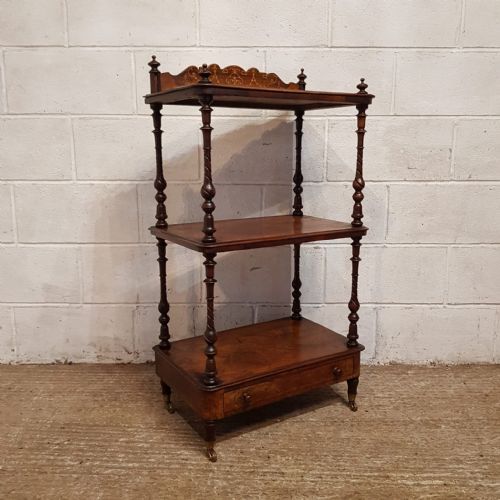


Antique Marquetry Whatnot
An antique marquetry whatnot brings layered display tiers and intricate wood inlays into a room, offering a practical stage for small treasures.
Antique Marquetry Whatnot
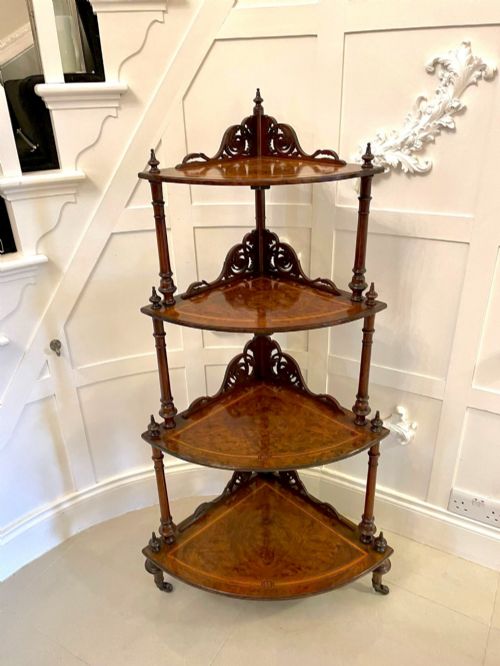
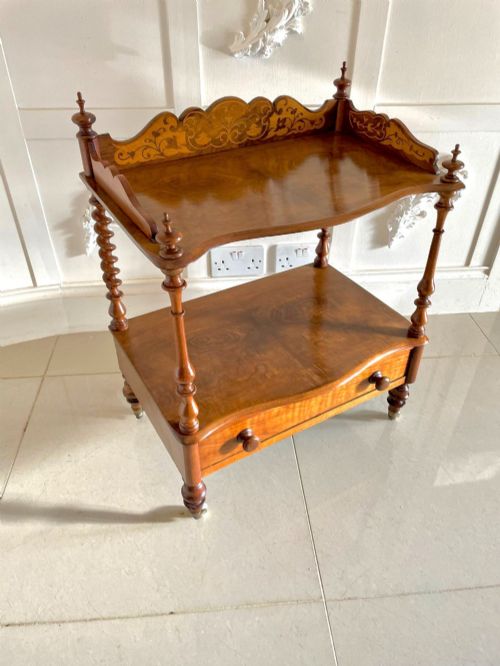
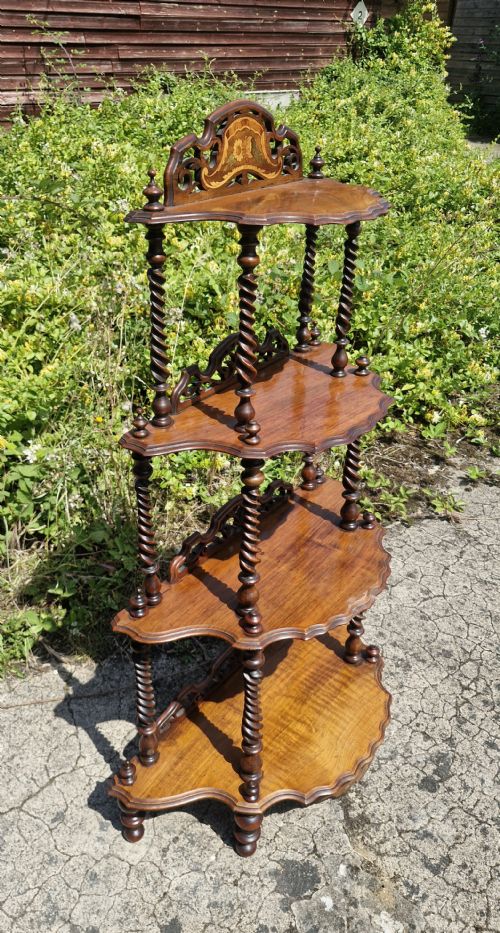
When you search for an antique marquetry whatnot, you are looking at tiered display furniture designed to hold books, ornaments, or small collections across multiple levels. These pieces range from open three-tier stands to refined corner designs and pieces fitted with enclosed jewellery cabinets or desks.
The versions you are most likely to meet on this page hail primarily from the Victorian and Edwardian eras, spanning the mid nineteenth century into the early twentieth century. Walnut and burr walnut dominate the forms, frequently enriched with boxwood inlay, brass mounts, and ebonised details.
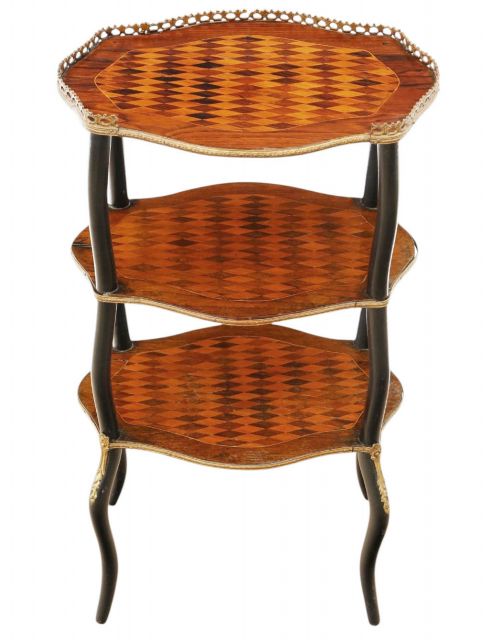
Makers of the period drew heavily on French styles, producing French Revival, Louis XV, and Napoleon III interpretations alongside traditional English freestanding and corner configurations. The structure relies on slender turned supports or columns holding up graduated shelves that create an airy silhouette against a wall.
How they were made
Cabinet makers utilised figured timbers such as burr walnut and mahogany as the foundational canvas for these tiered stands. These choice veneers provided rich natural grain patterns that framed the decorative elements placed upon the surfaces.
Marquetry and parquetry inlays, often executed in boxwood, were meticulously cut and fitted directly into the timber to form floral or geometric motifs. Ormolu mounts and brass gallery rails were then added to accent the edges and corners of the shelves.
Ebonised wood accents and turned spindle supports were employed to define the vertical framework and provide structural contrast to the warm brown tones of the walnut body.
Antique Marquetry Whatnot Retail Price Guide 2026
Typical asking prices for marquetry whatnot among the pieces listed under this phrase on Sellingantiques today, from the lower quarter to the upper quarter. They describe what is for sale here now, not the wider market.
Current selections span the Victorian and Edwardian eras, featuring walnut, mahogany, and ormolu alongside specialised forms like the davenport whatnot.
What varies in quality
The calibre of an antique marquetry whatnot rests upon the crispness of the wood inlays and the selection of the underlying timber. Stronger examples feature deeply figured burr walnut and cleanly articulated floral marquetry that remains flush with the surrounding surface.
Structural harmony also separates the finer items from standard production, visible in the balance of the tiered shelves and the delicacy of the turned or fluted supports. Richness of colour and the integration of quality cast ormolu mounts rather than plain metal further elevate a piece within the range.
The Antique Marquetry Whatnot Glossary
- Whatnot
- An open set of tiered shelves designed for displaying ornaments or holding books. It evolved during the eighteenth century and remained popular through the Victorian period in both freestanding and corner formats.
- Marquetry
- The art of applying small pieces of veneer to a structure to form decorative patterns or pictures. Craftsmen used contrasting woods to achieve tonal depth.
- Burr walnut
- Timber taken from the growth excrescence of a walnut tree, prized for its swirling, highly figured grain patterns. It provided a luxurious surface for high-end Victorian furniture.
- Ormolu
- Gilded bronze ornamentation applied to furniture mounts, feet, and galleries. It added a bright metallic contrast to dark cabinet woods during revival periods.
- Etagere
- A French term for a piece of furniture consisting of a set of open shelves for displaying small objects. The form is functionally synonymous with the English whatnot.
- Parquetry
- Geometric mosaic woodwork used for floors or furniture surfaces. It relies on regular repeating shapes rather than the pictorial designs of marquetry.
Antique Marquetry Whatnot: Frequently Asked Questions
What is a whatnot used for?
These tiered stands were originally designed to hold small decorative objects, porcelain, and books within a drawing room or parlour. Their multiple levels allowed collectors to display diverse items without cluttering main tabletops.
Today, they serve much the same purpose in modern interiors, fitting neatly into corners or against walls to hold plants, lamps, or personal collections.
What wood are most whatnots made from?
Walnut and burr walnut are the predominant timbers found across these tiers, often accented with lighter boxwood inlay. Mahogany also appears alongside ebonised wood finishes that imitate more expensive ebony.
Cabinet makers selected these woods for their ability to take a fine polish and to provide a strong contrast for intricate marquetry panels.
How do I care for an antique whatnot?
Keep the wood conditioned with a quality wax polish applied sparingly and buffed gently with a soft cloth. Avoid placing the piece in direct sunlight or near heat sources to prevent the delicate walnut veneers and boxwood inlays from drying out.
Ensure that heavier items are kept on the lower, sturdier shelves while lighter decorative pieces occupy the upper tiers.