




Antique Green Bracelet
An antique green bracelet brings together rich gemstones and historic metalwork, offering a distinctive wrist adornment for daily wear.
Antique Green Bracelet
When you search for an antique green bracelet, you find wrist adornments spanning from the late nineteenth century through the Art Deco period, defined by green hues. These pieces appear in forms ranging from gemstone settings to colourful metalwork.
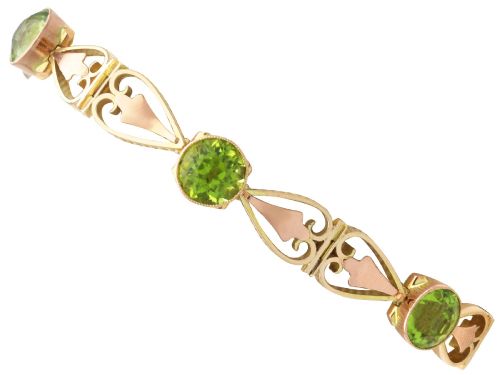
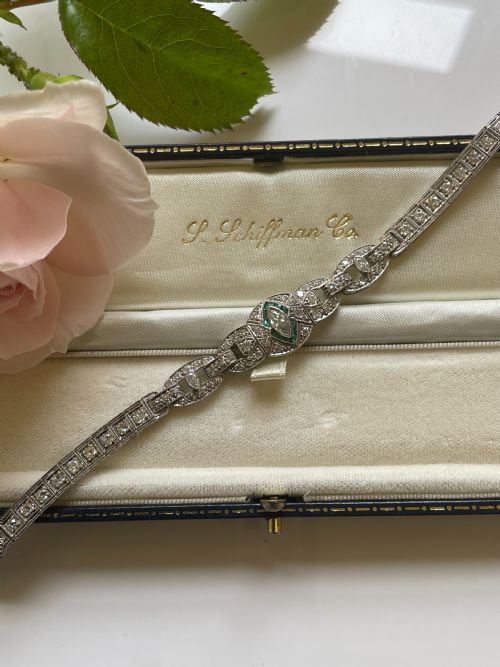
The most common examples on this page are Edwardian and Art Deco designs, particularly silver and enamel creations alongside gold pieces set with peridot, emerald, or zircon. These range from delicate Edwardian drop motifs to geometric Art Deco links.
Origins include Victorian, Edwardian, and Art Deco periods, drawing on stylistic movements such as Arts and Crafts, Jugendstil, and Art Nouveau. Each piece reflects the aesthetic priorities of its decade, whether botanical curves or industrial geometry.
How they were made
Metals form the structural framework, utilising yellow gold in 9ct and 15ct, alongside 18ct gold, solid silver, platinum, and chromium. These metals are shaped into links, bezels, and prongs to support the gemstones and enamelled surfaces.
Green colouration is achieved through natural stones including peridot, emerald, chrysoberyl, natural green zircon, and pearls, paired with vitreous enamel and guilloche enamel. Gemstones are cut in cushion and other period shapes to catch the light.
Techniques combine traditional hand fabrication with early twentieth-century industrial methods, particularly visible in chromium and enamel pieces. Enamel is fused to metal bases, while precious stones are secured in precious metal settings.
Antique Green Bracelet Retail Price Guide 2026
Typical asking prices for green bracelet among the pieces listed under this phrase on Sellingantiques today, from the lower quarter to the upper quarter. They describe what is for sale here now, not the wider market.
Jakob Bengel turned industrial watch chain machinery into sleek Art Deco chrome masterpieces that accidentally mirrored modernist architecture.
What varies in quality
The choice of materials dictates the baseline of quality, separating solid precious metals and fine gemstones from base metal and enamel iterations. Platinum and high-carat gold demand greater skill in manipulation than chromium or standard silver.
Execution of detail separates workshop output from mass production, evident in the crispness of guilloche enamel patterns and the precision of stone setting. Hand-finished components show subtle variations that distinguish individual maker craftsmanship.
Jakob Bengel·Murrle Bennett·Fahrner and Bennett
The Antique Green Bracelet Glossary
- Guilloche enamel
- A decorative technique where a precise geometric pattern is mechanically engraved beneath a translucent layer of coloured enamel. This method creates depth and shimmering light reflection across the metal surface.
- Peridot
- A yellowish-green silicate mineral used widely in Edwardian and Art Nouveau jewellery. Its characteristic olive hue provides a distinct alternative to emerald.
- Jugendstil
- The German variant of Art Nouveau, flourishing around nineteen hundred. It emphasises stylised organic forms and flowing lines in metalwork and enamel.
- Chromium
- A hard, corrosion-resistant transition metal utilised in Art Deco manufacturing. It provided a bright, modern finish for affordable twentieth-century jewellery.
Antique Green Bracelet: Frequently Asked Questions
How do I clean an antique green bracelet?
Clean precious metal and gemstone bracelets gently with warm soapy water and a soft brush, avoiding harsh chemical dips. Enamel pieces require particular care to protect the glass surface from moisture damage.
Dry thoroughly with a lint-free cloth before storing. Professional inspection helps ensure stone settings remain secure.
Can I wear an antique green bracelet daily?
Sturdier metal and gemstone designs suit regular wear with sensible precautions against impact. Delicate enamel or pearl pieces benefit from reserved use to preserve their fragile surfaces.
Removing jewellery during vigorous physical activity prevents unnecessary strain on old clasps and links.
How do I distinguish Art Deco from Edwardian bracelets?
Art Deco bracelets favour geometric symmetry, chromium, and calibrated emeralds set in platinum. They reflect a modern, industrial aesthetic.
Edwardian pieces lean towards delicate filigree, flowing lines, and soft peridots or pearls in yellow gold. They reflect a lighter, romantic sensibility.
What metals are typical in these bracelets?
Yellow gold appears in nine, fifteen, and eighteen carat purities, alongside solid silver and platinum. Twentieth-century pieces frequently employ chromium.
Each metal reflects the prevailing fashion and technological capabilities of its respective decade.