




Antique Foliate Pendant
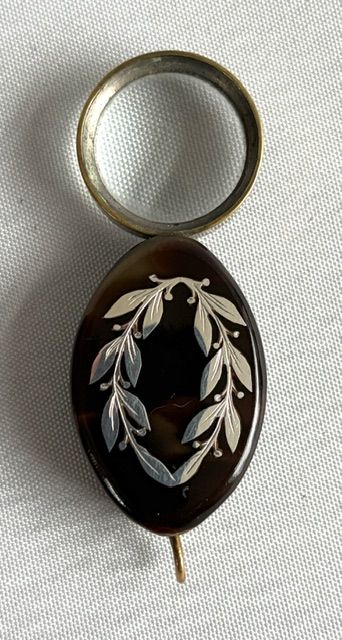
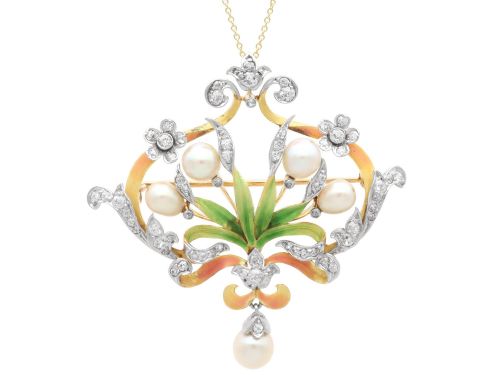
These antique foliate pendant pieces capture natural leaf motifs in gold and silver, offering a wearable piece of garden design from past centuries.
Antique Foliate Pendant
When you search for an antique foliate pendant, you encounter jewellery that draws upon leaf and plant forms for its outline and decoration. The pieces you meet on this page span the Victorian, Edwardian, and Arts and Crafts periods, shifting from ornate enamel work to hand-wrought silver set with moonstones and opals.
Most examples combine precious metals with stones such as amethyst, garnet, pearl, or turquoise, often fashioned as drops or lavalier necklaces. You also find convertible pieces that function as both pendants and brooches, reflecting the versatile dressing habits of the late nineteenth and early twentieth centuries.
How they were made
Maker workshops relied on yellow, rose, and white gold alongside silver to shape delicate botanical stems and curling foliage. Stones were hand-set into collet or claw mounts, frequently accompanied by seed pearls and coloured enamel highlights.
The Arts and Crafts examples show hand-beaten silver surfaces paired with cabochon stones like chrysoprase and opal, prioritising artisan construction over factory uniformity. Victorian and Edwardian items often utilised delicate filigree and engraving to give depth and texture to the metal leaves.
Antique Foliate Pendant Retail Price Guide 2026
Typical asking prices for foliate pendant among the pieces listed under this phrase on Sellingantiques today, from the lower quarter to the upper quarter. They describe what is for sale here now, not the wider market.
Some Victorian pendants double as secret mourning compartments, hiding a lock of hair behind the leaves.
What varies in quality
Quality rests upon the crispness of the metal chasing and the precision with which the foliage wraps around the central stones. Finer workshops invested time in hand-engraving individual leaf veins and securing delicate seed pearls without excess adhesive.
The distinction between standard commercial output and superior design lies in authorship and stone matching. Signed pieces from established guilds or makers command greater attention because their proportions and stone selections exhibit a cohesive artistic vision.
The Gaskins·WH Haseler for Liberty and Co·Liberty and Co·Dorrie Nossiter·Hamilton and Co·Artificers Guild
The Antique Foliate Pendant Glossary
- Foliate
- Decorated with leaf or plant motifs. This style draws inspiration directly from natural flora.
- Lavalier
- A pendant featuring a suspended drop stone below the main setting. This drop design gained popularity during the Edwardian era.
- Cabochon
- A gemstone shaped and polished with a smooth convex surface rather than faceted. This cut suits stones like opal, turquoise, and garnet.
- Seed pearl
- A very small natural or saltwater pearl used extensively in clusters. These tiny pearls were drilled and threaded onto fine silk or wire.
- Filigree
- Delicate ornamental work made from fine gold or silver wire twisted into open patterns. Artisans soldered these threads together to create lace-like metal backgrounds.
Antique Foliate Pendant: Frequently Asked Questions
What is an antique foliate pendant?
An antique foliate pendant is a piece of jewellery shaped like leaves and vines, typically produced during the Victorian, Edwardian, or Arts and Crafts eras.
These ornaments often incorporate gemstones such as amethyst, opal, or pearl alongside gold or silver settings.
How do I wear an antique pendant?
You can suspend these pendants from fine gold or silver chains to sit at the collarbone or lower chest depending on the length. Many Victorian examples also feature hinged pins, allowing you to wear them interchangeably as brooches.
Pairing them with simple necklines ensures the intricate metalwork and leaf motifs remain the focal point of your outfit.
How do I tell Victorian from Edwardian pendants?
Victorian pieces tend to use heavier yellow or rose gold, often featuring dark enamel, star motifs, or mourning elements with rich colour saturation. They feel substantial and reflect the romantic or sentimental tastes of the nineteenth century.
Edwardian designs shift towards lighter platinum, silver, and yellow gold combinations, favouring pastel stones like aquamarine, pink tourmaline, and seed pearls in airier, garland-style settings.
Were these pendants part of matching sets?
Many pendants originated alongside matching earrings, chains, or fitted presentation boxes from the original retailer. Some were also designed to convert between brooches and pendants to suit different daytime and evening garments.
Original fitted boxes often bear the name of the jeweller or retailer, providing helpful context about the piece's retail history.