

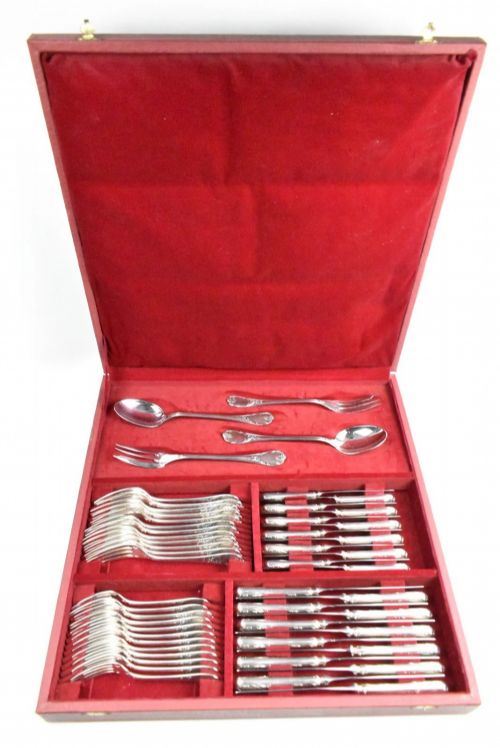


Antique Flatware Piece
These antique flatware piece examples span grand canteens and single caddy spoons, offering tactile silver and plated service for every table.
Antique Flatware Piece
When you search for an antique flatware piece, you encounter everything from single tea caddy spoons to extensive canteens numbering over one hundred items. The selection ranges through the Victorian, Edwardian, and Art Deco eras, alongside nineteenth-century Georgian and Balkan examples.
You are most likely to meet silver-plated cutlery sets housed in fitted cases, or sterling silver christening sets and individual serving spoons. Forms vary from simple bone-handled knives to elaborate settings in the Queens and Faneuil patterns, encompassing both formal dining services and specialised tea wares.
How they were made
Maker construction relies heavily on sterling silver and silver plate, shaped into robust forms intended for daily household use or formal dining. Many sets integrate contrasting materials such as wood, silk, velvet, and leatherette within their fitted presentation canteens and boxes.
Handles introduce further diversity, utilising natural bone alongside precious metals stamped with distinctive stylistic motifs. These fabrication methods combine durability with decorative restraint, reflecting the prevailing aesthetic movements of each respective decade.
Antique Flatware Piece Retail Price Guide 2026
Typical asking prices for flatware piece among the pieces listed under this phrase on Sellingantiques today, from the lower quarter to the upper quarter. They describe what is for sale here now, not the wider market.
Balkan nineteenth-century dining implements arrive with bone handles ready for mutton.
What varies in quality
Distinction across the range lies in the completeness of the service and the integrity of the original fitted case. Larger settings maintain greater uniformity when retained as a complete ensemble rather than assembled piecemeal.
The refinement of the decorative style - whether restrained Georgian lines, intricate Rococo Revival scrollwork, or geometric Art Deco patterns - dictates the visual weight and craftsmanship of each individual utensil.
Christofle Marly·Tiffany Sterling Silver·George Unite
The Antique Flatware Piece Glossary
- Canteen
- A fitted box or chest designed to store a complete set of cutlery securely. These cases often feature multiple tiers lined in silk or velvet.
- Christening set
- A small, specialised grouping of tableware, typically comprising a knife, fork, and spoon, presented as a traditional gift for an infant. They frequently appear in Victorian sterling silver.
- Caddy spoon
- A short-handled spoon specifically designed for measuring loose tea leaves from a caddy. Georgian and Victorian examples often feature ornate shell or floral bowls.
- Queens pattern
- A decorative nineteenth-century silverware motif characterised by shell and scroll borders. This formal design recurs across Victorian knives and forks.
- Silver plate
- A base metal foundation coated with a layer of pure silver. This technique provided an accessible alternative to solid sterling silver for large dining services.
Antique Flatware Piece: Frequently Asked Questions
How do I store a large cutlery canteen?
Large canteens require dry, temperature-controlled environments to protect both the metal utensils and the internal fabric linings. Keeping pieces enclosed in their fitted cases prevents tarnishing from airborne sulphur.
Silk and velvet interiors help cushion the silver and keep individual items separated. Proper placement within the designated slots avoids scratching the polished surfaces.
Are caddy spoons used only for tea?
Caddy spoons were originally created to scoop loose tea leaves from storage caddies into pots. Their compact bowls and short handles suited the narrow openings of period containers.
Collectors today appreciate them as standalone decorative silver objects. Their diverse bowl shapes reflect distinct nineteenth-century silversmithing trends.
How do I identify Art Deco flatware?
Art Deco flatware displays geometric lines, stylized motifs, and streamlined forms characteristic of the interwar period. The style moves away from heavy nineteenth-century ornamentation toward modern symmetry.
Sets from this era, such as those from the nineteen-thirties, often feature clean handle profiles. Makers utilised these crisp patterns to modernize formal dining settings.