


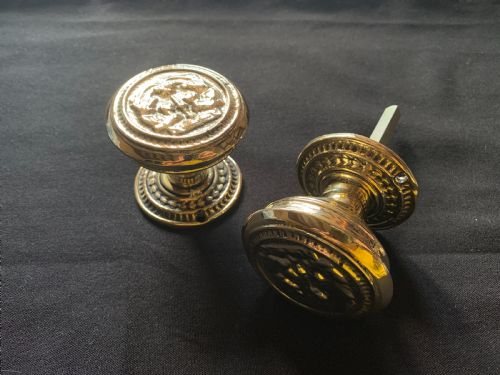


Antique Door Knobs
Antique door knobs carry the weight of past centuries quite literally in the hand, offering daily tactile contact with Georgian, Regency, and Victorian craftsmanship.
Antique Door Knobs
When you search for antique door knobs, you encounter functional hardware that transformed domestic interiors across the Georgian, Regency, and Victorian periods. These pieces range from simple utilitarian designs to decorative centre door knobs intended to make an immediate impression in a hallway.
The most common versions on this page are brass and bronze pairs alongside single centre pulls suited for heavier doors. You will also find rarer variants incorporating materials like oak, ebony wood, and amber glass within Victorian and Edwardian contexts.
Materials and construction
Metalworking dominates the evidence, with solid brass, bronze, steel, and iron forming the primary structural components for both backplates and turning mechanisms. These metals were cast and shaped into distinctive geometric profiles such as octagonal, ovular, and beehive forms.
Organic and composite materials appear frequently alongside metal work, utilising dense timbers like oak and ebony, or moulded glass. Artisans combined these textures to create tactile contrast, pairing turned wooden grips with brass mountings during the nineteenth century.
Antique Door Knobs Retail Price Guide 2026
Typical asking prices for door knobs among the pieces listed under this phrase on Sellingantiques today, from the lower quarter to the upper quarter. They describe what is for sale here now, not the wider market.
Materials represented across the hardware include brass, bronze, steel, iron, oak, ebony, and amber glass.
Distinguishing quality
Subtlety of casting and weight separate substantial hardware from lighter alternatives. Heavier brass and bronze examples demonstrate density and durability that survive centuries of daily rotation.
The precision of geometric turning, particularly on beehive and octagonal designs, indicates the maker's hand. Crisp definition in Arts and Crafts or Art Nouveau detailing elevates certain pairs above standard production.
The Antique Door Knobs Glossary
- Centre door knob
- A stationary pull mounted in the middle of a front door rather than operated as a latch. These are typically larger and heavier than standard door hardware.
- Beehive knob
- A turning style defined by concentric stepped rings resembling a traditional skep. This profile provides a secure, tactile grip characteristic of the Victorian era.
- Finger plate
- A protective metal sheet mounted behind the handle to prevent fingerprints and wear on the paint or wood. They frequently accompany matching knobs in Arts and Crafts sets.
- Door hardware
- The collective term for functional metal fixtures attached to portals, including locks, plates, pulls, and latches. These elements define the period character of an interior doorway.
Antique Door Knobs: Frequently Asked Questions
How do I date an antique door knob?
Dating relies heavily on the prevailing style, material combinations, and manufacturing marks visible on the hardware. Georgian and Regency pieces favour clean geometric brass, while Victorian examples introduce complex textures like beehive turnings and ebony woods.
Later Edwardian and Art Nouveau designs shift towards lighter profiles or organic floral motifs. Cross-referencing the screw types and backplate shapes provides further chronological clarity.
Can I fit antique knobs to modern doors?
Many vintage door knobs can be adapted to contemporary doors with careful measurement of the spindle and latch mechanisms. Older square spindles sometimes require sleeves or conversion bars to match modern lock bodies.
Consider the thickness of your door and the backset distance before installation. Consulting a knowledgeable ironmonger ensures the antique mechanism functions smoothly without damaging the original metal.
What is a centre door knob used for?
Centre door knobs serve as a fixed pull and architectural focal point on main entrance doors rather than operating a latch. Visitors used them to push or pull heavy exterior panels when entering or leaving.
They are traditionally positioned at eye level in the middle of the door leaf. This placement balances the visual symmetry of the entrance.
How should I clean brass door hardware?
Cleaning antique brass requires gentle methods to preserve the accumulated patina developed over decades of use. Mild soap, warm water, and a soft cloth remove surface dirt without stripping the historic finish.
Avoid harsh chemical polishes that strip away age-related character. Regular dusting keeps the metal protected and maintains its natural appearance.