


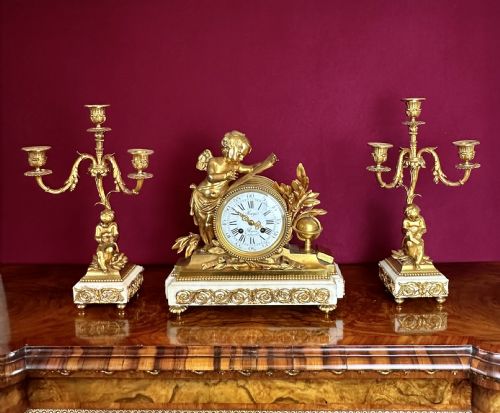


Antique Desk Set Piece
These antique desk set piece examples bring heavy metals, marble, and hand-painted porcelain to your writing table with undeniable presence.
Antique Desk Set Piece
When you search for an antique desk set piece, you are looking at substantial writing accessories and multi-component ensembles that anchor a formal study or library. These objects include multi-piece desk sets, clock garnitures, and mantle clock sets produced across the eighteenth, nineteenth, and early twentieth centuries.
You are most likely to meet French and English creations on this page, spanning the Victorian and Edwardian eras alongside earlier manifestations. The materials deployed range from cast brass and ormolu to white marble, porcelain, and coromandel wood.
The forms vary from simple matching inkstands and blotters to grand three-piece clock sets flanked by candelabras or side ornaments. Each piece served a functional or decorative purpose in a period interior, combining utility with heavy sculptural weight.
How they were made
Metal components rely on traditional foundry methods, utilising cast bronze, gilt bronze, ormolu, and brass to form ornate frames and mounts. These metallic structures often feature chased surface details executed by hand.
Non-metallic elements incorporate carved white marble, polished coromandel wood, and inset porcelain panels that are frequently hand-painted with floral or figurative scenes. Agate cabochons and enamel details provide colourful punctuation across the metalwork.
Makers assembled these multi-part ensembles by securing the decorative mounts to stone or wood bases with threaded pins and screws. The construction prioritises heavy, durable materials designed to withstand daily use on a writing desk or mantelpiece.
Antique Desk Set Piece Retail Price Guide 2026
Typical asking prices for desk set piece among the pieces listed under this phrase on Sellingantiques today, from the lower quarter to the upper quarter. They describe what is for sale here now, not the wider market.
Materials appearing across current pieces include white marble, coromandel wood, porcelain, and gilt bronze.
What varies in quality
Quality rests upon the crispness of the metal casting and the depth of the subsequent chasing or gilding. Superior examples display sharp relief work where every leaf and scroll is individually defined rather than smoothed by mass production.
The selection of materials creates a clear hierarchy, with dense marbles, genuine coromandel wood, and finely painted porcelain inserts commanding greater attention than plain brass or lesser stones. The integration of hardstones like agate cabochons elevates the ambition of the piece.
Maker attribution and structural completeness also govern value, as intact multi-piece sets by known workshops retain their original harmony. The weight and gauge of the metal used in the frames indicate the maker's willingness to invest in substantial materials.
Marson & Jones·Ferdinand Berthoud·Japy Freres
The Antique Desk Set Piece Glossary
- Ormolu
- Gilded bronze produced through a mercury amalgamation process that leaves a durable, rich golden surface. It is characteristic of fine French decorative objects from the eighteenth and nineteenth centuries.
- Clock garniture
- A set comprising a central mantel clock accompanied by matching side ornaments such as urns, vases, or candelabras. These sets were designed to create a symmetrical display on a mantelpiece or cabinet top.
- Coromandel
- A dense, dark timber imported from Southeast Asia, prized for its contrasting figure and rich colour. It provides a luxurious dark foundation for brass and ormolu mounts on nineteenth-century writing equipment.
- Cabochon
- A gemstone or hardstone shaped and polished rather than faceted. In desk accessories, agates and similar stones are cut in this rounded form to accent metal frames.
- Gilt bronze
- Metal cast in bronze and subsequently covered with a thin layer of gold leaf or gold wash. It provides the lustrous metallic finish seen across many nineteenth-century French sets.
Antique Desk Set Piece: Frequently Asked Questions
What is included in a desk set piece?
A desk set piece often forms part of a larger ensemble of matching writing accessories, such as inkwells, blotters, and pen trays. Some listings include larger garnitures that combine timepieces with matching side pieces.
These items were manufactured to create a unified aesthetic across a desk or writing table, utilising matching metals, stones, and decorative motifs.
How do I date an antique desk set?
Dating relies on the stylistic cues of the period, ranging from Louis XVI neoclassical restraint to ornate Victorian and Belle Epoque revivals. Materials like coromandel wood and specific metal alloys also point to distinct decades.
Maker marks stamped onto the bronze or clock movements provide the most reliable chronological anchor, linking the object to known working dates.
Were these pieces used daily?
Many items served practical functions in nineteenth-century studies, holding ink, blotting wet ink, and telling the time during long hours of correspondence. Their heavy construction in marble and bronze ensured they remained stable during active use.
Over time, many transitioned from working desk tools into purely decorative objects displayed in formal rooms.
How should I clean marble and ormolu?
Marble requires gentle wiping with a soft, damp cloth to avoid scratching the polished stone surface or driving moisture into unsealed pores. Harsh chemical cleaners strip the protective patinas from the stone.
Ormolu mounts should be dusted dry with a soft brush, avoiding metal polishes that can wear away the thin gold surface layer.