


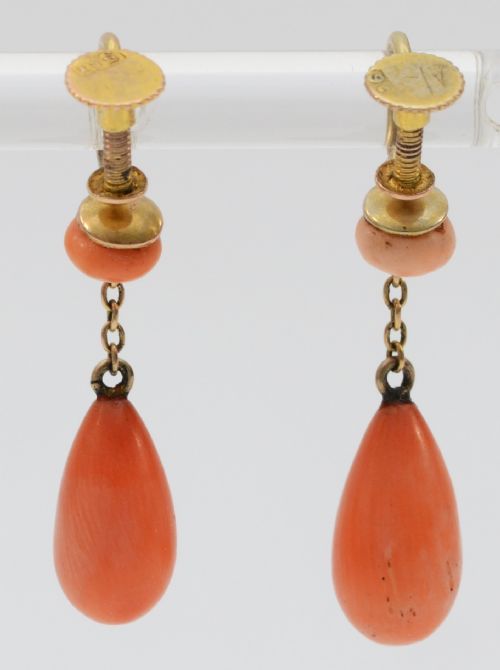


Antique Coral Bead Jewellery
Antique coral bead jewellery brings rich natural warmth to the skin, spanning simple single strands to heavy Dutch provincial necklaces.
Antique Coral Bead Jewellery
Antique coral bead jewellery encompasses necklaces, bracelets, earrings, pendants, and bangles sourced from periods including the Georgian era, Victorian times, and the mid-twentieth century. Buyers exploring antique coral bead jewellery encounter everything from delicate single strands to long, dramatic ropes and substantial natural branch pieces.
The selections available here rely heavily on Victorian craftsmanship alongside pieces from the nineteen-twenties, thirties, forties, and fifties. Common configurations pair the coral beads with complementary materials such as pearls, seed pearls, turquoise, and various gold or silver clasps.
How they were made
Makers shaped Mediterranean red, pink, and salmon coral into graduated beads, round beads, and natural rod or stick branches, often stringing them securely onto silk thread. Goldsmiths and silversmiths completed these pieces with custom clasps in nine-carat gold, fourteen-carat gold, fifteen-carat gold, gilt metal, or silver.
Artisans incorporated intricate details such as floral cameos, oval enamelled clasps, and seed pearl clusters alongside the coral elements. These construction methods ensure the durability of the beads while highlighting the organic variations of the material.
Strand lengths vary widely, from tight nineteen-inch chokers to dramatic ropes measuring over sixty inches long.
What varies in quality
Quality rests upon the natural colour saturation of the coral, ranging from pale pink to deep Mediterranean red, and whether the material remains entirely un-dyed. Graduation symmetry and bead uniformity further separate standard items from exceptional examples.
The sophistication of the metalwork, including enamelled clasps, gold purity from nine to fifteen carats, and the inclusion of accents like pearls and turquoise, elevates the overall standing of a piece.
The Antique Coral Bead Jewellery Glossary
- Coral
- A marine organic material formed by polyps, utilised extensively in antique jewellery for its distinct red, pink, and salmon hues. It is traditionally carved or polished into beads and branches.
- Seed Pearl
- Very small, naturally occurring or cultured pearls often used to accent or frame coral beads in Victorian and Georgian designs. They add delicate texture and a soft lustre.
- Graduated Bead
- Beads that steadily increase in size from the clasp towards the centre of a necklace. This traditional technique creates a balanced, elegant drape around the neck.
- Natural Rod Stick Branch
- Uncut or minimally shaped pieces of coral that retain their original organic branch formation. These create dramatic, tactile lengths of jewellery.
Antique Coral Bead Jewellery: Frequently Asked Questions
How do I care for antique coral bead jewellery?
Coral is an organic gemstone that is relatively soft and sensitive to acids, cosmetics, and harsh chemicals. Wipe the beads gently with a soft, damp cloth after wearing and store them separately from harder gems.
Avoid submerging strung pieces in water, as moisture can weaken silk thread over time. Regular professional restringing ensures long pieces remain secure during regular use.
How can I tell natural coral from dyed substitutes?
Natural coral typically exhibits subtle growth patterns, slight colour variations, and tiny surface pits visible under magnification. Uniform colour throughout without any natural striations often points towards dyed alternatives or synthetic materials.
Un-dyed red coral displays organic depth that does not rub off or fade with gentle cleaning. Examining the drill holes can also reveal the genuine porous structure beneath the polished surface.
What periods do these pieces come from?
The pieces span multiple historical eras, beginning with Georgian designs and continuing through the Victorian period. You will also find Edwardian, Art Deco, and mid-century examples up to the nineteen-fifties.
Victorian items frequently incorporate rich gold settings and sentimental details like floral cameos. Later twentieth-century pieces often favour clean, striking lines or heavier bead counts.
Are these pieces made from Mediterranean coral?
Many items feature Mediterranean red or pink coral, prized historically for its vibrant and consistent tone. Listings also note un-dyed red varieties and salmon coral.
The geographic origin often influences the shade and density of the coral material. Artisans matched these specific tones with appropriate yellow gold or silver mounts.