

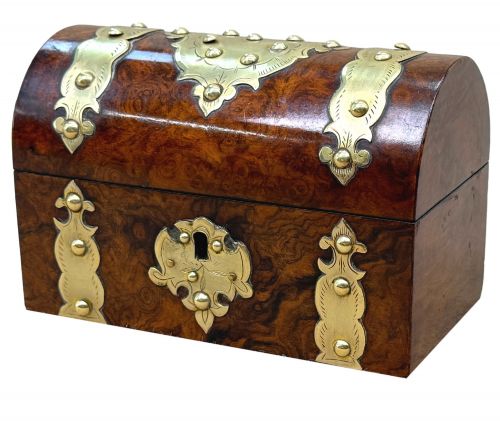


Antique Brass Stationary
These antique brass stationary items are handsome desk accessories and boxes that organise correspondence with period craft.
Antique Brass Stationary
When you search for antique brass stationary, you encounter desk boxes, cabinets, and caskets designed to hold letters and writing materials. These pieces emerge chiefly from the nineteenth century and the Victorian era, reflecting a period when correspondence demanded dedicated desk furniture.
The most common examples on this page are stationary boxes and cabinets constructed from dense timbers and mounted with brass. Alongside these traditional desk boxes, the listings include occasional writing slopes and stationary steam engine models.
Makers housed correspondence in forms ranging from dome-topped caskets to substantial walnut cabinets fitted with internal compartments. Each piece serves as a tactile link to nineteenth-century desk organisation.
How they were made
Cabinet makers built the structural carcasses of these boxes from timbers such as mahogany, walnut, burr walnut, and coromandel wood. They selected these dense woods for their rich grain patterns before housing them in protective housings.
Brass formed the hinges, mounts, locks, and binding straps that reinforced the wooden carcasses and added decorative contrast. Master craftsmen combined these two principal materials to create durable containers that withstood daily desk use.
Antique Brass Stationary Retail Price Guide 2026
Typical asking prices for brass stationary among the pieces listed under this phrase on Sellingantiques today, from the lower quarter to the upper quarter. They describe what is for sale here now, not the wider market.
Victorian letter writers relied on secret compartments within these boxes to keep private notes away from prying eyes.
What varies in quality
Quality in these items rests on the selection of decorative veneers and the precision of the metal mounts. Pieces featuring figured burr walnut or coromandel wood sit at the upper end of the scale.
Makers who incorporated specialised details like Pietra Dura panels or secret drawers achieved a higher standard of production. The integration of solid brass hinges and robust locks further distinguishes finer workshop output.
Houghton and Gunn·George Austin of Dublin·C.G. Hope Hastings
The Antique Brass Stationary Glossary
- Stationery box
- A desk accessory designed specifically to hold writing paper, envelopes, and correspondence. These containers usually feature tiered internal partitions for organisation.
- Coromandel
- A dense, heavy wood imported from Asia, valued for its dark brown colour and striking contrasting grain. It appears frequently on high-status Victorian desk boxes.
- Pietra Dura
- An artistic technique using cut and fitted polished coloured stones to create pictorial designs. It decorates the lids of select nineteenth-century boxes.
- Gothic Revival
- An architectural and decorative style popular during the Victorian period, characterised by pointed arches and medieval motifs. This style heavily influenced desk box design.
- Writing slope
- A portable desk with a slanted writing surface that opens to reveal storage for pens, ink, and paper. These pieces often share materials with stationary boxes.
Antique Brass Stationary: Frequently Asked Questions
What is an antique stationary box?
An antique stationary box is a small desk container built during the nineteenth century to store writing paper and envelopes neatly.
These pieces typically feature hinged lids and fitted wooden interiors designed to keep correspondence organised on a desk.
What is Victorian Gothic Revival style?
Victorian Gothic Revival is a design movement that drew inspiration from medieval architecture and decorative arts.
Stationary boxes in this style often incorporate architectural motifs, pointed lines, and robust brass hardware.
Where did people keep writing slopes?
People kept writing slopes on library tables, desks, or specialised stands within nineteenth-century homes.
These portable boxes allowed individuals to write letters in different rooms before folding the slope shut to conceal their writing materials.