


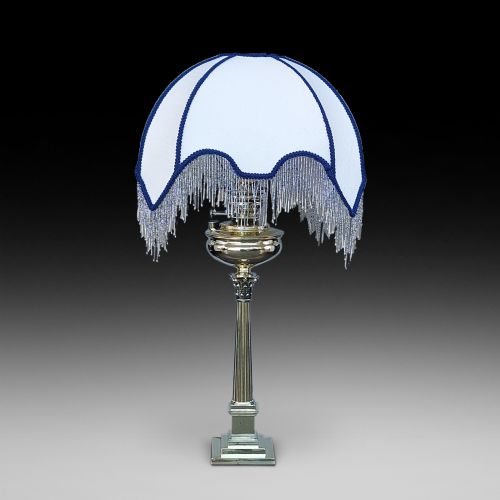


Antique Bead Fringe Lamp
An antique bead fringe lamp brings tactile textile texture and warm filtered light to a room, which is precisely why these pieces remain so sought after.
Antique Bead Fringe Lamp
When you search for an antique bead fringe lamp, you encounter an array of lighting fixtures that combine metal bases with soft textile shades trimmed in hanging glass beads. These objects span from the late nineteenth century through the 1920s, encompassing styles such as Victorian, Art Nouveau, and Art Deco.
The most common forms on this page include brass table lamps, French porcelain cherub lamps with beaded shades, and standard floor lamps. Makers and manufacturers utilised materials like silk, frosted glass, and fabric to build shades that rely on bead fringes to diffuse the light downwards.
Originating across various European and American workshops, these lamps incorporate classical columns, bronze figures, and gilded spelter into their foundational structures. A buyer finds both pairs of table lamps and individual reading or standard lamps, reflecting diverse domestic interiors of the past.
How they were made
Makers constructed the foundational bodies of these lamps from cast brass, bronze, silver plate, and gilded spelter, often employing classical motifs like the Corinthian column. Figures such as cherubs or vases were also cast and occasionally adapted from earlier statuettes.
Shades combined textile frames of silk and fabric with delicate glass beads strung along the lower edges to form the characteristic fringe. Frosted glass and porcelain elements frequently worked alongside these fabric shades to modulate the brightness of the bulb or oil flame.
Antique Bead Fringe Lamp Retail Price Guide 2026
Typical asking prices for bead fringe lamp among the pieces listed under this phrase on Sellingantiques today, from the lower quarter to the upper quarter. They describe what is for sale here now, not the wider market.
A mischievous bronze cherub once cast in the nineteenth century now moonlights as an electrified table lamp.
What varies in quality
Quality rests in the heaviness and fidelity of the metal casting, whether a solid brass Corinthian column or a detailed bronze figure. Superior examples display crisp chasing and robust structural integrity in the base.
The standard of the shade construction and the uniformity of the glass beads distinguish finer pieces from simpler ones. Intricate textile work and securely strung glass fringes elevate the overall execution of the fixture.
Georges Leleu
The Antique Bead Fringe Lamp Glossary
- Spelter
- A zinc alloy commonly used as a less expensive substitute for bronze in decorative metalwork. It was frequently painted or gilded to imitate more costly metals.
- Corinthian column
- A classical architectural order featuring an ornate capital decorated with acanthus leaves. It is a frequent design motif for nineteenth-century metal lamp shafts.
- Gilt toleware
- Painted tin or metalware treated with a gold-coloured finish. This technique appeared on decorative lamp components and shade mounts.
- Cabochon
- A polished, unfaceted gem or piece of glass with a convex top. These are embedded into metal lamp bodies for decorative effect.
- Torchere
- A tall stand or standard lamp designed to hold a light source high. Examples often take the form of vase standard lamps.
Antique Bead Fringe Lamp: Frequently Asked Questions
What is an antique bead fringe lamp?
These pieces are historical lighting fixtures featuring decorative bases made of materials like brass, bronze, or porcelain, paired with textile shades finished with hanging glass beads.
They were designed to provide soft, ambient illumination while serving as ornamental centrepieces in period rooms.
How were these lamps used originally?
They functioned as task or ambient lighting on tables, desks, and reading corners, or stood as floor lamps in parlours and drawing rooms.
Many started as oil lamps before being converted to electricity as domestic power supply expanded through the early twentieth century.
How do I date an antique bead fringe lamp?
Dating relies on identifying the stylistic markers of the base, such as Victorian neoclassical motifs, Art Nouveau organic lines, or Art Deco geometric forms.
Materials like brass columns point towards the late nineteenth century, while torchere vase standard lamps often date to the 1920s.
How do I live with an antique lamp?
Integrate them into contemporary spaces by placing them on side tables or desks where the bead fringe can cast patterned shadows and warm light.
Ensure the wiring meets modern safety standards while preserving the original structural components of the metal and shade.