




Amethyst Halo Ring
An amethyst halo ring gathers a central purple stone within a border of smaller gems, bringing colour and structure to the finger.
Amethyst Halo Ring
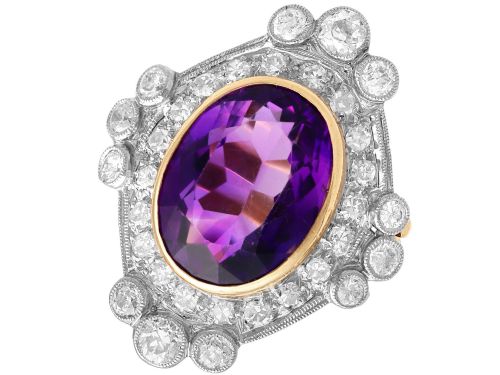
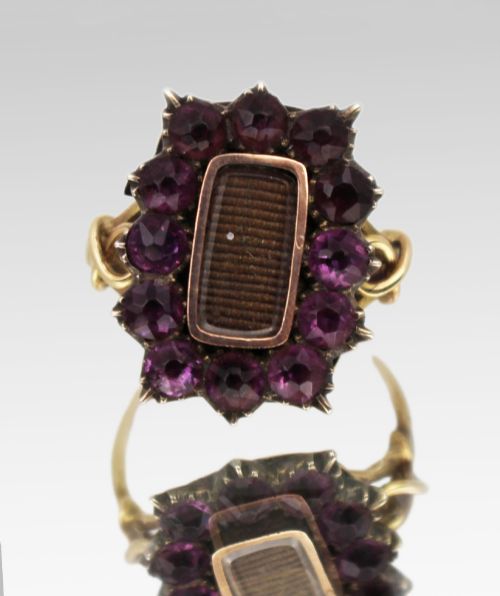
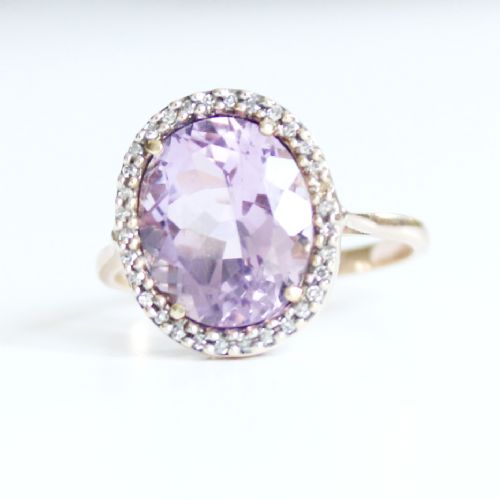
An amethyst halo ring is a piece of jewellery centring on a purple quartz stone enclosed by an outer border of contrasting gems. Buyers searching for an amethyst halo ring encounter designs spanning the Georgian, Victorian, Edwardian, and mid-century decades, reflecting shifting tastes in cluster settings.
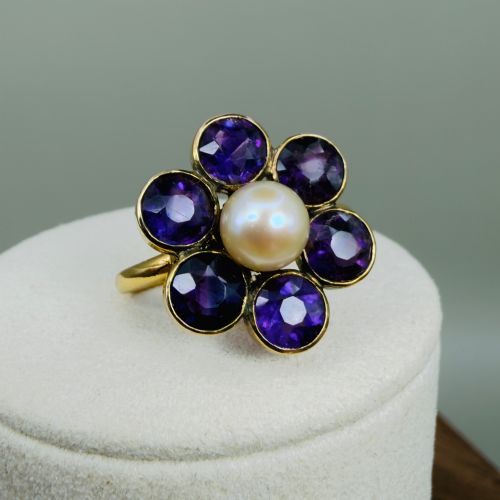
The most common versions on this page pair a central amethyst with a border of small seed pearls or sparkling diamonds. These pieces appear in configurations ranging from early nineteenth-century cluster mounts to 1930s platinum settings and later vintage dress rings.
Makers utilised various yellow, rose, and white gold alloys alongside silver to frame the purple stones. Whether sourced from the 1800s or the mid-twentieth century, each amethyst halo ring relies on the visual contrast between the central gemstone and its surrounding border.
Materials and construction
Goldsmiths constructed these rings using nine-carat and eighteen-carat yellow and rose gold, alongside platinum and silver mounts. Amethysts are secured centrally, often accompanied by diamonds or seed pearls set closely together to form the signature border.
Setting techniques varied by period, shifting from hand-beaded metalwork in Georgian and Victorian clusters to geometric platinum channels in later 1930s examples. Metal was worked around each stone by hand to secure both the main amethyst and the smaller surrounding gems.
Amethyst Halo Ring Retail Price Guide 2026
Typical asking prices for amethyst halo ring among the pieces listed under this phrase on Sellingantiques today, from the lower quarter to the upper quarter. They describe what is for sale here now, not the wider market.
Materials span nine-carat and eighteen-carat gold, rose gold, silver, and platinum in various cluster and dress ring forms.
Distinctions in quality
Quality rests on the saturation of the central amethyst and the matching uniformity of the surrounding diamonds or pearls. Finer rings display deep, even purple hues in the quartz paired with well-matched border stones that follow the contour of the central mount.
The skill of the metalwork defines the construction, with superior pieces showing precise stone placement and robust prongs or bezels. Heavier gold or platinum gauges in the shank indicate higher build quality, whereas lighter mounts reflect more modest production.
The Amethyst Halo Ring Glossary
- Halo ring
- A ring design featuring a central gemstone encircled by a concentric border of smaller stones. This arrangement emphasises the size and colour of the main gem.
- Cluster ring
- A jewellery configuration where multiple stones are grouped closely together rather than set singly. In these pieces, an amethyst forms the focal point of the cluster.
- Seed pearl
- A very small, naturally or cultured saltwater pearl used historically to form delicate borders. These pearls appear frequently in Victorian and Edwardian cluster settings.
- Emerald cut
- A rectangular gemstone cut with stepped facets and cropped corners. This cut allows light to reflect across the broad table of the amethyst.
- Georgian
- Pertaining to the period of British history spanning the reigns of the four Georges from 1714 to 1830. Jewellery from this era often employs closed-back settings and handcrafted gold mounts.
Amethyst Halo Ring: Frequently Asked Questions
What is an amethyst halo ring?
An amethyst halo ring is a finger ornament featuring a central purple quartz stone surrounded by a ring of smaller accent gems such as diamonds or pearls. This layout creates a distinct border that draws the eye directly to the central colour.
These rings appear across multiple historical periods, evolving from Georgian cluster designs into Edwardian and mid-century interpretations.
How do I date an antique ring?
Dating relies on observable characteristics including metal alloys, gemstone cuts, and construction techniques specific to eras like the Victorian or Edwardian periods. Hallmarks stamped inside the shank also provide official markers for British-made pieces.
Comparing the setting style with documented jewellery epochs helps narrow the decade of manufacture.
Are pearls durable in rings?
Seed pearls set into historical rings require gentle care because organic material is softer than mined gemstones and precious metals. Wearing them with mindfulness prevents undue friction and protects the delicate border.
Many surviving Victorian and Edwardian pearl-bordered rings retain their original elements when treated with appropriate respect.
What metals were used?
Jewellery makers utilised nine-carat and eighteen-carat gold, including distinct rose gold alloys, alongside silver and platinum. The choice of metal often shifts depending on the era of production.
Earlier pieces favour yellow and rose gold, while mid-century examples incorporate platinum and white metals to frame the stones.