
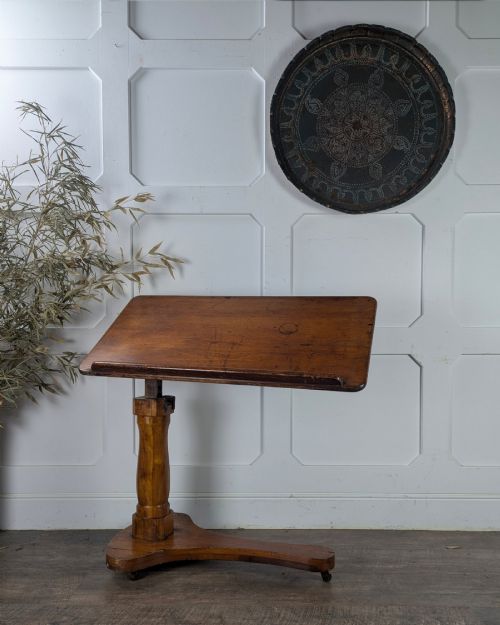
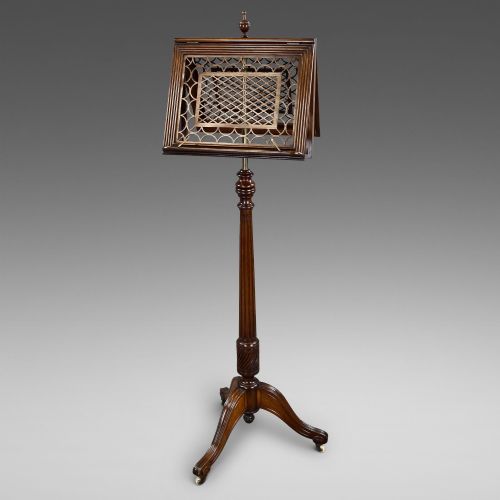
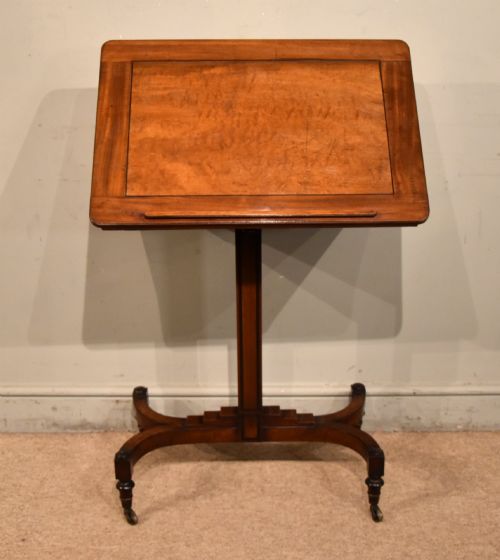
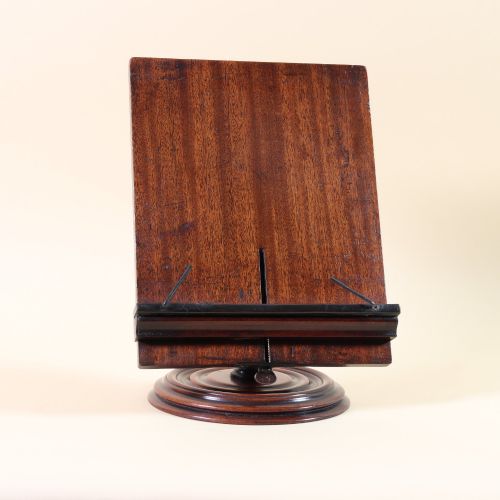


Adjustable Wooden Lectern
An adjustable wooden lectern supports a book or sheet music at a comfortable angle while bringing solid timber into a room.
Adjustable Wooden Lectern
When you search for an adjustable wooden lectern, you find stands designed for reading and music, spanning periods from the Georgian era to the early twentieth century. Most examples on this page are fashioned from mahogany or walnut, taking the form of music stands, desk-top book rests, and reading tables.
The selection ranges from simple folding book stands to elaborate duet stands supported on tripod bases or central columns. Regency and Victorian pieces dominate the listings, offering mechanical adjustment for height and slant.
Form follows function closely in these pieces, serving musicians, readers, and scholars who required a stable surface that could be altered to suit a seated or standing position.
Materials and construction
Cabinet makers utilised dense hardwoods such as mahogany, walnut, and oak to build these stands, often adding brass fittings for the ratchets and adjustable joints. Satinwood inlay and burr veneers appear on finer items, providing decorative contrast to the primary timber.
Joinery techniques include turned columns, carved tripod legs, and fretted music desks secured to pivoting mechanisms. Iron and cast metal feature in the structural hardware or bed-table adaptations, ensuring stability during adjustment.
Mahogany and walnut form the primary timbers across these listings, accompanied by brass hardware and iron mechanisms.
Assessing quality and execution
Quality rests in the precision of the mechanical adjustment and the selection of figured timber for the reading surface. Finely carved details on the column and base separate standard production from superior workshop output.
The integrity of the pivoting mechanism and the weight of the timber base dictate how steadily the stand holds heavy folios or music books at high angles.
The Adjustable Wooden Lectern Glossary
- Duet stand
- A wide music stand designed to accommodate two musicians reading from the same sheet. These often feature adjustable double desks.
- Tripod base
- A three-legged support structure commonly found on music stands and reading tables to ensure stability on uneven floors.
- Reading table
- A form of furniture incorporating an adjustable top for books or writing, frequently used beside chairs or beds.
- Fretted
- Woodwork pierced with decorative open patterns, often seen on the gallery or rest of a music stand.
Adjustable Wooden Lectern: Frequently Asked Questions
How do I adjust the height?
Most pieces utilise a brass screw mechanism, wooden peg, or sliding ratchet located on the central column. Turning or releasing this allows the reading desk to move vertically.
Once the desired height is reached, tightening the fitting secures the stem in place before use.
Were these made for music or reading?
They served both purposes depending on the workshop design and the presence of page retainers. Music stands often feature lyre-shaped supports and sheet ledges, while reading tables provide broader flat surfaces.
Many adjustable stands cross over between both functions, holding large folios, Bibles, or sheet music with equal ease.
How do I clean the wood?
Dust the timber regularly with a soft, dry cloth to prevent a buildup of grime on the carved details and turned columns. Avoid modern liquid polishes that leave silicone residue on antique finishes.
Apply a traditional beeswax sparingly when the wood appears dry, buffing it gently to maintain the natural sheen of the mahogany or walnut.
Can these hold heavy books?
The structural stability depends on the weight of the tripod base and the strength of the tightening screw. Heavy volumes sit securely if the centre of gravity remains balanced over the legs.
Adjustable mechanisms on nineteenth-century stands are robust, but extra care is required when extending tall columns to maximum height with heavy folios.