

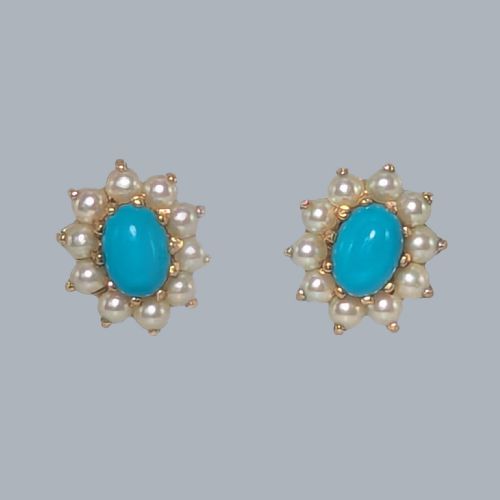


9ct Gold Blue Studs
These 9ct gold blue studs bring mid-century colour and compact form together, offering an everyday way to wear precious and semi-precious stones.
9ct Gold Blue Studs
These pieces are earrings designed to sit close to the lobe or drop slightly beneath it, combining nine-carat yellow or white gold with blue and turquoise stones. When buyers search for 9ct gold blue studs, they find vintage items spanning the 1920s to the 1960s, encompassing retro, mid-century modern, and classic fine jewellery styles.
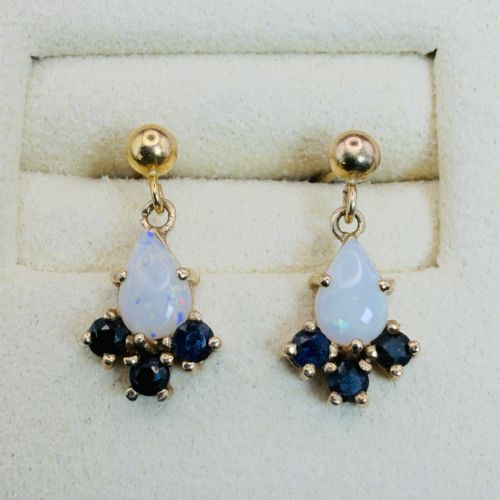
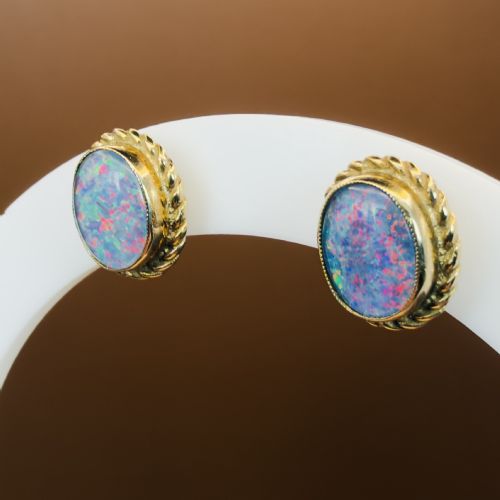
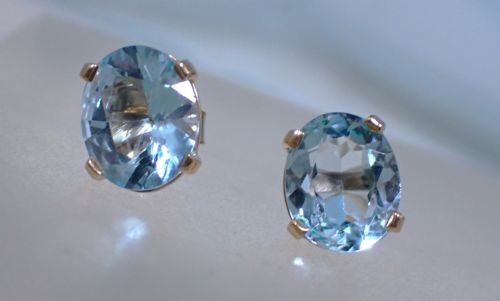
The selection on this page relies heavily on mid-century designs from the 1950s and 1960s, alongside earlier vintage examples from the 1920s. Forms range from simple cluster and solitaire cuts to pear-shaped, square, and oval aquamarine drops, turquoise clusters, and black opal doublets.
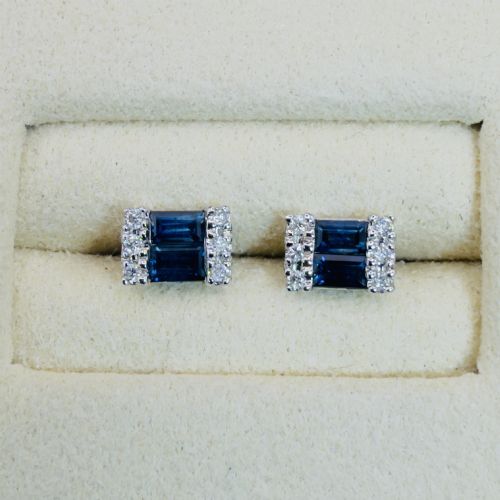
Earrings in this category utilise a variety of blue stones, notably aquamarine, blue topaz, sapphire, turquoise, blue zircon, and black opal doublets. Some examples incorporate split pearls and diamonds alongside the main blue gems to create contrast within the gold settings.
How they were made
The metalwork in these pieces employs nine-carat yellow or white gold, fashioned into settings that securely hold faceted and cut stones. Gemstones such as aquamarine, blue topaz, and sapphire appear in pear, square, and oval cuts, while turquoise and black opal doublets utilise smooth cabochon profiles.
Construction techniques include cluster arrangements, filigree metalwork, and drop configurations where stones hang beneath the main stud fitting. Hallmarks, such as those from London dated to 1965, indicate the assay practices and origin of the period.
Listings in this category span four decades, moving from the delicate filigree of the 1920s through the bold cluster forms of the 1950s to mid-century modern designs of 1960.
What varies in quality
The distinction between tiers of these earrings rests on the clarity and depth of colour in the stones, whether aquamarine, sapphire, or blue topaz. Superior examples display well-matched gems and precise faceting that maximises light return within the nine-carat gold setting.
Execution of the metalwork also separates pieces, visible in the fineness of filigree details, the symmetry of cluster arrangements, and the security of prong or bezel settings. Hallmarking provides an additional measure of origin and period integrity for pieces carrying official marks.
The 9ct Gold Blue Studs Glossary
- 9ct Gold
- An alloy of gold containing 37.5 percent pure gold, balanced with other metals to provide durability for everyday jewellery settings. It appears in both yellow and white varieties across these earrings.
- Aquamarine
- A pale blue to light greenish-blue variety of beryl, frequently cut in pear, square, or oval shapes for mid-century drop earrings. Its clarity defines its visual appeal.
- Doublet
- A composite gemstone consisting of a thin slice of precious stone, such as black opal, glued to a backing material to give the appearance of a solid, larger gem. This technique offered stability and volume.
- Cluster
- An arrangement of multiple smaller gemstones gathered tightly around a central stone or focal point, common in vintage sapphire and turquoise designs. This layout increases surface sparkle and colour impact.
- Filigree
- An ornate form of delicate metalwork made with twisted threads of gold soldered together in open patterns. It gives a lace-like texture to vintage settings.
9ct Gold Blue Studs: Frequently Asked Questions
How do I clean my 9ct gold blue studs?
Clean these earrings using warm water, mild washing-up liquid, and a very soft brush to remove dust from behind the stones. Avoid harsh chemical dips, especially when cleaning porous materials like turquoise or composite stones like doublets.
Dry them thoroughly with a lint-free cloth before storing them away from other items to prevent scratching the gold and softer gems.
Are these earrings suitable for daily wear?
Nine-carat gold provides a durable metal alloy that resists daily wear better than higher purity golds. However, care remains necessary depending on the specific stone set into the mounting.
Harder gems like sapphire and topaz tolerate regular use well, whereas turquoise and opal doublets require gentler treatment to avoid moisture damage or surface abrasion.
How can I tell a 1950s pair from a 1920s pair?
Pieces from the 1920s often lean towards delicate filigree and specific vintage cuts like blue zircon, reflecting art deco or transitional aesthetics. Items from the 1950s and 1960s frequently introduce bolder atomic or mid-century modern cluster shapes, aquamarine drops, and structured turquoise arrangements.
Examining the prong styles, gallery construction, and any accompanying hallmarks helps anchor the earrings to their specific decade.
What is the difference between an aquamarine and a blue topaz?
Aquamarine is a natural beryl mineral with a typically soft, icy blue or greenish-blue hue that occurs naturally. Blue topaz shares a similar bright blue appearance but is frequently treated to achieve its vivid saturation.
Under magnification, the internal characteristics and facet reflections differ between the two minerals.