
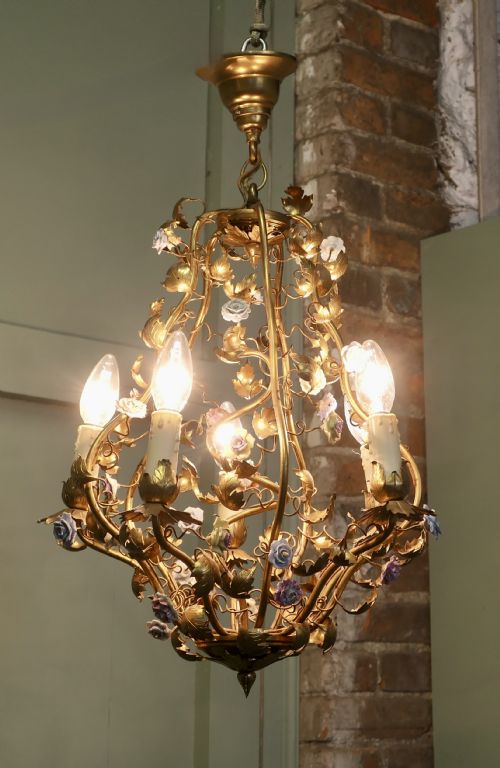

5 Light Floral Chandelier
A 5 light floral chandelier brings botanical form and illumination to a room, drawing the eye with metal leaves and ceramic blossoms.
5 Light Floral Chandelier
A 5 light floral chandelier combines branch-like metal framing with botanical motifs to illuminate interiors. These fixtures emerge across periods such as the Victorian era, the Edwardian years, and the 1920s and 1930s.
The pieces appearing here lean heavily toward French provincial and Italian Florentine workshops. Toleware interpretations featuring painted metal leaves and ceramic blooms dominate the selection.
Buyers encounter variations ranging from delicate wire frames with wired flowers to robust cast brass and gilt metal structures. Each example balances functional lighting with sculptural plant forms.
Materials and Construction
Craftsmen built these chandeliers using malleable metals including brass, wrought iron, and gilt metal to form the curving branches and stems. Toleware components, fashioned from painted tin, provided the colourful petals and leaves.
Ceramic and porcelain elements were shaped into individual flowers and opaque floral clusters, often paired with glass or crystal drops. Gilding and polychrome paint finished the surfaces to mimic natural flora.
Listings feature items spanning the Victorian era through the 1930s, constructed in brass, gilt metal, toleware, and ceramic.
Distinctions in Quality
Quality rests upon the delicacy of the botanical modelling and the hand-applied finish of the toleware and porcelain. Superior examples display finely sculpted petals and convincing leaf textures rather than heavy, generic stampings.
The integration of the five lights into the floral composition dictates the overall harmony of the piece. Masterful wiring concealment and substantial metal gauge separate standard production from finer decorative output.
The 5 Light Floral Chandelier Glossary
- Toleware
- Painted or enamelled sheet metalware utilised for decorative items, particularly popular in French lighting. It provides the brightly coloured leaves and petals found on botanical fixtures.
- Florentine
- A regional Italian style characterised by ornate gilt finishes, often incorporating carved wooden or metal scrollwork and leaf motifs. Pieces from this tradition emphasise rich surface gilding.
- Lustre
- A ornamental glass or porcelain pendant, sometimes hung in groups around a light source to refract illumination. They frequently accompany nineteenth-century chandeliers and wall sconces.
- Gilt metal
- Base metal treated with a thin layer of gold leaf or gold paint to simulate solid gold. It offers a reflective surface that catches the ambient glow of the bulbs.
5 Light Floral Chandelier: Frequently Asked Questions
What rooms suit a floral chandelier?
Dining rooms, bedrooms, and entrance halls provide ideal settings where the botanical forms can be viewed closely. The gentle scale of a five-light arrangement fits comfortably in spaces with standard ceiling heights.
Placing the fixture over a table or in the centre of a modest room creates a focal point. The metal leaves and ceramic flowers harmonize well with traditional and eclectic interior schemes.
How do I clean ceramic and metal flowers?
Dusting requires a soft, dry brush to remove particles from delicate petals without causing detachment. Moisture should be applied sparingly, using a slightly damp cloth only on robust metal surfaces.
Harsh chemical cleaners strip away original gilding and polychrome paint finishes. Gentle maintenance preserves the historical integrity of the painted toleware and porcelain.
Can I replace missing ceramic petals?
Sourcing matching replacement ceramic or toleware flowers demands patience within the antique market. Many collectors accept minor losses as part of an item's history rather than attempting modern restorations.
Specialist restorers can occasionally sculpt matching leaves, though matching the exact vintage patina remains difficult. Evaluating the completeness of the floral elements helps determine the condition of the piece.