


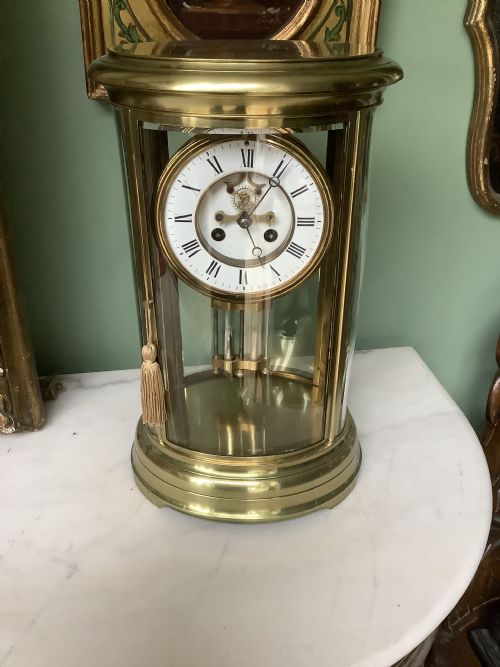
4 Glass Pendulum Clock
When you search for a 4 glass pendulum clock, you encounter precision timepieces housed within bevelled glass panels and brass or gilt bronze frames, designed to display the movement from every side.
4 Glass Pendulum Clock
A 4 glass pendulum clock is typically a mantel or bracket clock featuring glass panels on four sides, allowing an uninterrupted view of the intricate mechanical movement and suspended pendulum within. These timepieces originate predominantly from the nineteenth century, with French examples forming a significant portion of the available selection, alongside Victorian and Edwardian iterations.
The architectural cases range from rectangular gorge frames to oval and domed configurations, constructed to sit prominently on a mantelpiece or shelf. Alongside standard striking movements, variations include anniversary clocks with torsion pendulums and crystal regulators that emphasise transparency and mechanical display.
How they were made
Movements were engineered with precision, incorporating mercury-filled or compensated pendulums to maintain accurate timekeeping despite temperature fluctuations. The brass frameworks were frequently cast, chased, and gilded, while glass panels were individually cut and bevelled to fit the precise geometry of the case.
What varies in quality
The quality of a 4 glass pendulum clock is determined by the crispness of the cast brass or gilt bronze work and the clarity and thickness of the bevelled glass panels. Superior examples exhibit finely engraved dials, signed movements from established makers, and mercury-weighted or torsion pendulums that reflect higher standards of nineteenth-century horology.
Heavier case construction, well-integrated architectural mouldings, and intricate decorative details such as hand-painted enamel or visible escapements separate standard production pieces from finer workshop outputs.
Samuel Marti·Tiffany·AD Mougin·Jaeger-LeCoultre
The 4 Glass Pendulum Clock Glossary
- Bevelled glass
- Glass with edges cut at an angle to create a framed border effect. This technique adds depth and catches the light along the vertical corners of the case.
- Gilt bronze
- Bronze metal coated with a thin layer of gold. It provides a durable, lustrous surface finish common on nineteenth-century French clock cases.
- Mercury pendulum
- A pendulum utilising jars of liquid mercury to compensate for thermal expansion. It keeps the clock ticking accurately across changing seasonal temperatures.
- Torsion pendulum
- A suspended spring pendulum that rotates back and forth rather than swinging. This slow-moving mechanism is characteristic of annual or anniversary clocks.
- Crystal regulator
- A mantel clock with glass panels on all sides and a mercury or compensated pendulum. The style showcases the entire mechanical movement in operation.
4 Glass Pendulum Clock: Frequently Asked Questions
How do I wind a 4 glass pendulum clock?
Most of these clocks use a key inserted into holes on the enamel dial to tension the mainspring barrels. Care must be taken not to over-wind the movement.
Some models feature eight-day movements requiring weekly attention, while year-running torsion variations operate much longer between adjustments.
Why does the pendulum use mercury?
Mercury expands upward as temperatures rise, offsetting the downward expansion of the pendulum rod. This keeps the effective length constant.
In modern environments, these historic pendulums are appreciated for their traditional engineering and visual appeal.
Where should I place a 4 glass clock?
These clocks require a stable, level surface such as a heavy mantelpiece or dedicated shelf free from vibrations. Proper levelling ensures the pendulum swings evenly and the escapement ticks true.
Direct sunlight and damp environments should be avoided to protect the gilded brass and delicate enamel dials.
How do I identify the period of the clock?
Stylistic cues such as the heavy use of ormolu in Charles X designs or the sleek lines of later Edwardian cases help narrow the date. Maker stamps on the movement backplate provide definitive production eras.
Victorian and Belle Epoque examples often combine architectural brass framing with ornate dial details distinctive to the late nineteenth century.