

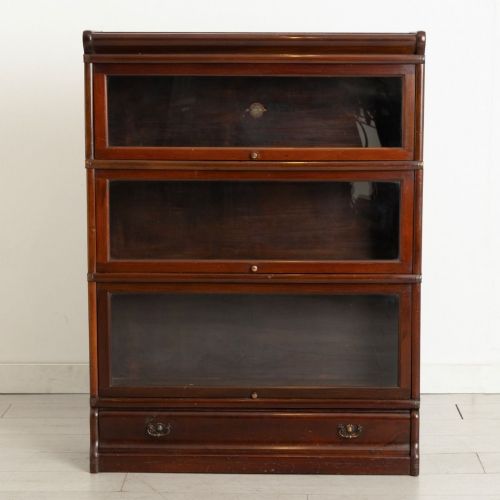
3 Tier Barrister Cabinet
These modular bookcases bring practical organisation and classic timber character to any study, offering flexible shelf space behind glazed rising doors.
3 Tier Barrister Cabinet
A 3 tier barrister cabinet is a sectional bookcase built from stacked modular units that share a common base and top cornice. Each individual tier encloses books behind a glazed door that lifts and slides into the cabinet above.
Most examples found here date from the Edwardian period through to the 1930s, reflecting a heavy reliance on modular office furniture during the early twentieth century. Makers constructed these units in standard heights to accommodate various book sizes while allowing owners to expand their libraries vertically.
Oak and mahogany dominate the selection, often appearing alongside walnut in both golden and deeper brown tones. The standard three tier format sits comfortably at desk height or lower wall levels, making it a manageable size for modern rooms.
How they were made
Cabinet makers utilised solid oak and mahogany alongside select veneers to construct the modular carcass frames. Brass fittings secure the internal mechanisms that guide the rising glass doors smoothly along their tracks.
Glazing takes the form of plain glass panels or leaded sections held within wooden frames. Individual tiers interlock securely without permanent fixings, allowing the cabinet to be disassembled into separate modular boxes for transport.
3 Tier Barrister Cabinet Retail Price Guide 2026
Typical asking prices for 3 tier barrister cabinet among the pieces listed under this phrase on Sellingantiques today, from the lower quarter to the upper quarter. They describe what is for sale here now, not the wider market.
Listings feature oak, mahogany, walnut, and leaded glass across Edwardian and Art Deco periods.
What varies in quality
Quality differences often show in the choice of timber and the precision of the modular joints. Finer pieces employ solid mahogany or figured oak throughout the carcass, whereas standard versions rely on simpler cuts of timber.
The sophistication of the hardware also dictates standard, with superior brass mechanisms ensuring the glazed doors glide without catching. Additionally, the presence of matching cornices and designated base drawers separates standard utility office furniture from refined domestic library pieces.
Globe Wernicke·Lebus·Gunn Furniture·AMYL·Warwick
The 3 Tier Barrister Cabinet Glossary
- Sectional bookcase
- A modular bookcase composed of separate stacked tiers that combine into a single tall cabinet. This design allows the entire assembly to grow as a library expands.
- Elastic bookcase
- An alternative period term for a stacking bookcase that can be expanded by adding further tiers. The system stretches upward to fit changing storage needs.
- Leaded glass
- Small panes of glass joined together by narrow strips of lead within a window or cabinet door. This technique creates geometric patterns across the front of the shelf tier.
- Cornice
- The decorative moulded projection that sits across the top of the cabinet. It finishes the uppermost tier and crowns the entire piece.
- Base drawer
- A lower storage compartment fitted beneath the bottom shelf tier. It provides extra space for small items separate from the main book sections.
3 Tier Barrister Cabinet: Frequently Asked Questions
What is a barrister bookcase?
A barrister bookcase is a specialised stacking cabinet designed with individual glass-fronted tiers that protect law books from dust while remaining portable.
The modular structure allowed lawyers to transport their working libraries easily between courts by separating the individual boxes.
Can I separate the tiers?
Yes, the individual tiers rest securely on one another using interlocking joints rather than permanent fixings. You can take the cabinet apart into separate modular boxes for moving or rearranging.
The top cornice and bottom base piece lift off independently from the shelf sections.
What periods do these cabinets span?
The available pieces originate primarily from the Edwardian era and the early twentieth century, spanning from nineteen hundred through to the nineteen thirties.
During this time, offices and homes widely adopted modular stacking furniture for its practical adaptability.