




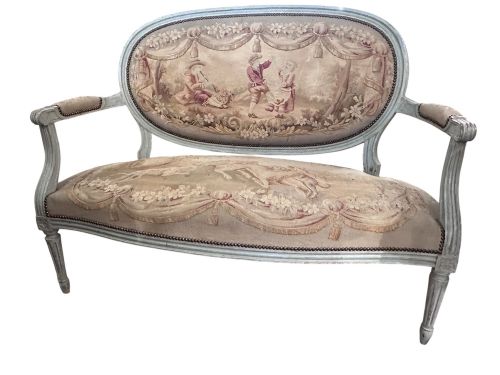

19th Century Parlor Settee
A 19th century parlor settee anchors a reception room with defined period form and rich upholstery.
19th Century Parlor Settee
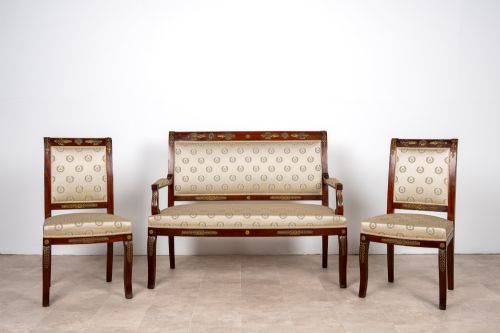
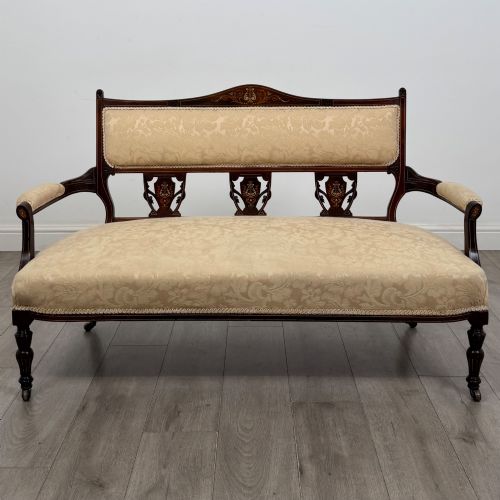
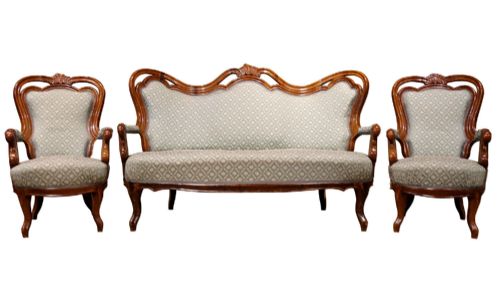
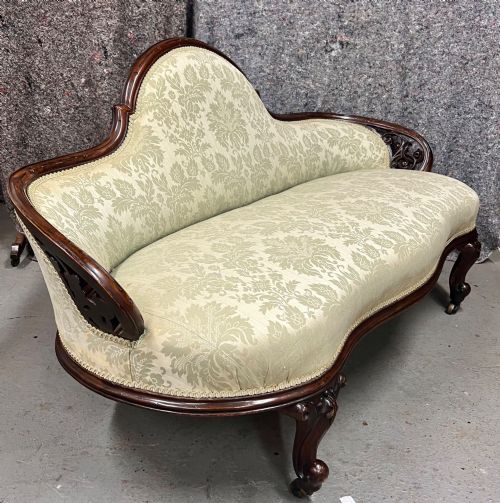
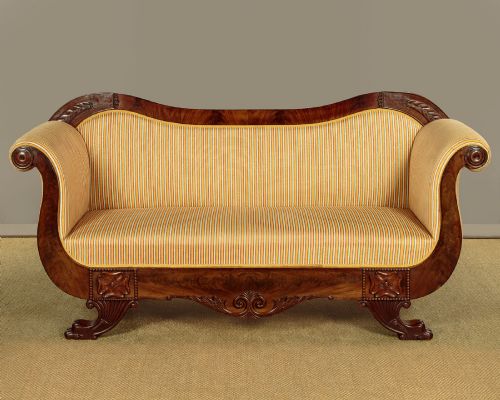
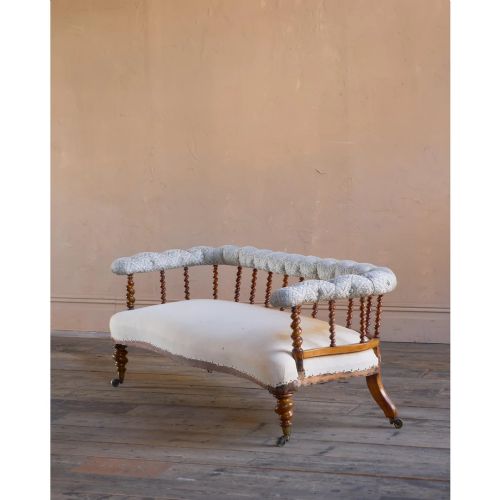
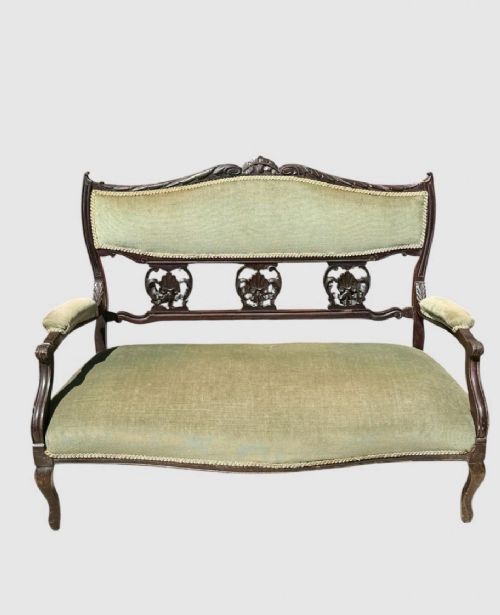
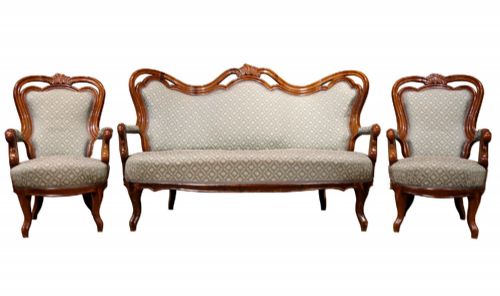
A 19th century parlor settee serves as formal seating, originating in periods from Regency to late Victorian. These pieces take forms such as compact two-seaters, double spoon back frames, scroll end couches, and larger multi-piece salon suites.
The material record spans centuries and stylistic revivals, capturing Rococo Revival, French Empire, Sheraton Revival, and Victorian Chinoiserie aesthetics. Buyers encounter everything from carved walnut and rosewood frames to giltwood and painted caned structures.
Most examples function as focal points in reception rooms or drawing rooms. They arrive either as standalone sofas or as part of larger matching salon and living room suites incorporating chairs.
How they were made
Cabinetmakers constructed the supportive frames using dense timbers including mahogany, walnut, rosewood, satinwood, and burr birch, often incorporating decorative brass accents and inlaid details. Structural elements rely on precise joinery to support elaborate carved woodwork like cameo backs and spindle structures.
Upholstered surfaces utilise traditional textiles, velvet, and fabric coverings, frequently styled with Aubusson tapestries. Frames incorporate detailed carving, gilding, or painted finishes depending on the specific regional workshop and stylistic influence.
19th Century Parlor Settee Retail Price Guide 2026
Typical asking prices for 19th century parlor settee among the pieces listed under this phrase on Sellingantiques today, from the lower quarter to the upper quarter. They describe what is for sale here now, not the wider market.
Some nineteenth century drawing rooms required seven separate matching seats just to ensure nobody had to stand.
What varies in quality
The refinement of the carved wooden frame dictates the distinction between standard production and master craftsmanship. Crisp detailing in scroll ends, applied inlays, and deep relief carving on walnut and rosewood elevate specific pieces.
Cohesion within larger salon suites and the preservation of original upholstery materials influence overall standing. Pieces featuring integrated design schemes across matching chairs and settees demonstrate higher design ambition.
C. Hindley & Sons
The 19th Century Parlor Settee Glossary
- Salon suite
- A matched set of seating comprising a settee and associated armchairs designed for formal reception rooms. These suites maintain uniform timber and decorative motifs.
- Spoon back
- An upholstered chair or settee back shaped in the concave contour of a spoon. This form appears frequently on Victorian seating.
- Scroll end
- A sofa arm or terminal curved outward in a spiral scroll shape. This profile characterises Regency and Empire designs.
- Caned
- Woven rattan or split cane panels utilised for seats or backs. This technique lightens the visual weight of formal frames.
19th Century Parlor Settee: Frequently Asked Questions
What distinguishes a settee from a standard sofa?
A 19th century parlor settee typically describes a lighter, more decorative form of upholstered seating designed for formal reception spaces. These pieces often feature exposed wooden frames and specific period revival styling.
Larger variations may form part of a coordinated salon suite alongside matching chairs. Their primary purpose involved formal entertaining rather than casual daily lounging.
How do I identify a Regency period piece?
Regency seating demonstrates classical influence through clean lines, scroll end arms, and architectural timber framing. These examples date from the early decades of the century.
Makers frequently utilised rosewood and mahogany, sometimes accented with brass inlay. The overall silhouette references French Empire and classical antiquity.
Where were these settees originally placed?
These furnishings occupied formal reception rooms, parlors, and drawing rooms of substantial homes. They provided seating for guests during afternoon calls and formal gatherings.
Matching salon suites ensured a unified decorative scheme throughout the reception space. Individual settees also served as statement accent seating against parlor walls.