
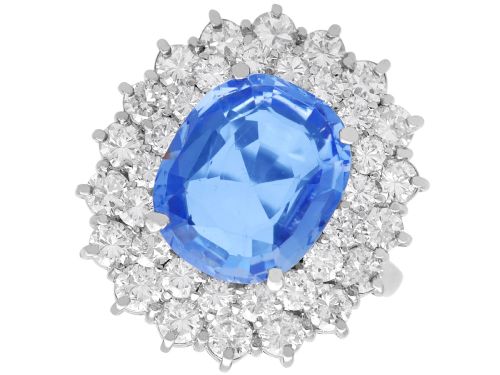


1960s Sapphire Engagement Ring
A 1960s sapphire engagement ring brings mid-century character and vivid colour to the hand, offering a distinctive alternative to modern diamond solitaires.
1960s Sapphire Engagement Ring
When you search for a 1960s sapphire engagement ring, you encounter jewels shaped by mid-century design, often drawing upon earlier aesthetics like Art Deco revival alongside contemporary modernism. The pieces available here span cluster, solitaire, and crossover forms, each anchoring a central blue or pink sapphire with surrounding diamonds.
The most common version you will meet on this page is the cluster ring, where a vibrant sapphire takes centre stage framed by brilliant or rose cut diamonds. These designs reflect the distinct tastes of the 1960s, favouring substantial centre stones and varied mountings in yellow gold, white gold, or platinum.
Materials and Construction
The construction of these rings relies on precious metals including platinum, 18ct white gold, and yellow gold to secure the gemstones. Settings frequently combine white gold or platinum for the metal claws and galleries to enhance the brightness of the diamonds while anchoring the sapphires.
Gemstone selection defines the era's output, pairing natural sapphires - including unheated Burmese and Ceylon origins - with old cut, rose cut, or standard diamonds. Stones are shaped into faceted cuts or smooth cabochons, reflecting the diverse lapidary techniques utilised during the mid-century period.
Listings on this site feature platinum, 18ct white gold, and yellow gold paired with natural sapphires and diamonds.
Distinctions in Quality
Quality in these rings rests upon the origin, clarity, and treatment status of the sapphire, with unheated stones originating from regions like Burma or Ceylon commanding particular attention. The depth of colour and natural saturation within the sapphire dictate visual presence.
The integration of the metalwork alongside the diamond accompaniment shapes the overall standard of the piece. Fine claw work, secure platinum settings, and well-matched diamond weights elevate the execution of mid-century cluster and crossover designs.
The 1960s Sapphire Engagement Ring Glossary
- Cluster ring
- A ring design featuring a prominent central gemstone surrounded by a border of smaller stones, typically diamonds encircling a sapphire.
- Cabochon
- A gemstone shaped and polished with a smooth, rounded convex surface rather than faceted edges.
- Crossover ring
- A style where the shank splits or two bands sweep past one another in a graceful curve, often holding paired stones.
- Unheated sapphire
- A natural gemstone that has undergone no thermal enhancement to improve its colour or clarity after being mined.
- Rose cut
- An antique diamond cut characterised by a flat base and a domed crown consisting of triangular facets that culminate in a point.
1960s Sapphire Engagement Ring: Frequently Asked Questions
What defines a 1960s sapphire engagement ring?
These rings embody mid-century design characteristics, frequently utilising cluster or crossover configurations that pair vibrant natural sapphires with diamond accents. The aesthetic bridges traditional craftsmanship with modern geometric styling.
Settings from this decade often employ white gold or platinum mountings to accentuate the cool tones of the stones while retaining the warmth of yellow gold bands.
How are different sapphire origins distinguished?
Origins such as Ceylon or Burma are noted for their specific saturation and crystalline qualities, often documented through geological testing. These regional traits influence the visual depth of the blue hue.
Natural stones show internal characteristics under magnification that separate them from synthetic alternatives produced in laboratories.
Are these rings suitable for daily wear?
Sapphire rates high on the hardness scale, making it a durable choice for a ring worn every day. Regular cleaning helps maintain the brilliance of the surrounding diamonds and metal.
Settings from the mid-century period are robust, though older claw settings benefit from periodic checks by a jeweller to ensure stone security.
What gold purity is common in this era?
Eighteen-carat gold and platinum are standard materials found in mid-century fine jewellery production. These precious metals provide the necessary structural integrity for secure stone setting.
White gold variants from the period often feature platinum settings to maintain a bright white backdrop for the diamond cluster.