

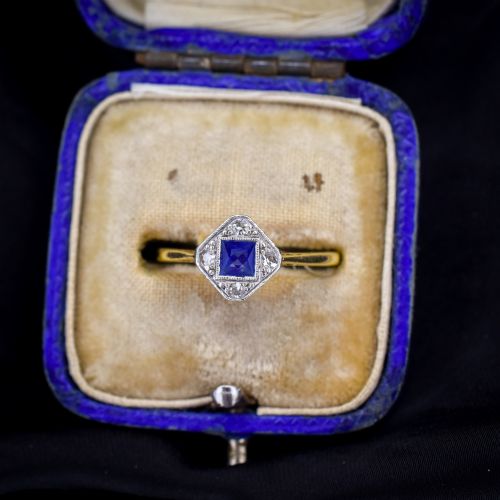


1930s Sapphire Target Ring
A 1930s sapphire target ring offers a striking concentric geometry of blue stones and diamonds that defines interwar jewellery design.
1930s Sapphire Target Ring
A 1930s sapphire target ring is characterised by a central sapphire encircled by a halo of diamonds, creating a bullseye pattern on the finger. The form belongs firmly to the Art Deco aesthetic, favouring geometric precision and high-contrast colour combinations over Victorian sentimentality.
Most examples found here date from the 1920s to the 1930s, reflecting the enduring popularity of cluster settings during those decades. Buyers will encounter both deep blue basaltic sapphires and Burmese stones, often paired with bright white diamonds to emphasise the concentric tiers.
How they were made
Goldsmiths constructed these rings using platinum, 18ct white gold, and 18ct yellow gold, sometimes combining metals to create a two-tone mount. Platinum was particularly favoured for its strength, allowing for delicate claw or millegrain settings that securely held the diamond halos without bulk.
1930s Sapphire Target Ring Retail Price Guide 2026
Typical asking prices for 1930s sapphire target ring among the pieces listed under this phrase on Sellingantiques today, from the lower quarter to the upper quarter. They describe what is for sale here now, not the wider market.
Some sapphires manage to look like deep ocean trenches while the diamonds sparkle like miniature headlights.
What varies in quality
The distinction between tiers of quality rests largely on the saturation and origin of the central sapphire, alongside the weight and clarity of the surrounding diamonds. Burmese stones and unheated gems command greater attention for their natural colour depth, whereas basaltic sapphires display a darker, inkier blue.
Proportion and symmetry dictate visual success in a target ring, where the concentric tiers must balance harmoniously without the central stone appearing lost or overwhelmed by the diamond border. Superior examples exhibit seamless integration between the millegrain work and the underlying metal structure.
The 1930s Sapphire Target Ring Glossary
- Target ring
- A concentric ring design featuring a central stone encircled by one or more geometric tiers of contrasting gemstones. This layout became a hallmark of interwar geometric jewellery.
- Basaltic sapphire
- A sapphire originating from alkali basalt terrains, typically characterised by a deep, saturated blue hue. These stones frequently appear in antique cluster settings.
- Millegrain
- A decorative technique involving a row of tiny raised metal beads along the edge of a setting. It introduces a soft texture that contrasts with sharp geometric lines.
- Cabochon
- A gemstone cut with a smooth, rounded convex top rather than faceted planes. This style highlights the natural colour and lustre of the sapphire.
- Cluster ring
- A ring featuring a central gemstone surrounded by a group of smaller stones. The configuration maximises overall brilliance and presence on the hand.
1930s Sapphire Target Ring: Frequently Asked Questions
What is a target ring?
A target ring is a cluster design where a central gemstone is encircled by concentric rings of smaller stones, creating a bullseye pattern.
This geometric arrangement gained immense popularity during the Art Deco period for its clean lines and striking visual impact.
How do I care for platinum settings?
Platinum is a remarkably durable and dense metal that withstands daily wear exceptionally well while securely holding precious stones in delicate claws.
Cleaning requires only warm soapy water and a soft brush to restore the brightness of the diamonds and sapphire without harming the metal.
Are these rings suitable for daily wear?
Sapphires and diamonds rate very high on the Mohs scale of hardness, making them resilient enough for regular use on the hand.
However, the intricate millegrain and fine platinum or gold settings benefit from occasional professional checks to ensure the stones remain secure.
How do I identify Art Deco style?
Art Deco jewellery is defined by strict symmetry, geometric motifs, and a strong emphasis on contrasting colours and clean structural forms.
These designs moved away from the flowing, organic lines of the preceding Edwardian and Art Nouveau eras in favour of modern architectural precision.