
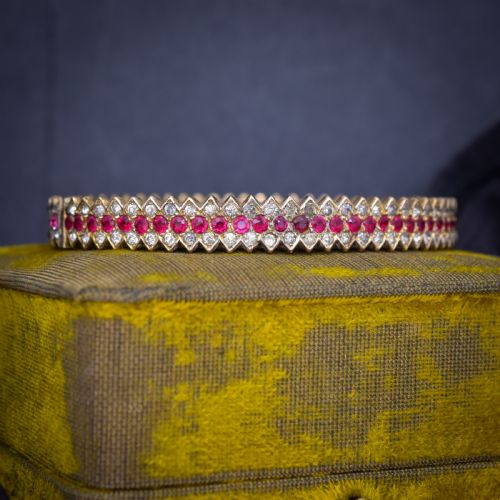


1930s Gold Bracelet
A 1930s gold bracelet brings together geometric Art Deco lines and precious stones, offering an authentic piece of period glamour that elevates any wrist.

1930s Gold Bracelet
The selections span from delicate rose gold and yellow gold seed pearl bands to substantial platinum-topped diamond cocktail watches and sapphire-accented links. Buyers frequently encounter French and Portuguese workmanship within this category, alongside playful items like enamel cottage charms.
Articulated links and flexible mesh bands dominate the structural forms, allowing the metal to drape smoothly over the wrist. Whether set with aquamarine, Burmese ruby, or paste glass, each variant captures the distinct architectural aesthetic of the era.
How they were made
Goldsmiths worked primarily in 15ct rose gold, 18ct yellow and white gold, and 14ct white gold, frequently pairing them with platinum settings to highlight diamonds and sapphires. Stones were precision-cut into chevrons, baguettes, and round brilliants to fit rigid geometric channels and delicate millegrain edges.
Articulated manufacturing techniques allowed heavy metal sections, such as tank bracelets, to remain flexible while maintaining structural rigidity. Master jewellers integrated concealed clasps and integrated mesh straps into functional cocktail watches to ensure seamless continuity of design.
An enamelled miniature cottage hangs ready to tell a miniature story from a 1930s wrist.
What varies in quality
The caliber of a 1930s gold bracelet depends heavily on the precision of the stone setting and the integrity of the articulated joints. Superior examples feature perfectly matched gemstone graduations, such as unheated aquamarines or certified diamonds, secured within crisp millegrain work.
Construction weight and metal purity also separate standard production from exceptional studio output, with heavier 16ct and 18ct gold foundations offering greater durability. The sophistication of the geometric engraving and the smoothness of the hinge movement ultimately define the tier of craftsmanship.
Bucherer
The 1930s Gold Bracelet Glossary
- Art Deco
- A design style spanning the 1920s and 1930s characterised by sleek geometric shapes, stylised symmetry, and industrial influences. It remains the defining aesthetic of this jewellery category.
- Tank bracelet
- A bold, architectural link bracelet named after the heavy treads of military tanks popularised during the interwar period. These pieces feature wide, flat, articulated metal sections.
- Millegrain
- A decorative jewellery technique involving a border of tiny, raised metal beads along the edge of a setting. This softens the transition between metal and gemstone.
- Cocktail watch
- A small, ornamental timepiece designed primarily for evening wear, often disguised beneath a diamond-set or gemstone-encrusted bracelet cover.
1930s Gold Bracelet: Frequently Asked Questions
How do I identify a 1930s gold bracelet?
Examine the piece for characteristic Art Deco geometry, architectural tank links, and platinum-topped gold settings. Look closely at the gemstone cuts and construction methods typical of the interwar period.
Check for period hallmarks on the clasp or inner band, noting that many originate from French and Portuguese workshops of that decade.
Are these bracelets suitable for daily wear?
These items require careful handling due to their delicate articulation, intricate stone settings, and age-related wear. Reserve them for special occasions rather than rough everyday tasks.
Store them flat in a lined jewellery box to prevent strain on the flexible mesh bands and fragile hinge connections.
What metals were commonly used?
Goldsmiths of the era favoured 15ct rose gold, 18ct yellow gold, and 14ct white gold, often combining them with platinum. Platinum was frequently utilised in top-tier pieces to securely hold diamonds and sapphires.
Gilt metal and lower-purity options also appear, particularly in decorative pieces incorporating paste glass or enamel work.
Can cocktail watches still tell time?
Many vintage cocktail watches retain functional mechanical movements that can be wound by hand. Professional servicing by a horologist is usually recommended to ensure reliable timekeeping.
Treat the internal mechanisms with care, as replacement parts for interwar watch movements can require specialist sourcing.