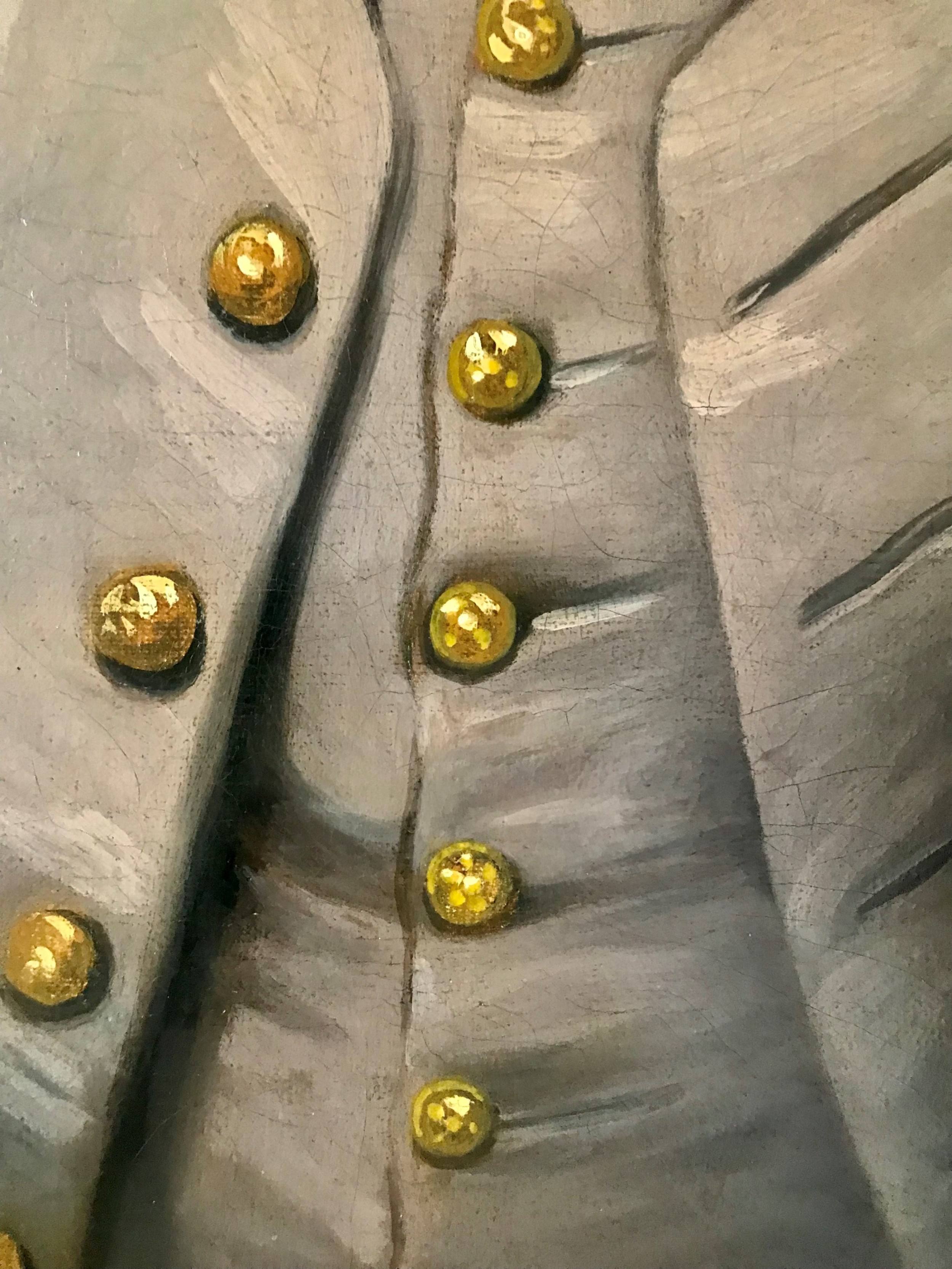
Roy Precious - Antiques & Fine Art has dated this piece to the 18th Century.
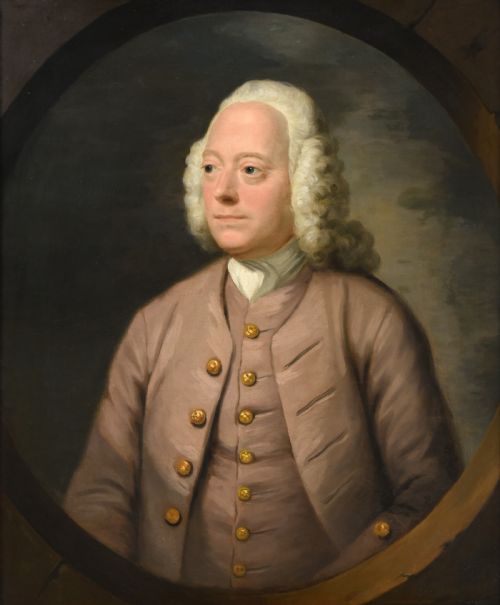
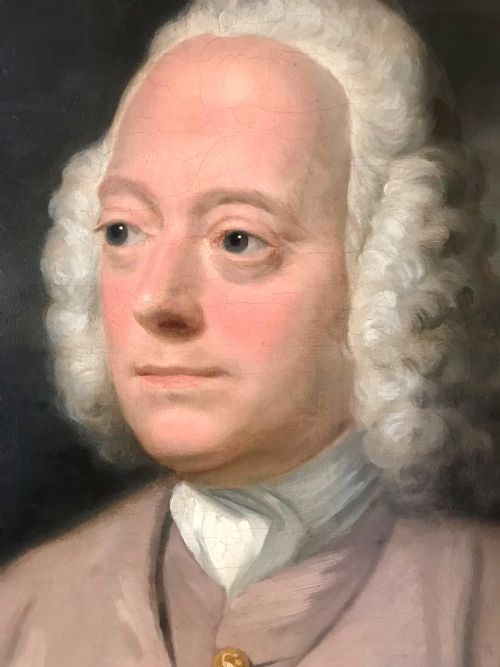
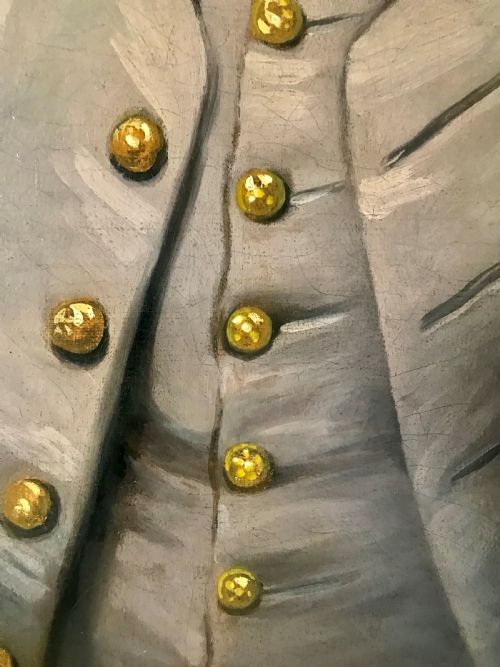
This portrait is typical of Pine's insightful and sensitive style, giving a strong sense of the character of the sitter.
ROBERT EDGE PINE (1727-1788) was an English portraitist and history painter who spent the last four years of his life in the United States. He was one of the first artists to paint history paintings of the events of the American Revolution.
Pine was born in London, around 1730, the son of engraver John Pine. His exact birth date has never been discovered, and nothing is known of his training. In 1760 he won first prize from the Society for the Encouragement of the Arts for his Surrender of Calais to Richard III (unlocated). He exhibited regularly at the Society of Artists and the Free Society of Artists from 1763 until 1772, when he moved to Bath.
Already sympathetic to the American cause, he painted an allegory in 1778 titled America (engraved, 1781; destroyed by fire, 1803), showing a suffering "America" visited by Liberty, Concord, Plenty and Peace. In Bath he met George William Fairfax, close friend and neighbour of George Washington. Another patron was Samuel Vaughan, a London merchant and friend of Benjamin Franklin, who commissioned Pine to paint portraits of his children.
At the end of the American Revolution Pine decided to go to the United States and asked Samuel Vaughan's son John about "the present state of the country, with respect to the disposition and ability of its inhabitants for giving encouragement to Painting, either at Portraits or in perpetuating to Posterity the many glorious Acts which honours the name of an American." (Letter of April 29, 1784, Dreer collection, Historical Society of Pennsylvania, quoted in Stewart 1979, 20). On August 23rd Fairfax sent Washington a print of Pine's America and recommended Pine to Washington and his friends. After his arrival in Philadelphia, Pine obtained permission to use a room in the State House (Independence Hall) as an exhibition space and painting room for his projected series of paintings of the events of the Revolution. Despite the patronage of financier Robert Morris, only one painting from the projected series, Congress Voting Independence, was completed (destroyed 1803; copied in oil and engraved by Edward Savage).
After Pine's death in Philadelphia in November 1788, the paintings in his studio were purchased by wax modeler Daniel Bowen, who exhibited them with other objects in his museum in Philadelphia, New York and Boston, beginning in 1792. Nearly all of Pine's paintings were destroyed by fire in 1803, leaving two family groups and about forty individual portraits as examples of his American work.
SIZE: 35 x 29.5 inches framed.
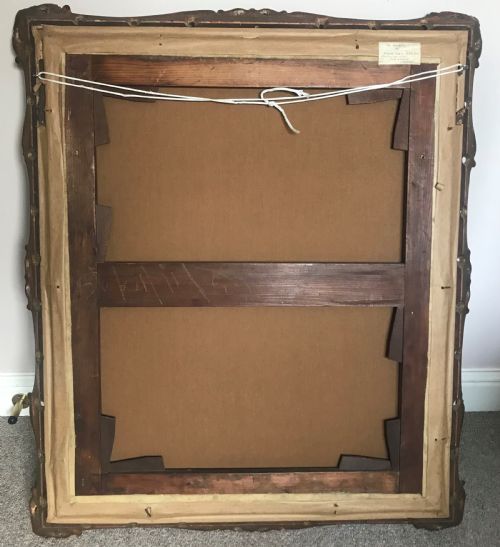
PROVENANCE: *Collection of Baron Rees-Mogg, (1928 – 2012) Quondam Editor and Director of The Times, Vice Chairman of the BBC, Chairman of the Arts Council & High Sheriff of Somerset, Ston Easton Park, Somerset. (Old handwritten label verso).
With Roy Precious Fine Art, King William House, Settle, North Yorkshire.
North Yorkshire Private Collection 2003-2022.
Roy Precious - Antiques & Fine Art has dated this piece to the 18th Century.
Roy and nadine precious: specialists in portraiture from the 16th to the 20th century. Established in 1972.
You can view the stock and full dealer information on the Roy Precious - Antiques & Fine Art Profile Page
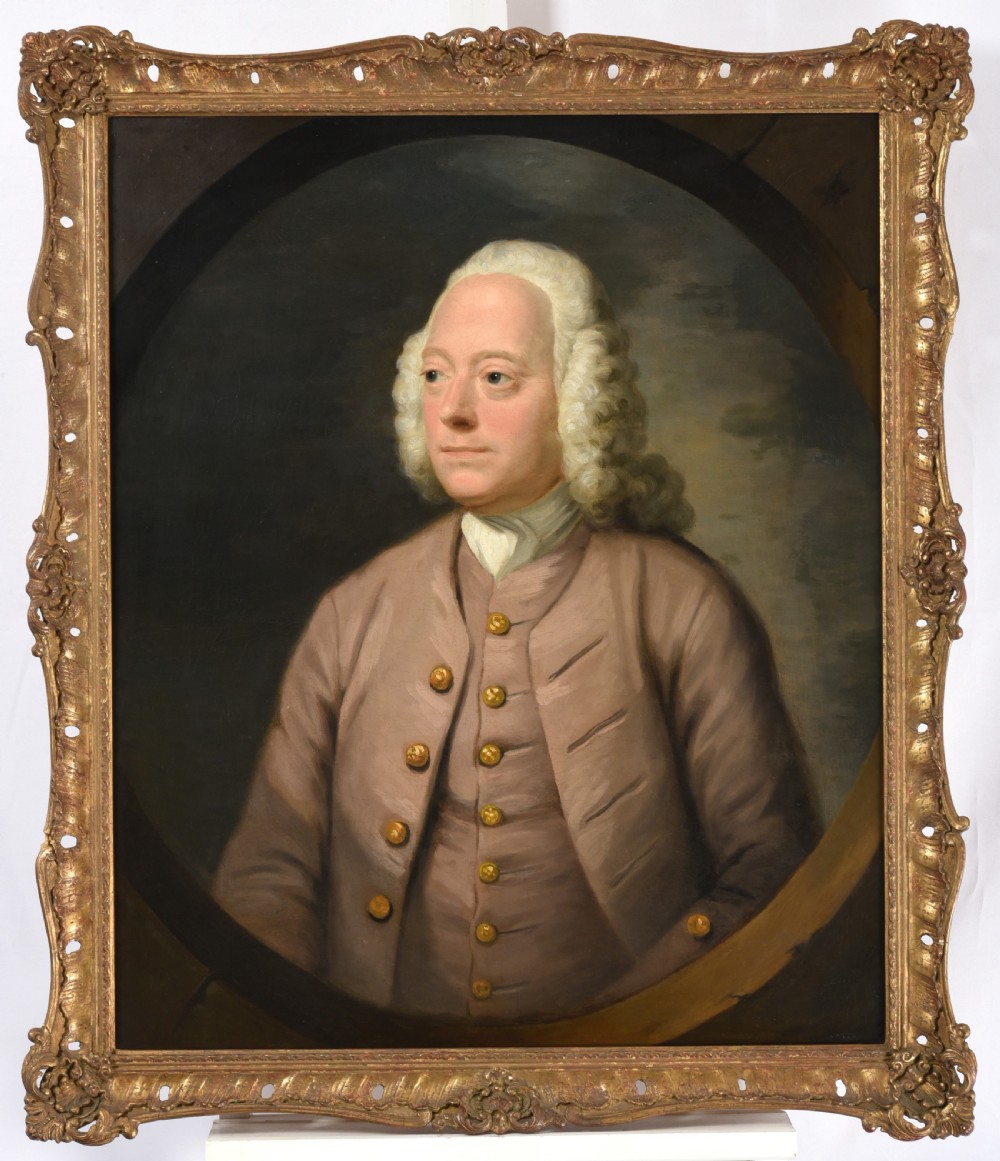

Portrait of a Gentleman C.1760; Attributed to Robert Edge Pine.