30,511  PAGES BROWSED TODAY PAGES TODAY 74  ANTIQUES UPLOADED TODAY NEW ARRIVALS
ID #SA837554
FOR SALE
£800
Email
Save
Geoffrey Robert Russell, 1902 - 1945 Portrait of Arthur Eric Rowton Gill 1882-1940 in His Studio
Artware Fineart
for sale €936     $1,016
£800

Artware Fineart

Sellingantiques Verified Since Sep 2008
View Dealers Stock Page
Id #SA837554
PDF SHARE
SAVE

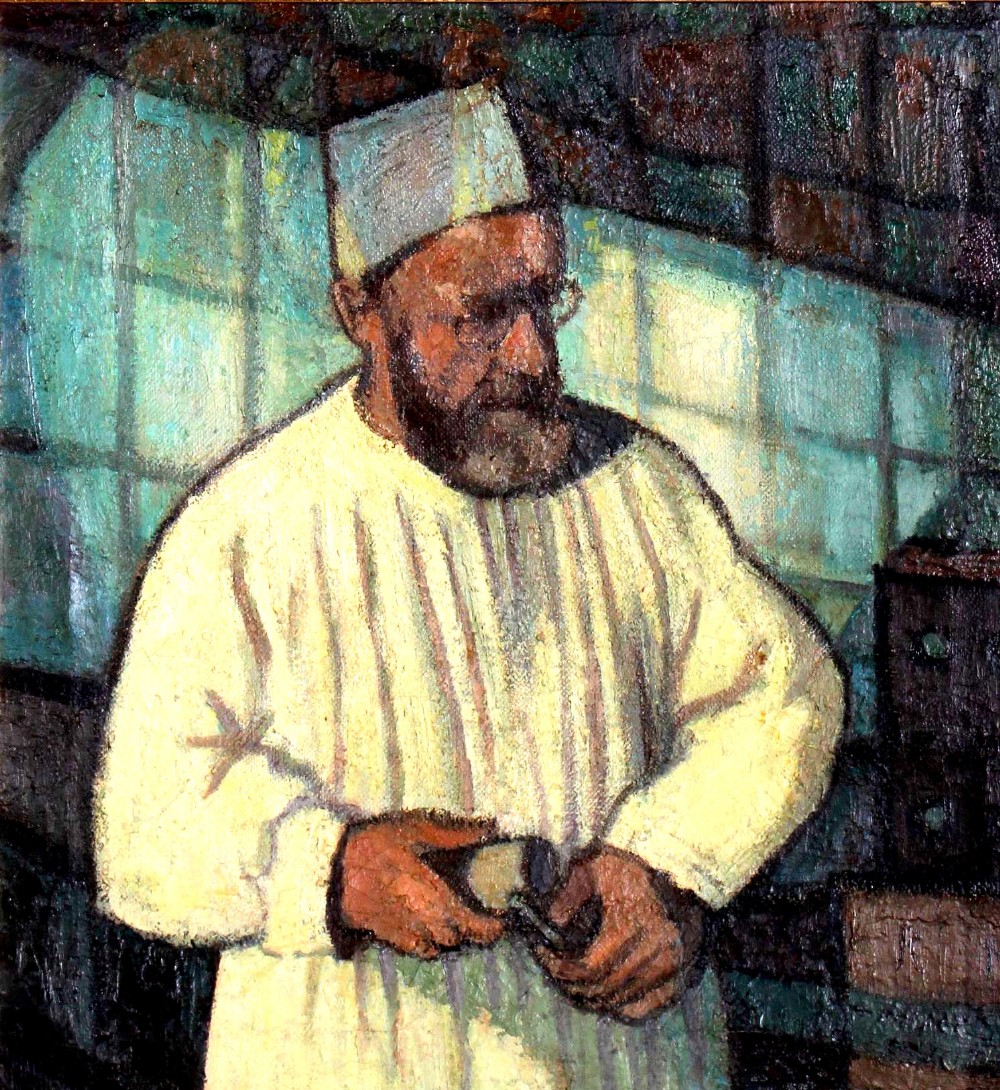
Geoffrey Robert Russell, 1902 - 1945 Portrait of Arthur Eric Rowton Gill 1882-1940 in His Studio

1920 - 1940
For Sale by Artware Fineart
Description

Geoffrey Robert Russell, 1902 - 1945

Portrait of Arthur Eric Rowton Gill 1882-1940 in his studio

Signed/Inscribed:

"Robert Russell"

oil on canvas

48 x 46 cm. (19 x 18 in.)

Gill, (Arthur) Eric Rowton (1882–1940), artist, craftsman, and social critic, was born at 32 Hamilton Road, Brighton, Sussex, on 22 February 1882, the eldest son and second of the thirteen children of the Revd Arthur Tidman Gill (1848–1933), minister of the Countess of Huntingdon's Connexion, a Calvinist Methodist church, and his wife, (Cicely) Rose King (d. 1929), formerly a professional singer of light opera under the name Rose le Roi. His younger brother, Leslie MacDonald [Max] Gill became a noted decorative cartographer. Arthur Tidman Gill, who came from a long line of Congregational missionaries and had been born in the South Seas, had himself been a Congregational minister, but had recently left the church of his forebears, after doctrinal disagreements, to join the connexion. Eric Gill was brought up in an atmosphere of religious controversy and holy poverty that helped shape his own valiant, if not totally successful, ambition 'to make a cell of good living in the chaos of our world' (Gill, Autobiography, 282).
Gill became the greatest artist–craftsman of the twentieth century: a letter-cutter and type designer of genius, whose Gill Sans and Perpetua typefaces have continued in world-wide use for many decades; a sculptor whose powerful work initiated a return to the directness of hand carving; a draughtsman and wood-engraver of consummate subtlety and skill. In any one of these crafts Gill would be considered a prime practitioner. He was also a copious essayist and a vociferous polemicist. The energy and spread of his activity, underpinned by a fervent belief in the values of making by hand as a bastion against the dehumanizing forces of industrialization, make his achievement comparable with that of William Morris in the century before.
Brighton and Chichester, 1882–1899

Eric, named after the hero of Dean Farrar's moralistic school story Eric, or, Little by Little, later wrote affectionately of his early childhood, spent in a succession of small, tightly packed houses near the railway line in Brighton where Eric—always to be an admirer of functional engineering design—watched and drew the trains. He went intermittently to a local kindergarten kept by the Misses Browne, sisters of the Dickensillustrator Hablot K. Browne (Phiz). He then spent seven years at Arnold House, a traditional boys' preparatory school in Hove where he was 'fairly happy', although poor to mediocre in all academic subjects except arithmetic. In retrospect the uninspired regime at Arnold House quite suited his developing iconoclasm: 'I was taught nothing in such a way as to make it difficult to discard' (Gill, Autobiography, 24).

Gill's unashamed fascination with the bodily functions, especially the sexual, surfaced early. Towards the end of his schooldays, he discovered the splendours of the male erection: 'how shall I ever forget the strange, inexplicable rapture of my first experience? What marvellous thing was this that suddenly transformed a mere water tap into a pillar of fire—and water into an elixir of life?' (Gill, Autobiography, 53). His struggles to reconcile the flesh and spirit determined his later life, his writings, and his art.

In 1897 the Gill family moved to 2 North Walls, Chichester. Arthur Tidman Gill had now joined the Church of England. Eric enrolled at the Chichester Technical and Art School, where he was befriended and encouraged by the art master George Herbert Catt, winning a queen's prize for perspective drawing. But the examination-dominated art school training, designed to produce more art teachers, was irksome to a student of Gill's wide-ranging curiosity. He learned more from his explorations of Chichester itself,

Physical Dimensions
Height
48cm (18.90")
Width
46cm (18.11")
Depth
2cm (0.79")
Declaration

Artware Fineart has dated this Antique Oil Portrait Painting to the 1940s.

Reference Numbers
Sellingantiques Reference
SA837554
Dealers Internal Reference
3967
Description
Geoffrey Robert Russell, 1902 - 1945

Portrait of Arthur Eric Rowton Gill 1882-1940 in his studio

Signed/Inscribed:

"Robert Russell"

oil on canvas

48 x 46 cm. (19 x 18 in.)

Gill, (Arthur) Eric Rowton (1882–1940), artist, craftsman, and social critic, was born at 32 Hamilton Road, Brighton, Sussex, on 22 February 1882, the eldest son and second of the thirteen children of the Revd Arthur Tidman Gill (1848–1933), minister of the Countess of Huntingdon's Connexion, a Calvinist Methodist church, and his wife, (Cicely) Rose King (d. 1929), formerly a professional singer of light opera under the name Rose le Roi. His younger brother, Leslie MacDonald [Max] Gill became a noted decorative cartographer. Arthur Tidman Gill, who came from a long line of Congregational missionaries and had been born in the South Seas, had himself been a Congregational minister, but had recently left the church of his forebears, after doctrinal disagreements, to join the connexion. Eric Gill was brought up in an atmosphere of religious controversy and holy poverty that helped shape his own valiant, if not totally successful, ambition 'to make a cell of good living in the chaos of our world' (Gill, Autobiography, 282).

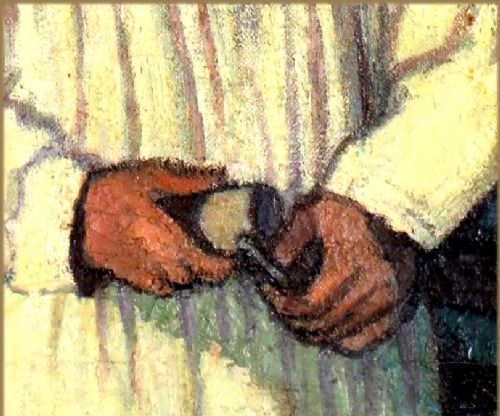
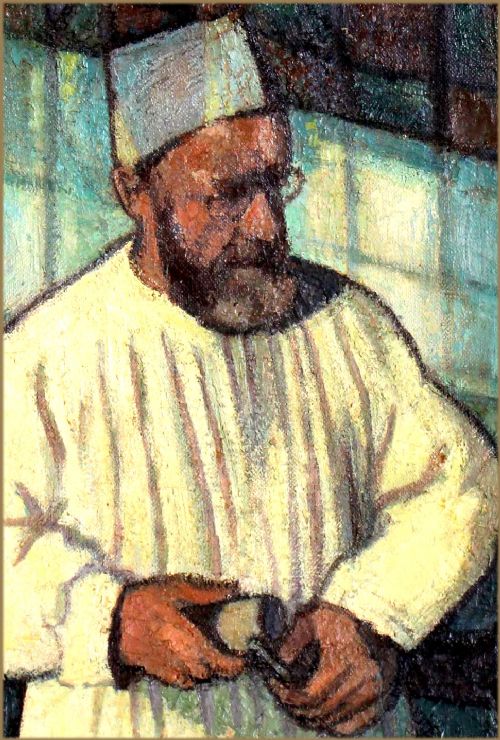
fig 1. An oil portrait painting depicting artist Eric Gill wearing a tunic and cap while holding tools inside a studio setting.
fig 1. Geoffrey Robert Russell, 1902 - 1945 Portrait of Arthur Eric Rowton Gill 1882-1940 in His Studio

Gill became the greatest artist–craftsman of the twentieth century: a letter-cutter and type designer of genius, whose Gill Sans and Perpetua typefaces have continued in world-wide use for many decades; a sculptor whose powerful work initiated a return to the directness of hand carving; a draughtsman and wood-engraver of consummate subtlety and skill. In any one of these crafts Gill would be considered a prime practitioner. He was also a copious essayist and a vociferous polemicist. The energy and spread of his activity, underpinned by a fervent belief in the values of making by hand as a bastion against the dehumanizing forces of industrialization, make his achievement comparable with that of William Morris in the century before.

fig 2. An oil portrait painting depicting artist Eric Gill wearing a tunic and cap while holding tools inside a studio setting.
fig 2. Geoffrey Robert Russell, 1902 - 1945 Portrait of Arthur Eric Rowton Gill 1882-1940 in His Studio

Brighton and Chichester, 1882–1899

Eric, named after the hero of Dean Farrar's moralistic school story Eric, or, Little by Little, later wrote affectionately of his early childhood, spent in a succession of small, tightly packed houses near the railway line in Brighton where Eric—always to be an admirer of functional engineering design—watched and drew the trains.

He went intermittently to a local kindergarten kept by the Misses Browne, sisters of the Dickensillustrator Hablot K.
Artware Fineart

Browne (Phiz). He then spent seven years at Arnold House, a traditional boys' preparatory school in Hove where he was 'fairly happy', although poor to mediocre in all academic subjects except arithmetic. In retrospect the uninspired regime at Arnold House quite suited his developing iconoclasm: 'I was taught nothing in such a way as to make it difficult to discard' (Gill, Autobiography, 24).

Gill's unashamed fascination with the bodily functions, especially the sexual, surfaced early. Towards the end of his schooldays, he discovered the splendours of the male erection: 'how shall I ever forget the strange, inexplicable rapture of my first experience? What marvellous thing was this that suddenly transformed a mere water tap into a pillar of fire—and water into an elixir of life?' (Gill, Autobiography, 53). His struggles to reconcile the flesh and spirit determined his later life, his writings, and his art.

In 1897 the Gill family moved to 2 North Walls, Chichester. Arthur Tidman Gill had now joined the Church of England. Eric enrolled at the Chichester Technical and Art School, where he was befriended and encouraged by the art master George Herbert Catt, winning a queen's prize for perspective drawing. But the examination-dominated art school training, designed to produce more art teachers, was irksome to a student of Gill's wide-ranging curiosity. He learned more from his explorations of Chichester itself,

Height
48cm (18.90")
Width
46cm (18.11")
Depth
2cm (0.79")
Date of Manufacture

Artware Fineart has dated this Antique Oil Portrait Painting to the 1940s.

Reference Numbers
Sellingantiques Ref
SA837554
Dealers Internal Ref
3967
Artware Fineart
Sellingantiques verified Since Sep 2008
Dealer Profile

You can view the stock and full dealer information on the Artware Fineart Profile Page
PDF SHARE
SAVE
An oil portrait painting depicting artist Eric Gill wearing a tunic and cap while holding tools inside a studio setting.
1 / 3
Archive I An oil portrait painting depicting artist Eric Gill wearing a tunic and cap while holding tools inside a studio setting.

Geoffrey Robert Russell, 1902 - 1945 Portrait of Arthur Eric Rowton Gill 1882-1940 in His Studio

Archive II An oil portrait painting depicting artist Eric Gill wearing a tunic and cap while holding tools inside a studio setting. View II
Archive III An oil portrait painting depicting artist Eric Gill wearing a tunic and cap while holding tools inside a studio setting. View III
FURTHER BROWSING

Visitors also looked at these ⇣

Enlarged Archival View
Telephone 07958 699 645
Location
18 La Gare
51 Surrey Row
London
SE1 0BZ
United Kingdom
Verified Since Sep 2008
Items For Sale 243
Items Sold 223
Artware Fineart
Verified Since Sep 2008
View Dealer Info
Location: 18 La Gare , 51 Surrey Row , London , SE1 0BZ , United Kingdom
Verified
Sep 2008
For Sale
243
Sold
223
An oil portrait painting depicting artist Eric Gill wearing a tunic and cap while holding tools inside a studio setting.
Geoffrey Robert Russell, 1902 - 1945 Portrait of Arthur Eric Rowton Gill 1882-1940 in his studio
Ref: SA837554
An oil portrait painting depicting artist Eric Gill wearing a tunic and cap while holding tools inside a studio setting.
Detail View 1
Detail View 2
Archival Detail
Every single antique dealer on our platform is individually approved by our internal team. We verify their professional trade history, ethical standards, and photographic quality to ensure a secure, high-standard buying environment. Upon joining, every dealer agrees to a strict 9-point code of conduct. While issues can occasionally arise, our dealers typically resolve them swiftly and directly with the buyer. In fact, since our founding in 2002, Sellingantiques has only had to step in to help resolve an issue on roughly five occasions—a true testament to the quality of our dealers and their dedication to your happiness.
Our dealers are highly experienced in packing and shipping fragile, high-value antiques. Because you are in direct contact with the dealer, you will be able to easily go through all available shipping and insurance options together to ensure your item arrives safely.
Antiques are the ultimate green purchase. By choosing historical pieces over newly manufactured goods, you completely eliminate the carbon footprint of modern mass production while preserving exceptional, timeless craftsmanship.

Early 20th-century British portraiture often reflects a transition from traditional Victorian representation toward Modernist experimentation, focusing on texture, visible brushwork, and expressive atmospheric lighting.

Artists typically used oil pigments mixed with drying oils such as linseed, applied directly onto stretched linen canvas or prepared timber panels.

Authentic paintings from this era typically display natural craquelure, surface patination, historical stretcher construction, and period frame markings or inscriptions on the reverse.

A figurative portrait can serve as a focal point above a sideboard or mantelpiece, where neutral walls highlight the tonal depth and textural impasto of the artwork.

Keep the canvas away from direct sunlight, moisture, and fluctuating temperatures, dusting the surface gently with a soft, dry brush without liquid cleaners.
items
Add keywords to the filter
Price
£100
£250000
Era
Movements
Material
Origin
Stock Location
Freshness
Online Payments
Categories