
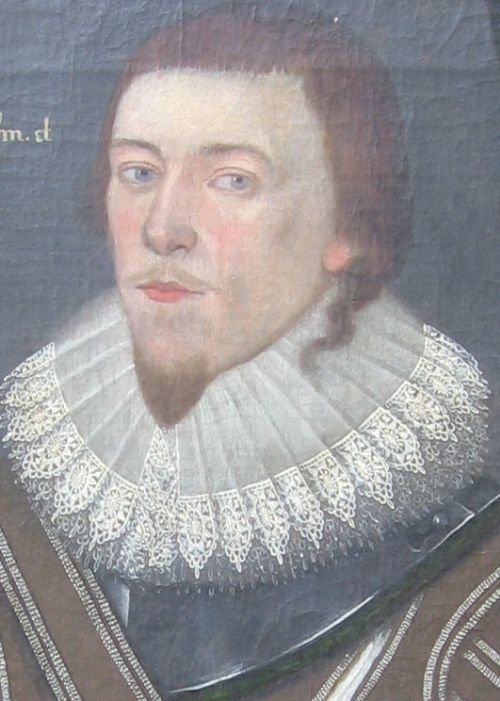
The sitter wears the metal gorget of an officer which contrasts with the very expensive 'reticella' lace he also wears.
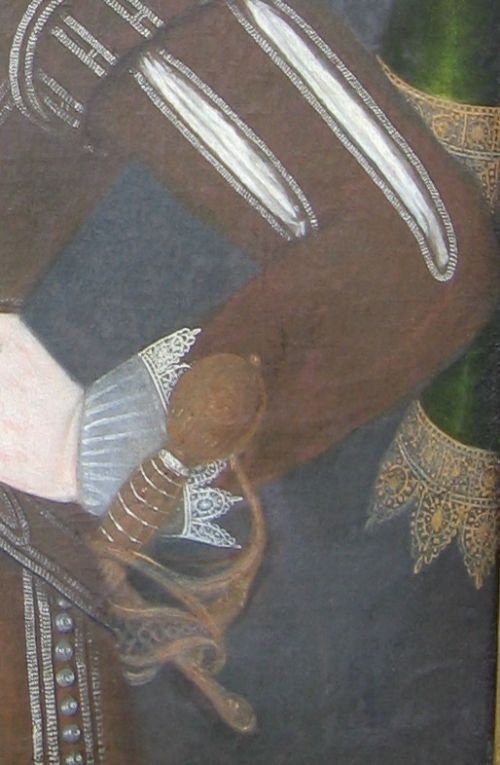
The arquebus (sometimes spelled harquebus or hackbut) was a primitive firearm used in the 15th to 17th centuries. Like its successor, the musket, it was a smoothbore firearm although somewhat smaller than its predecessors, which made it easier to carry.The arquebus was fired by a matchlock mechanism and the arquebusier supported the gun's barrel with a pole with a forked end when firing.
Fortescue was born in East Allington in 1596; his father was Edmund Fortescue, born 1552, and his mother, Mary (Maria) Champernoune, born 1567.
Their ancestor Sir Richard le Fort came to England with William the Conqueror and was given the name Fort Escue (strong shield) through having protected Duke William with his shield at the Battle of Hastings in 1066.
The family resided at East Allington in South Devon for many generations; their arms are displayed in the village church of St. Andrew.
SIZE: 38 x 35.5 inches inc. frame.
PROVENANCE: By descent through the Fortescue family to the late Mrs Charles Steuart.
Then to a private collection in an East Anglian
Georgian country house.
With the portrait comes a printout of the the Fortescue family tree from the Norman Conquest to the mid 17th century. Extracted from 'The Visitations of the County of Devon' by Lt. Col. J.L. Vivian, 1895.
Roy and nadine precious: specialists in portraiture from the 16th to the 20th century. Established in 1972.
You can view the stock and full dealer information on the Roy Precious - Antiques & Fine Art Profile Page
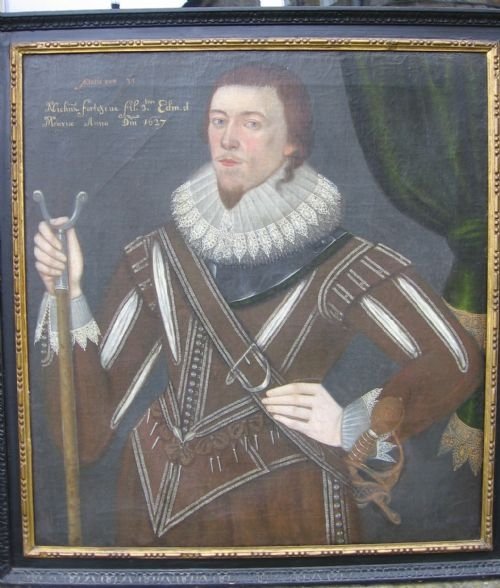
Sold....portrait of Nicholas Fortescue,1627; English School
