
his portraits of Richard Rich, Earl of Warwick, King Charles I, and William Knollys, Earl of Banbury among others).
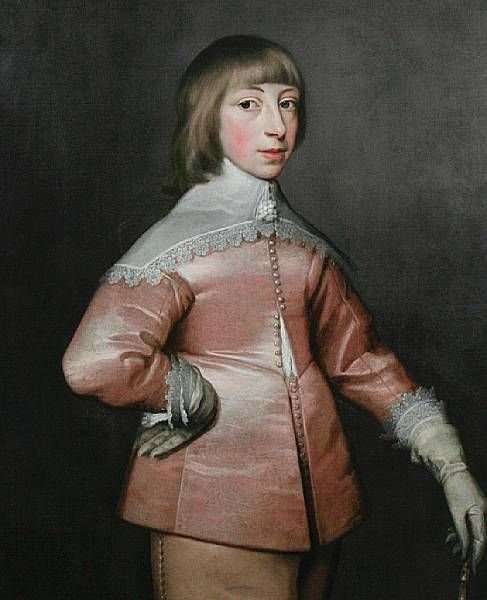
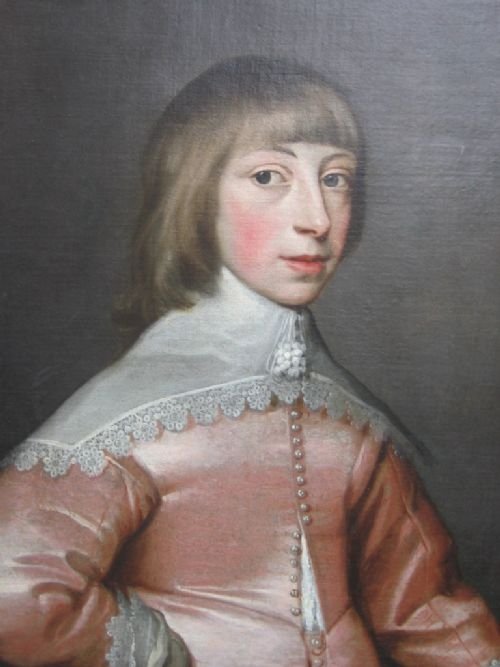
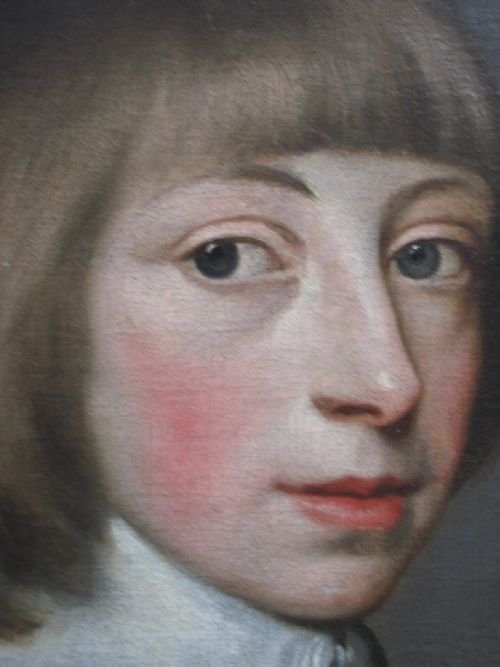
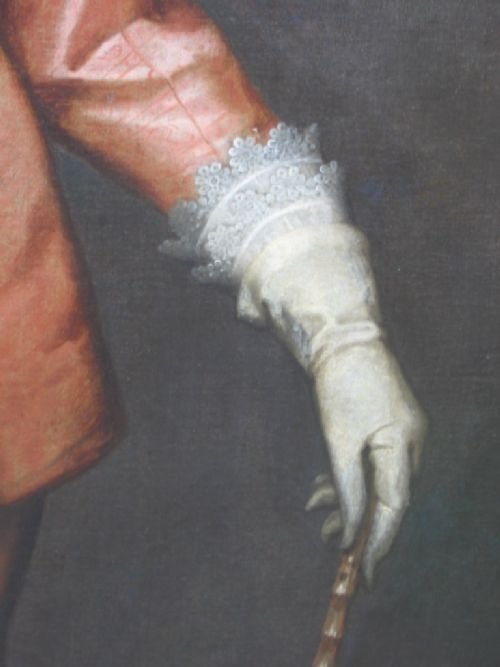
Yet despite the aristocratic posture the artist manages to sensitively convey a sense of a slight insecurity in the boy as he is painted, perhaps for the first time, as a man.
His identity is, as yet, unknown, but his expensive and fashionable clothes are of the Court.
Daniël Mijtens (Delft, c. 1590 – The Hague, 1647/48), known in England as DANIEL MYTENS the Elder, was a Dutch portrait painter who spent the central years of his career working in England. He was born in Delft into a family of artists and trained in The Hague, possibly in the studio of Van Mierevelt.
By 1618, he had moved to London where his initial patron was the leading art collector Thomas Howard, 21st Earl of Arundel. Mytens painted the Earl and his Countess, and was soon commissioned to paint King James I and his son Charles, Prince of Wales. In 1625 he became painter to King Charles I.
After the prince's accession to the throne as Charles I in 1625 Mytens produced such a large number of full length portraits of Charles I and his courtiers, including duplicates, that it is assumed that he had workshop assistance. Mytens made visits to the Netherlands in 1626 and 1630, perhaps to study the latest developments in his field, more particularly the works of Rubens and Van Dyck.
Mytens introduced a new naturalism into the English court portrait, but after the arrival in England of Anthony Van Dyck in 1632 he was superseded as the leading court portraitist, and around 1634 he appears to have returned to the Netherlands permanently.
Some of Mytens' works are still owned by the Royal Family.
SIZE: 51 x 42 inches inc. replica frame.
PROVENANCE:
with the Simon Carter Gallery in 1990;
London Collection of Severin Wunderman.
SEVERIN WUNDERMAN Born Brussels, 1938.
Died Nice, 2008.A child Holocaust survivor he built up a multi-million pound business in luxury watches and became a major art collector and philanthropist. In the 1970s he set up watch production for Gucci, which he ran and controlled for over 25 years until Gucci Timepieces was bought back by the family in 1998.
Diagnosed with inoperable lung cancer in the 1990s, he promised the specialist, who was reluctant to treat him, $5 million a year in research funding for every year he survived.
This resulted in the Severin Wunderman Family Foundation for research into incurable illnesses. He eventually died from a stroke.
He was a board member of Steven Spielberg's Shoah Foundation and received the Légion d'Honneur in 2005.
This portrait hung in the hall of his London house until his death. Wunderman also owned a French Chateau in the Cote d`Azur and a penthouse in Los Angeles.
Roy and nadine precious: specialists in portraiture from the 16th to the 20th century. Established in 1972.
You can view the stock and full dealer information on the Roy Precious - Antiques & Fine Art Profile Page
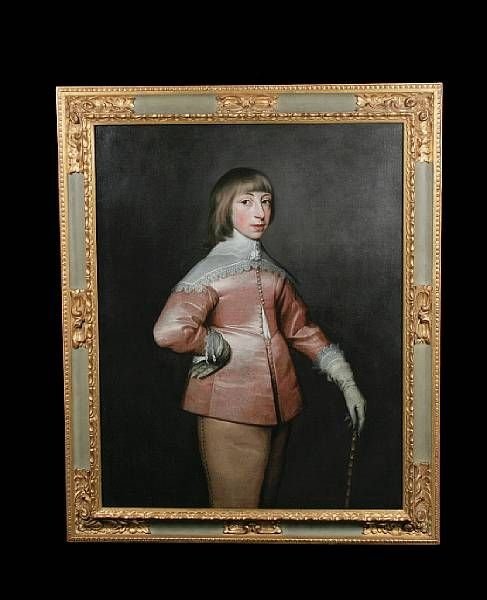
Sold....portrait of a Young Nobleman C.1630; Studio or Circle of Daniel Mytens.
