20,231  PAGES BROWSED TODAY PAGES TODAY 36  ANTIQUES UPLOADED TODAY NEW ARRIVALS
ID #SA663559
FOR SALE
£800
Email
Save
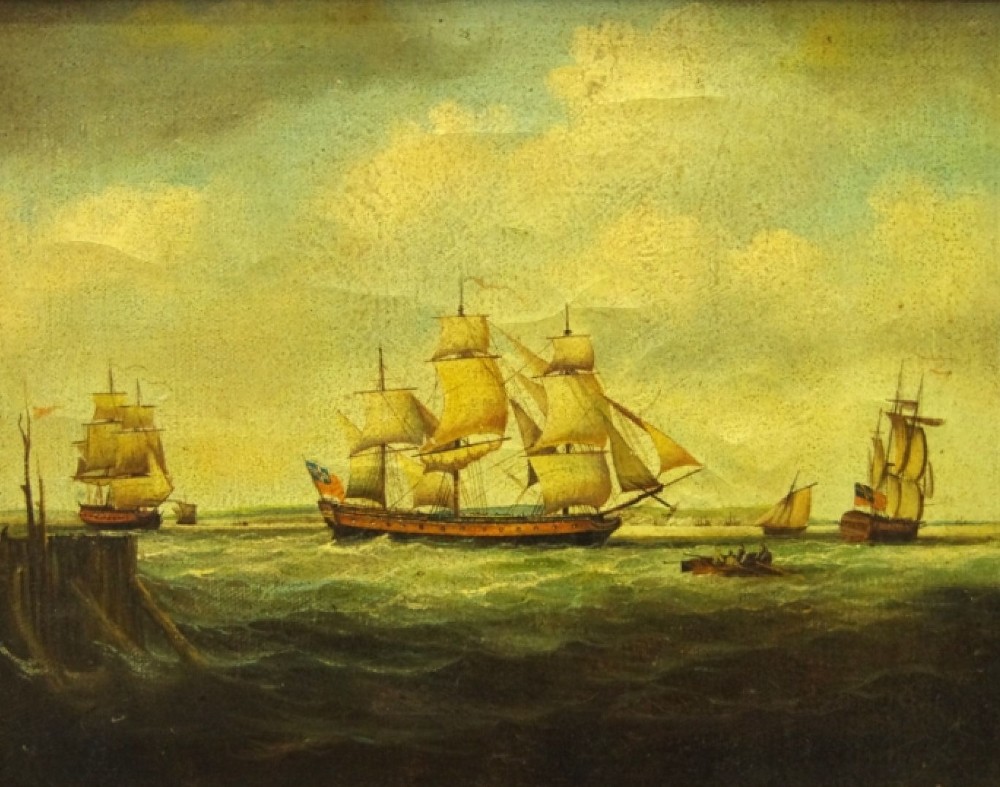
English School 19th, Century a Frigate in Three Positions Off the Downs on the English Coast
Artware Fineart
for sale €936     $1,016
£800

Artware Fineart

Sellingantiques Verified Since Sep 2008
View Dealers Stock Page
Id #SA663559
PDF SHARE
SAVE

English School 19th, Century a Frigate in Three Positions Off the Downs on the English Coast

19th century
For Sale by Artware Fineart
Description

English School 19th, Century

A Frigate in Three Positions off the Downs on the English Coast

oil on canvas

33 x 44 cm. (13 x 17.1/2in.)

A frigate is any of several types of warship, the term having been used for ships of various sizes and roles over the last few centuries. In the 17th century, the term was used for any warship built for speed and maneuverability, the description often used being "frigate-built". These could be warships carrying their principal battery of carriage-mounted guns on a single deck or on two decks (with further smaller carriage-mounted guns usually carried on the forecastle and quarterdeck of the vessel). The term was generally used for ships too small to stand in the line of battle, although early line-of-battle ships were frequently referred to as frigates when they were built for speed. In the 18th century, the term referred to ships which were usually as long as a ship-of-the-line and were square-rigged on all three masts (full rigged), but were faster and with lighter armament, used for patrolling and escort. In the definition adopted by the British Admiralty, they were rated ships of at least 28 guns, carrying their principal armament upon a single continuous deck—the upper deck, while ships-of-the-line possessed two or more continuous decks bearing batteries of guns. Frigates did not carry any guns (or have any gunports) on their lower decks; confusingly, the lower deck was often referred to as the "gun deck" in the British Royal Navy (in the United States Navy, it was usually called the "berth deck"), even for frigates, where it did not carry any guns or have gunports. Both types could (and usually did) additionally carry smaller carriage-mounted guns on their quarter decks and forecastles (the superstructures above the upper deck). Technically, rated ships with fewer than 28 guns could not be classed as frigates but as "post ships"; however, in common parlance most post ships were often described as "frigates", the same casual misuse of the term being extended to smaller two-decked ships that were too small to stand in the line of battle. In the late 19th century (beginning about 1858 with the construction of prototypes by the British and French navies), the armoured frigate was a type of ironclad warship and for a time was the most powerful type of vessel afloat. The term "frigate" was used because such ships still mounted their principal armament on a single continuous upper deck. The later 19th century battleship thus developed from the frigate rather than from the ship of the line.

Physical Dimensions
Height
33cm (12.99")
Width
44cm (17.32")
Depth
2cm (0.79")
Declaration

Artware Fineart has dated this 19th Century Marine Painting to the 19th Century.

Reference Numbers
Sellingantiques Reference
SA663559
Dealers Internal Reference
3593
Description
English School 19th, Century

A Frigate in Three Positions off the Downs on the English Coast

oil on canvas

33 x 44 cm. (13 x 17.1/2in.)

A frigate is any of several types of warship, the term having been used for ships of various sizes and roles over the last few centuries.
Artware Fineart

In the 17th century, the term was used for any warship built for speed and maneuverability, the description often used being "frigate-built". These could be warships carrying their principal battery of carriage-mounted guns on a single deck or on two decks (with further smaller carriage-mounted guns usually carried on the forecastle and quarterdeck of the vessel). The term was generally used for ships too small to stand in the line of battle, although early line-of-battle ships were frequently referred to as frigates when they were built for speed. In the 18th century, the term referred to ships which were usually as long as a ship-of-the-line and were square-rigged on all three masts (full rigged), but were faster and with lighter armament, used for patrolling and escort. In the definition adopted by the British Admiralty, they were rated ships of at least 28 guns, carrying their principal armament upon a single continuous deck—the upper deck, while ships-of-the-line possessed two or more continuous decks bearing batteries of guns. Frigates did not carry any guns (or have any gunports) on their lower decks; confusingly, the lower deck was often referred to as the "gun deck" in the British Royal Navy (in the United States Navy, it was usually called the "berth deck"), even for frigates, where it did not carry any guns or have gunports. Both types could (and usually did) additionally carry smaller carriage-mounted guns on their quarter decks and forecastles (the superstructures above the upper deck). Technically, rated ships with fewer than 28 guns could not be classed as frigates but as "post ships"; however, in common parlance most post ships were often described as "frigates", the same casual misuse of the term being extended to smaller two-decked ships that were too small to stand in the line of battle. In the late 19th century (beginning about 1858 with the construction of prototypes by the British and French navies), the armoured frigate was a type of ironclad warship and for a time was the most powerful type of vessel afloat. The term "frigate" was used because such ships still mounted their principal armament on a single continuous upper deck. The later 19th century battleship thus developed from the frigate rather than from the ship of the line.

Height
33cm (12.99")
Width
44cm (17.32")
Depth
2cm (0.79")
Date of Manufacture

Artware Fineart has dated this 19th Century Marine Painting to the 19th Century.

Reference Numbers
Sellingantiques Ref
SA663559
Dealers Internal Ref
3593
Artware Fineart
Sellingantiques verified Since Sep 2008
Dealer Profile

You can view the stock and full dealer information on the Artware Fineart Profile Page
PDF SHARE
SAVE
A 19th-century marine oil painting depicting a sailing frigate shown in three positions on a choppy sea under an ochre sky.
1 / 2
Archive I A 19th-century marine oil painting depicting a sailing frigate shown in three positions on a choppy sea under an ochre sky.

English School 19th, Century a Frigate in Three Positions Off the Downs on the English Coast
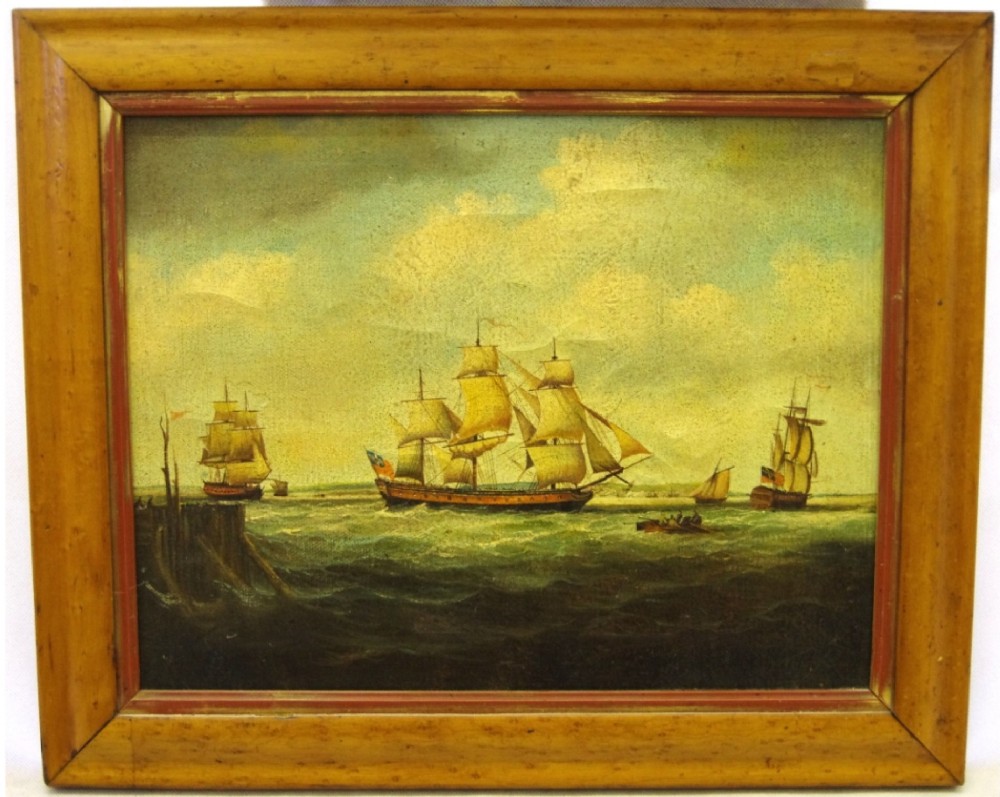
Archive II A 19th-century marine oil painting depicting a sailing frigate shown in three positions on a choppy sea under an ochre sky. View II
FURTHER BROWSING

Visitors also looked at these ⇣

Enlarged Archival View
Telephone 07958 699 645
Location
18 La Gare
51 Surrey Row
London
SE1 0BZ
United Kingdom
Verified Since Sep 2008
Items For Sale 243
Items Sold 223
Artware Fineart
Verified Since Sep 2008
View Dealer Info
Location: 18 La Gare , 51 Surrey Row , London , SE1 0BZ , United Kingdom
Verified
Sep 2008
For Sale
243
Sold
223
A 19th-century marine oil painting depicting a sailing frigate shown in three positions on a choppy sea under an ochre sky.
English School 19th, Century A Frigate in Three Positions off the Downs on the English Coast
Ref: SA663559
A 19th-century marine oil painting depicting a sailing frigate shown in three positions on a choppy sea under an ochre sky.
Detail View 1
Archival Detail
Every single antique dealer on our platform is individually approved by our internal team. We verify their professional trade history, ethical standards, and photographic quality to ensure a secure, high-standard buying environment. Upon joining, every dealer agrees to a strict 9-point code of conduct. While issues can occasionally arise, our dealers typically resolve them swiftly and directly with the buyer. In fact, since our founding in 2002, Sellingantiques has only had to step in to help resolve an issue on roughly five occasions—a true testament to the quality of our dealers and their dedication to your happiness.
Our dealers are highly experienced in packing and shipping fragile, high-value antiques. Because you are in direct contact with the dealer, you will be able to easily go through all available shipping and insurance options together to ensure your item arrives safely.
Antiques are the ultimate green purchase. By choosing historical pieces over newly manufactured goods, you completely eliminate the carbon footprint of modern mass production while preserving exceptional, timeless craftsmanship.

Marine painting during the 19th century in Britain focused on depicting naval vessels, harbour views, and sea compositions with precise attention to ship rigging, atmospheric light, and maritime topography.

Artists of this era typically executed paintings using oil pigments applied to stretched linen or cotton canvas, as well as wood panels, sealed with a protective varnish coat.

Authentic works exhibit age-appropriate craquelure across the paint layer, historical construction techniques on the stretcher bars, and accurate period details regarding vessel flags and naval architecture.

A traditional maritime oil painting can be styled as a focal point above a mantelpiece, console table, or within a gallery wall in a study or formal living room.

Keep the canvas away from direct sunlight, extreme humidity changes, and direct heat sources, and clean dust gently from the surface using a soft, dry brush.
items
Add keywords to the filter
Price
£100
£250000
Era
Movements
Material
Origin
Stock Location
Freshness
Online Payments
Categories