42,263  PAGES BROWSED TODAY PAGES TODAY 98  ANTIQUES UPLOADED TODAY NEW ARRIVALS
ID #SA627423
FOR SALE
£800
Email
Save
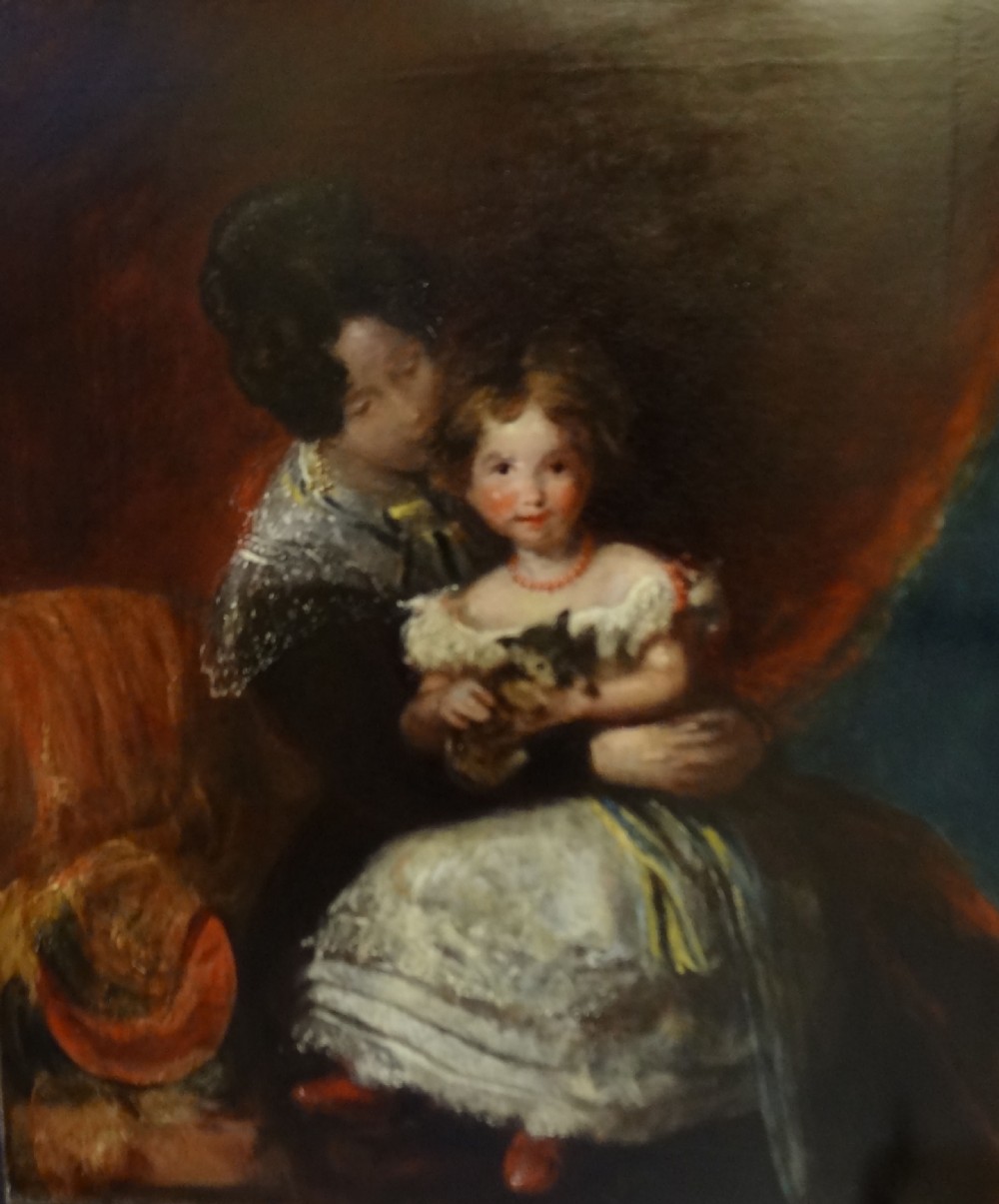
Circle of Sir Thomas Lawrence, Pra, 1769 - 1830 Portrait of a Mother and Child Holding a Kitten
Artware Fineart
for sale €936     $1,016
£800

Artware Fineart

Sellingantiques Verified Since Sep 2008
View Dealers Stock Page
Id #SA627423
PDF SHARE
SAVE

Circle of Sir Thomas Lawrence, Pra, 1769 - 1830 Portrait of a Mother and Child Holding a Kitten

19th century
For Sale by Artware Fineart
Description

Circle of Sir Thomas Lawrence, PRA, 1769 - 1830

Portrait of a Mother and Child holding a Kitten

oil on canvas

67 x 57 cm. (26.1/2 x 22.3/4 in.)

Sir Thomas Lawrence was born in Bristol. His father was an innkeeper, first at Bristol and afterwards at Devizes, and at the age of six Lawrence was already being shown off to the guests of the Bear as an infant prodigy who could sketch their likenesses and declaim speeches from Milton. In 1779 the elder Lawrence had to leave Devizes, having failed in business and Thomas's precocious talent began to be the main source of the family's income; he had gained a reputation along the Bath road.

His debut as a crayon portrait painter was made at Oxford, where he was well patronized, and in 1782 the family settled in Bath, where the young artist soon found himself fully employed in taking crayon likenesses of fashionable people at a guinea or a guinea and a half a head. In 1784 he gained the prize and silver-gilt palette of the Society of Arts for a crayon drawing after Raphael's "Transfiguration," and presently beginning to paint in oil.

Early career

Mr and Mrs John Julius Angerstein 1792 - Sir Thomas Lawrence

Mr and Mrs John Julius Angerstein 1792

Abandoning the idea of going on the stage which he had briefly entertained, Lawrence came to London in 1787, was kindly received by Sir Joshua Reynolds, and became a student at the Royal Academy. He began to exhibit almost immediately, and his reputation increased so rapidly that he became an associate of the Academy in 1791. The death of Sir Joshua in 1792 opened the way to further successes. Lawrence was at once appointed painter to the Dilettanti Society, and principal painter to King George III in lieu of Reynolds.

In 1794 he was a Royal Academician, and he became the fashionable portrait painter of the age, his sitters including England's most notable people, and ultimately most of the crowned heads of Europe. Caroline of Brunswick was one of his favourite subjects, and is reputed to have been his lover for a time.

Financial difficulty

Financial problems plagued Lawrence. In 1796, Francis Mackenzie, 1st Baron Seaforth, one of Lawrence's close patrons, gave him £1,000 (an enormous sum at the time) to relieve him from his financial difficulties. Lawrence painted several portraits for Lord Seaforth, including a full-length portrait of Seaforth's daughter, Mary.

Recognition

Mrs. Henry Baring and her Children 1817 - Sir Thomas Lawrence

Mrs. Henry Baring and her Children 1817

In 1815 Lawrence was knighted; in 1818 he went to Aachen to paint the sovereigns and diplomats gathered there for the third congress, and visited Vienna and Rome, everywhere receiving flattering marks of distinction from princes, due as much to his courtly manners as to his merits as an artist. After eighteen months he returned to England, and on the very day of his arrival was chosen president of the Academy in room of Benjamin West, who had died a few days before. He held the office from 1820 to his death. He was never married.

Sir Thomas Lawrence had all the qualities of personal manner and artistic style necessary to make a fashionable painter, and among English portrait painters he takes a high place, though not as high as that given to him in his lifetime. His more ambitious works, in the classical style, such as his once celebrated "Satan," are practically forgotten.

The best display of Lawrence's work is in the Waterloo Gallery of Windsor, a collection of much historical interest. "Master Charles William Lambton" (1825), painted for Lord Durham at the price of 600 guineas, is regarded as one of his best portraits, and a fine head in the National Gallery, London, shows his power to advantage. The Life and Correspondence of Sir T. Lawrence, by DE Williams, appeared in 1831.

Physical Dimensions
Height
67cm (26.38")
Width
57cm (22.44")
Depth
1cm (0.39")
Declaration

Artware Fineart has dated this Regency Mother Child Portrait to the 19th Century.

Reference Numbers
Sellingantiques Reference
SA627423
Dealers Internal Reference
3565
Description
Circle of Sir Thomas Lawrence, PRA, 1769 - 1830

Portrait of a Mother and Child holding a Kitten

oil on canvas

67 x 57 cm. (26.1/2 x 22.3/4 in.)

Sir Thomas Lawrence was born in Bristol. His father was an innkeeper, first at Bristol and afterwards at Devizes, and at the age of six Lawrence was already being shown off to the guests of the Bear as an infant prodigy who could sketch their likenesses and declaim speeches from Milton. In 1779 the elder Lawrence had to leave Devizes, having failed in business and Thomas's precocious talent began to be the main source of the family's income; he had gained a reputation along the Bath road.

His debut as a crayon portrait painter was made at Oxford, where he was well patronized, and in 1782 the family settled in Bath, where the young artist soon found himself fully employed in taking crayon likenesses of fashionable people at a guinea or a guinea and a half a head.

In 1784 he gained the prize and silver-gilt palette of the Society of Arts for a crayon drawing after Raphael's "Transfiguration," and presently beginning to paint in oil.
Artware Fineart

Early career

Mr and Mrs John Julius Angerstein 1792 - Sir Thomas Lawrence

Mr and Mrs John Julius Angerstein 1792

Abandoning the idea of going on the stage which he had briefly entertained, Lawrence came to London in 1787, was kindly received by Sir Joshua Reynolds, and became a student at the Royal Academy. He began to exhibit almost immediately, and his reputation increased so rapidly that he became an associate of the Academy in 1791. The death of Sir Joshua in 1792 opened the way to further successes. Lawrence was at once appointed painter to the Dilettanti Society, and principal painter to King George III in lieu of Reynolds.

In 1794 he was a Royal Academician, and he became the fashionable portrait painter of the age, his sitters including England's most notable people, and ultimately most of the crowned heads of Europe. Caroline of Brunswick was one of his favourite subjects, and is reputed to have been his lover for a time.

Financial difficulty

Financial problems plagued Lawrence. In 1796, Francis Mackenzie, 1st Baron Seaforth, one of Lawrence's close patrons, gave him £1,000 (an enormous sum at the time) to relieve him from his financial difficulties. Lawrence painted several portraits for Lord Seaforth, including a full-length portrait of Seaforth's daughter, Mary.

Recognition

Mrs. Henry Baring and her Children 1817 - Sir Thomas Lawrence

Mrs. Henry Baring and her Children 1817

In 1815 Lawrence was knighted; in 1818 he went to Aachen to paint the sovereigns and diplomats gathered there for the third congress, and visited Vienna and Rome, everywhere receiving flattering marks of distinction from princes, due as much to his courtly manners as to his merits as an artist. After eighteen months he returned to England, and on the very day of his arrival was chosen president of the Academy in room of Benjamin West, who had died a few days before. He held the office from 1820 to his death. He was never married.

Sir Thomas Lawrence had all the qualities of personal manner and artistic style necessary to make a fashionable painter, and among English portrait painters he takes a high place, though not as high as that given to him in his lifetime. His more ambitious works, in the classical style, such as his once celebrated "Satan," are practically forgotten.

The best display of Lawrence's work is in the Waterloo Gallery of Windsor, a collection of much historical interest. "Master Charles William Lambton" (1825), painted for Lord Durham at the price of 600 guineas, is regarded as one of his best portraits, and a fine head in the National Gallery, London, shows his power to advantage. The Life and Correspondence of Sir T. Lawrence, by DE Williams, appeared in 1831.

Height
67cm (26.38")
Width
57cm (22.44")
Depth
1cm (0.39")
Date of Manufacture

Artware Fineart has dated this Regency Mother Child Portrait to the 19th Century.

Reference Numbers
Sellingantiques Ref
SA627423
Dealers Internal Ref
3565
Artware Fineart
Sellingantiques verified Since Sep 2008
Dealer Profile

You can view the stock and full dealer information on the Artware Fineart Profile Page
PDF SHARE
SAVE
An early 19th-century style oil painting depicting a mother seated behind a young child holding a small kitten.
1 / 1
Archive I An early 19th-century style oil painting depicting a mother seated behind a young child holding a small kitten.

Circle of Sir Thomas Lawrence, Pra, 1769 - 1830 Portrait of a Mother and Child Holding a Kitten

FURTHER BROWSING

Visitors also looked at these ⇣

Enlarged Archival View
Telephone 07958 699 645
Location
18 La Gare
51 Surrey Row
London
SE1 0BZ
United Kingdom
Verified Since Sep 2008
Items For Sale 243
Items Sold 223
Artware Fineart
Verified Since Sep 2008
View Dealer Info
Location: 18 La Gare , 51 Surrey Row , London , SE1 0BZ , United Kingdom
Verified
Sep 2008
For Sale
243
Sold
223
An early 19th-century style oil painting depicting a mother seated behind a young child holding a small kitten.
Circle of Sir Thomas Lawrence, PRA, 1769 - 1830 Portrait of a Mother and Child holding a Kitten
Ref: SA627423
An early 19th-century style oil painting depicting a mother seated behind a young child holding a small kitten.
Archival Detail
Every single antique dealer on our platform is individually approved by our internal team. We verify their professional trade history, ethical standards, and photographic quality to ensure a secure, high-standard buying environment. Upon joining, every dealer agrees to a strict 9-point code of conduct. While issues can occasionally arise, our dealers typically resolve them swiftly and directly with the buyer. In fact, since our founding in 2002, Sellingantiques has only had to step in to help resolve an issue on roughly five occasions—a true testament to the quality of our dealers and their dedication to your happiness.
Our dealers are highly experienced in packing and shipping fragile, high-value antiques. Because you are in direct contact with the dealer, you will be able to easily go through all available shipping and insurance options together to ensure your item arrives safely.
Antiques are the ultimate green purchase. By choosing historical pieces over newly manufactured goods, you completely eliminate the carbon footprint of modern mass production while preserving exceptional, timeless craftsmanship.

Regency period portraits typically feature fluid brushwork, theatrical lighting, and idealised depictions of sitters, popularised by influential artists such as Sir Thomas Lawrence in early 19th-century Britain.

Artists utilised oil-based pigments mixed with linseed or walnut oil, applied onto stretched flax canvas or timber panels with natural bristle brushes.

Authentic works often exhibit natural craquelure consistent with age, period-appropriate hand-woven canvas backing, historical stretcher frames, and stylistic brush technique characteristic of the era.

Position the portrait as a focal point above a mantelpiece or sideboard, pairing it with clean-lined modern furniture or minimalist decor to create a balanced contrast between historic art and modern design.

Keep the painting away from direct sunlight and fluctuating humidity, dust gently with a soft microfibre cloth, and consult a professional conservator for varnish cleaning.
items
Add keywords to the filter
Price
£100
£250000
Era
Movements
Material
Origin
Stock Location
Freshness
Online Payments
Categories